invention, Tetenbaum collage
1 2026-01-07T05:44:44+00:00 Denna Iammarino 7f81a8a993e862c9bf54355dd199b85d1fa4dece 251 1 plain 2026-01-07T05:44:44+00:00 Denna Iammarino 7f81a8a993e862c9bf54355dd199b85d1fa4deceThis page is referenced by:
-
1
2025-12-31T22:22:14+00:00
Invention
14
plain
2026-01-08T04:36:48+00:00
“Of all the five canons—or major parts—of classical rhetoric, invention is the only one that directly addresses the content of communication as well as the process of creation, thus dealing with one of the most visible parts of published rhetorical performance, the content, and one of the most often invisible—the process by which a writer produced that content.”
---Janice Lauer, Invention in Rhetoric and Composition, 2-3
Invention is one of the five classical pillars of rhetoric. It centers on choosing and developing topics (topoi) often by exploring rhetorical situations and potentials. As Janet Lauer's passage suggests, this pivotal, yet oft-invisible practice is one of the only rhetorical tenets that focuses on both the content and design of an argument. A multimodal perspective can make this process more visible and centered, especially since multimodality can be both a lens to analyze texts as well as to make them.
Concepts: rhetoric, remix, remediation, recombination
Modes: spatial, visual, written, aural, gestural
Example:
Invention Game
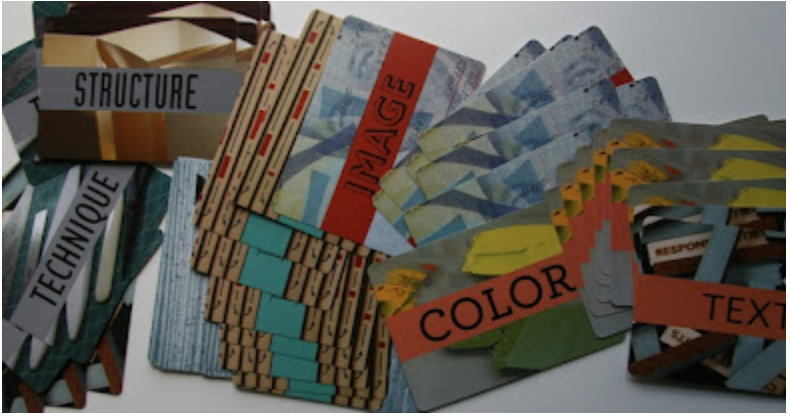
This is a way to jump-start a new project or inform one that is already in progress. It accelerates participation in invention by creating a set of rhetorical and design metrics to attend to. It is an exercise inspired by the invention game Artist's Book Ideation Cards by Barbara Tetenbaum and Julie Chen.
General Instructions:
There are two decks in the set: category cards and adjective cards.
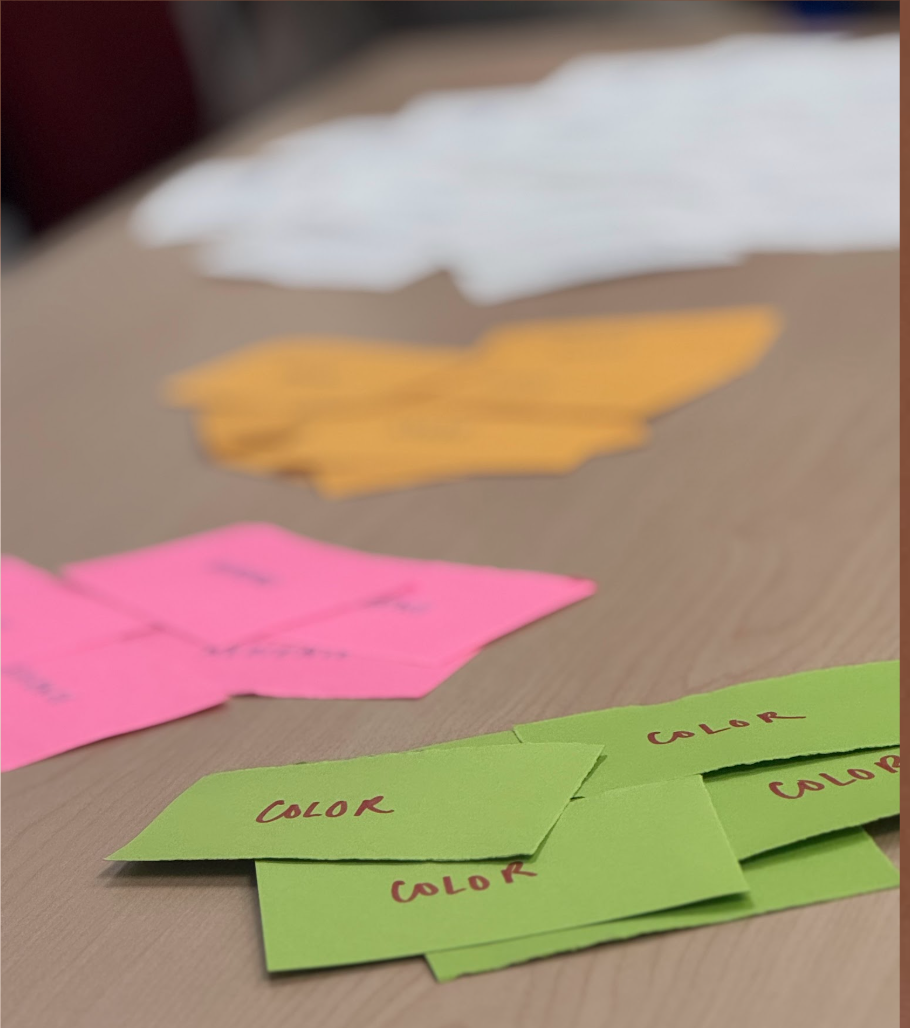
- Start by separating the cards in Deck 1 into four to eight categories. A version we do in our DHSI course with a zine making activity includes the categories: expository strategy [compare/contrast, definition, classification, cause/effect], color, audience, mode.
- Place the cards face down and choose one card at random from each stack. This will give you a basic 'recipe' for your project.
- Then choose five adjective cards at random from Deck 2. These will give you further information to use however you decide. You must use two of the five adjectives.
- If you want, you can exchange one category card and one adjective card before beginning.