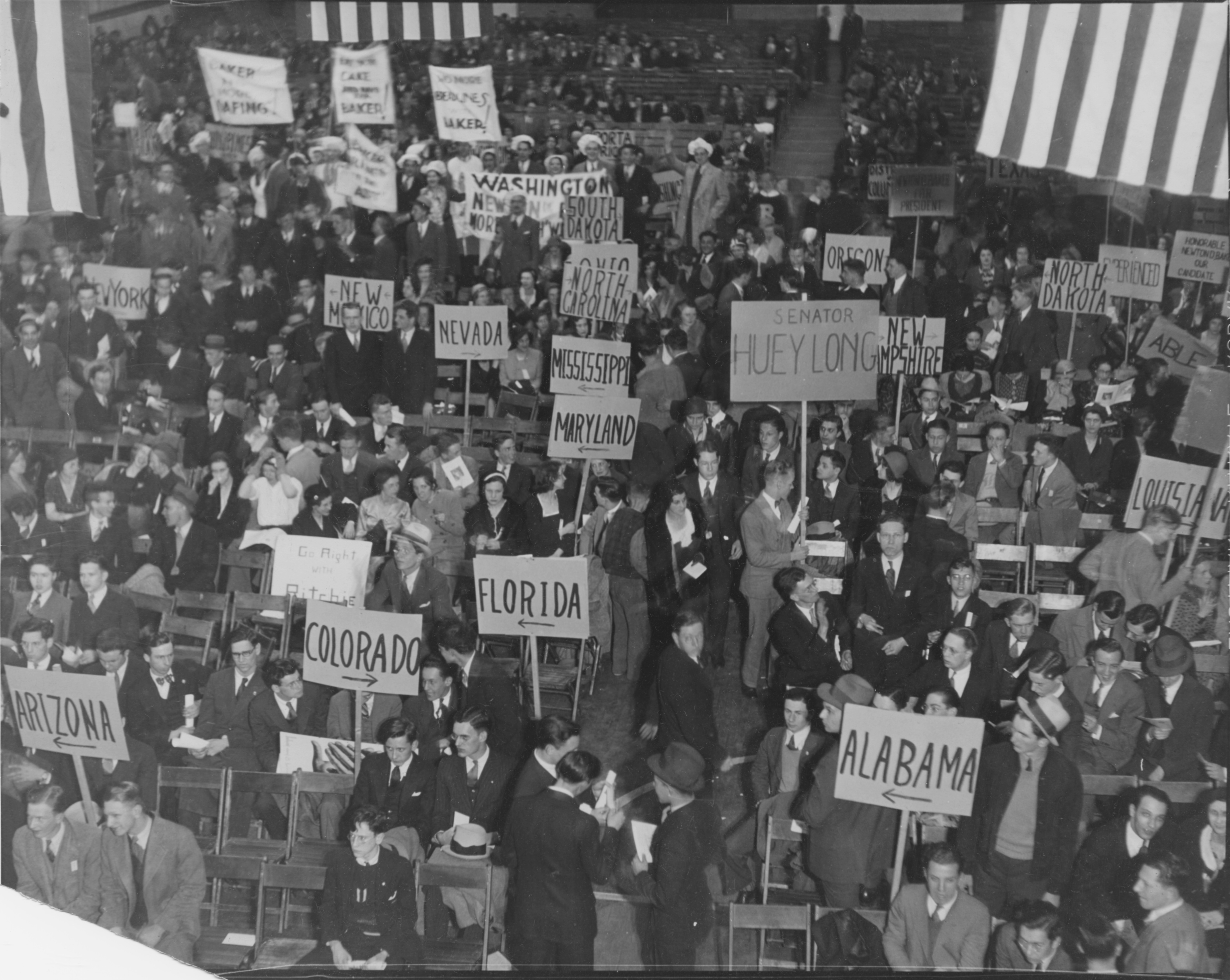
String of Red and White Bunting
1 2026-04-17T17:00:57+00:00 Benjamin Bowers 78b1957d54cda1d2cb3b1a500776f35a405a28f2 9 1 plain 2026-04-17T17:00:57+00:00 Benjamin Bowers 78b1957d54cda1d2cb3b1a500776f35a405a28f2This page is referenced by:
-
1
2026-03-31T14:34:16+00:00
Campaigning at CWRU: Presidential Elections, 1892-2008
44
Campaigning at CWRU: Presidential Elections, 1892-2008
plain
22603
2026-04-23T19:05:00+00:00
We've had mock political conventions - complete with parades and a Mock Political Convention Queen. We've had lecture series on public policy issues. We've had straw votes and our own Gallup poll. We've had faculty roundtables. We've had candidate and celebrity campaign appearances. We've had demonstrations and debates. Case Western Reserve University has a long and rich tradition of involvement in presidential elections.
The staff of the University Archives has produced this exhibit highlighting some of our past campaign activities, using material from the archives. Below is an overview of selected national and campus events. The year is a link to more details and images of campus events that year, as well as the election results – electoral votes and national and Ohio popular votes. The same pages can be accessed in the timeline above.
References to schools use names contemporaneous with events. Clarification may be found at Schools of CWRU.
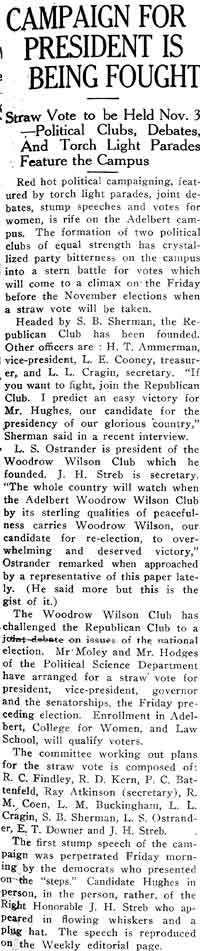
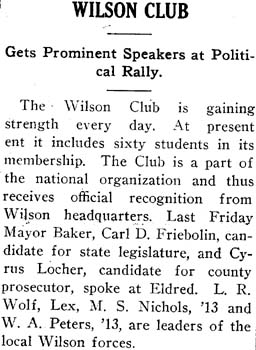
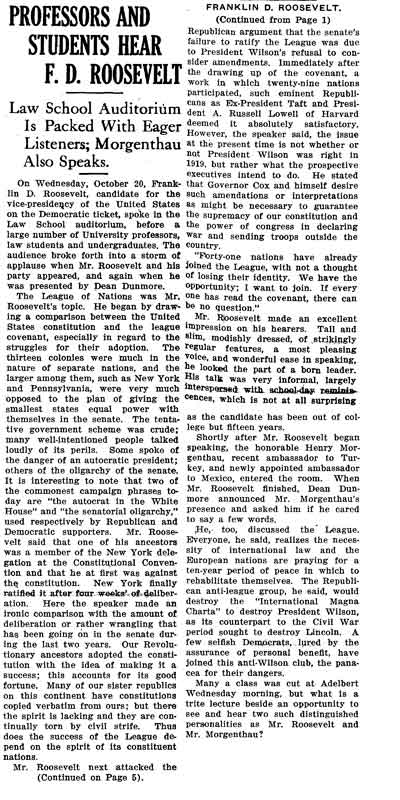
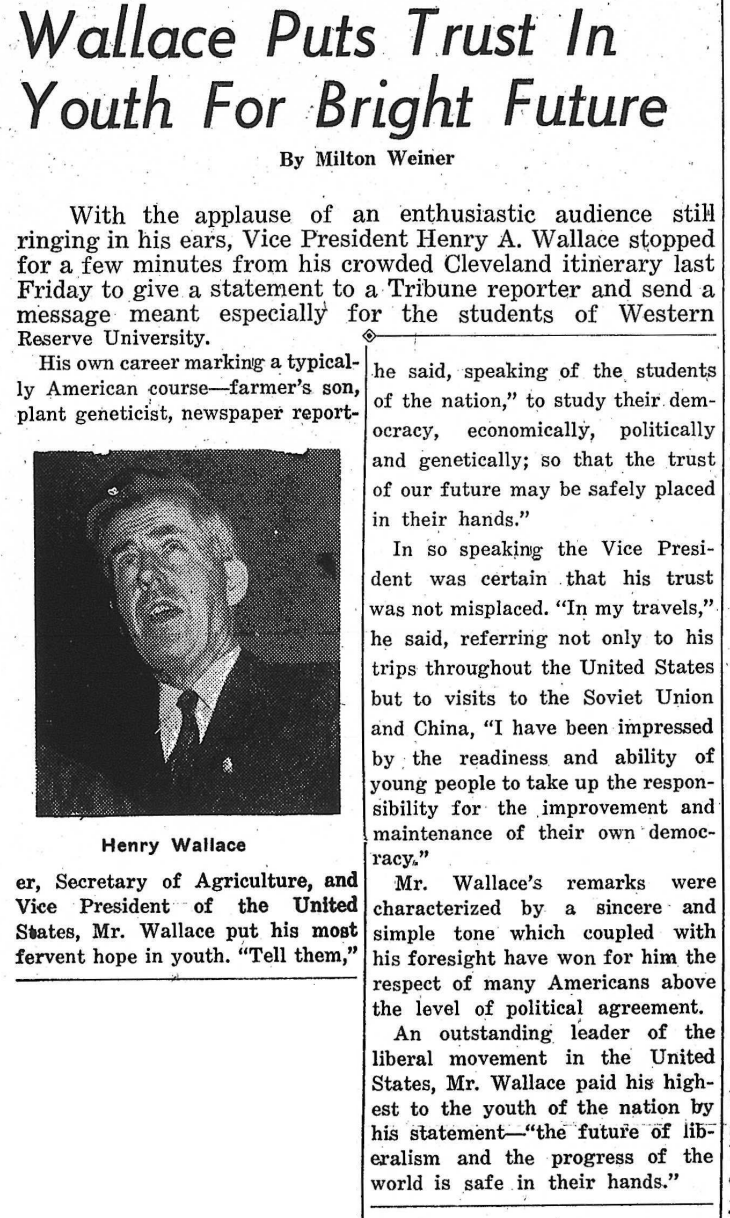
National Events Campus Events Ohio split its electoral votes, 1 for Grover Cleveland and 22 for Benjamin Harrison, for the only time between 1892 and 2000. 1892 Almost 30 years before they won the right to vote in presidental elections in Ohio, students at the College for Women held their own presidential election; "Election day at the college resulted in a sweeping Republican victory..." William Jennings Bryan, at 36, was the youngest presidential nominee ever. 1896 On October 8, 1896, the Adelbert chapter of the McKinley First Voter's Club and the delegation from Case traveled to Canton, Ohio, to hear William McKinley speak. Eugene Debs was nominated for the first of five times by the Socialists, on a platform including female suffrage. 1900 An editorial in the student newspaper affirmed there was a place in college for political clubs, "The college man should be the first citizen of the republic..." Called His Accidency by opponents referring to his succession to the presidency after McKinley's assassination, Roosevelt was the first former vice president elected since 1836. 1904 The Law School Republican Club was the only documented student political activity this year. For the first time, both major party presidential candidates campaigned vigorously and personally. 1908 A mock convention was held at Gray's Armory in downtown Cleveland on May 2, 1908. Preceded by a parade, it was made up of students who formed the delegations from states. After five ballots, Robert LaFollette was chosen as the nominee. Wilson's New Freedom competed with Roosevelt's New Nationalism. 1912 The Wilson Club brought state and local candidates, including Cleveland Mayor Newton D. Baker, to campus to speak to the students. Supreme Court Justice Charles E. Hughes was the Republican nominee for president. 1916 The WRU student newspaper reported that, "The formation of two political clubs of equal strength has crystallized party bitterness on the campus into a stern battle for votes which will come to a climax on Friday before the November elections when a straw vote will be taken." On August 26, 1920, Secretary of State Bainbridge Colby certified ratification of the Nineteenth Amendment to the U.S. Constitution. In 1920, 26 million women voted in the presidential election. 1920 On October 20, 1920, Franklin D. Roosevelt, Democratic vice presidential candidate, spoke at the Law School before a large number of faculty, law students, and undergraduates. The WRU student newspaper described him as, "tall and slim, modishly dressed, of strikingly regular features, a most pleasing voice, and wonderful ease in speaking, he looked the part of a born leader." The Republican convention was held in Cleveland in June, characterized by many as the most boring in party history. In contrast, the Democrats had a nine-day deadlock over the nomination. 1924 In a straw vote of Adelbert College students, LaFollette was picked as president with 196 votes. Coolidge received 129, and John W. Davis received 35. The anti-Catholicism in the campaign waged against Al Smith cast a pall over the presidential aspirations of Catholics until 1960, when Kennedy's election showed a Catholic could be elected. 1928 Voting machines were used on campus for the first time, to ensure an accurate vote-count in the straw vote sponsored by the Reserve Weekly, the WRU student newspaper. Franklin D. Roosevelt was the first major party candidate to deliver his acceptance speech at the party's convention, breaking the tradition that the nominee not appear at the convention, but accept the nomination at a ceremony held weeks later. 1932 The Reserve Politics Club staged a mock Democratic Convention in April 1932. The Flora Stone Mather chapter of the League of Women Voters helped plan the mock convention. Fraternities made up the delegations of states. The Republican Party convention was again held in Cleveland. 1936 WRU was one of six Ohio colleges that took part in a nation-wide collegiate straw vote for president organized by Princeton's Daily Princetonian. Franklin D. Roosevelt was the first and only President elected to a third term. 1940 Mary Gallup, of Mather House, conducted her own Gallup poll of Mather College. Both major party presidential candidates (Franklin D. Roosevelt and Thomas E. Dewey) were from New York. 1944 Vice President Henry Wallace, at a stop in Cleveland on October 13, told a Reserve Tribune reporter to tell students to "study their democracy, economically, politically and genetically; so that the trust of our future may be safely placed in their hands." Television coverage of party conventions began.
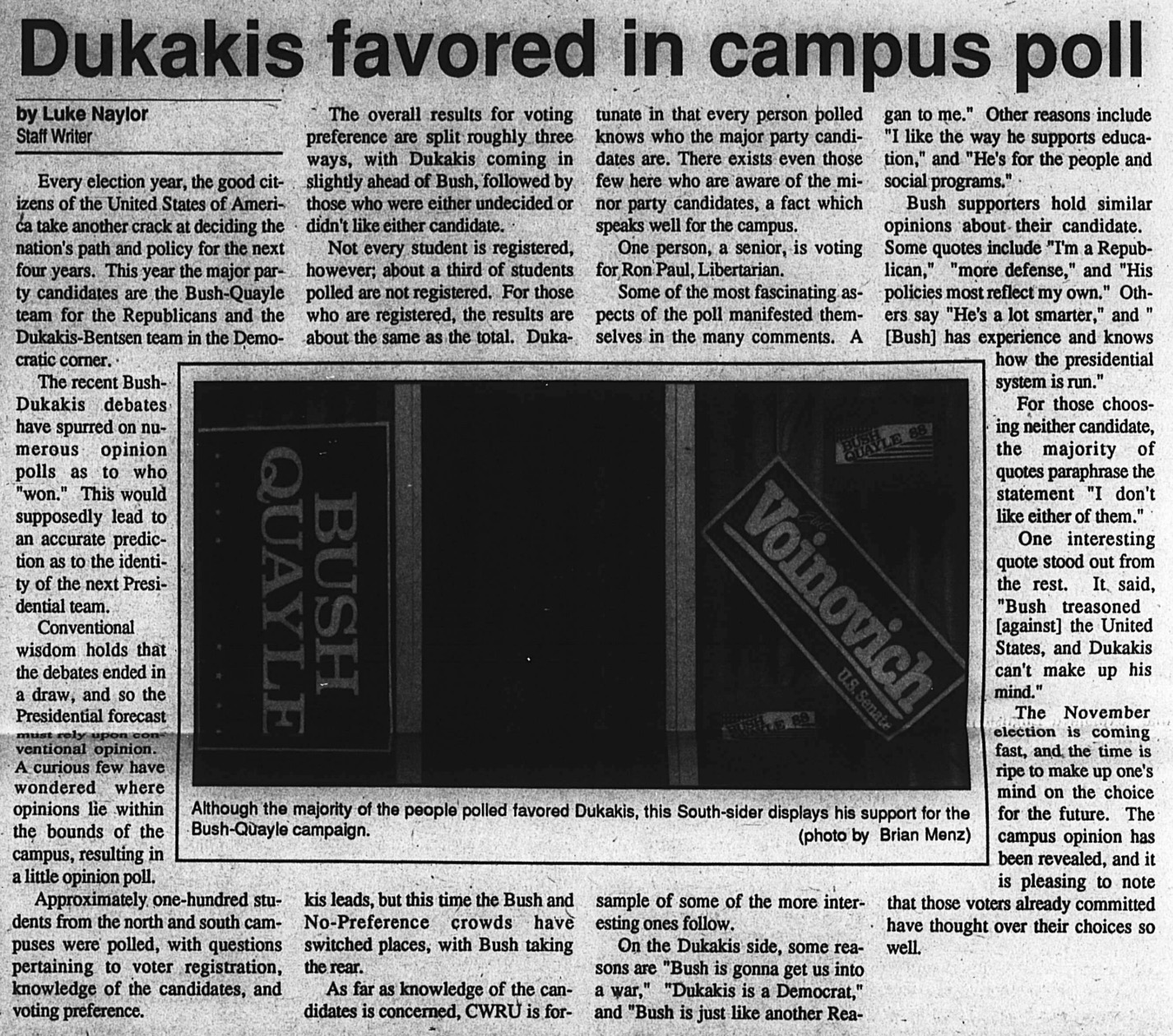
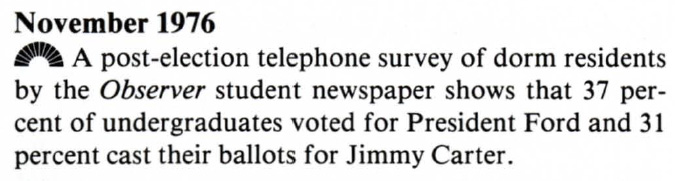
Leading political writers and pollsters predicted a Dewey victory. Post-election analysis concluded that polling was still an infant science and that too little attention had been paid to undecided voters.1948 On May 11, 1948, Case Institute of Technology held its first mock political convention. Classes were dismissed at 10am to permit students to participate. A large tent was set up on Van Horn Field for the event, while the previous evening convention activities started with a parade down Euclid Avenue. When the largest television audience yet assembled heard Vice President Richard M. Nixon's "Checkers Speech," the power of television in politics was confirmed. 1952 In an informal vote conducted by the Reserve Tribune, students picked Adlai Stevenson over Dwight Eisenhower. The only time in the twentieth century that the major parties ran the same candidates twice in a row. 1956 The WRU and Nursing chapters of Volunteers for Stevenson collected $200 on October 16, "D" (Dollars for Democracy) Day. The four general election presidential debates were sponsored by the three television networks, ABC, CBS, and NBC. The first debate was watched by 70 million viewers. 1960 On October 27, 1960, Republican vice presidential candidate Henry Cabot Lodge spoke to students from the steps of Haydn Hall. Lyndon Johnson's popular vote plurality was the largest to that time. 1964 Case’s mock political convention returned to the Republican Party after its single 1960 experiment with the Democrats. Eugene McCarthy's Children's Crusade was dominated by college students who cut their hair and shaved their beards to campaign in New Hampshire's primary with the slogan, Get Clean for Gene. 1968 Fred Halstead, Socialist Workers Party candidate for president, was the keynote speaker at the Ohio Young Socialist Conference, held at Hatch Auditorium. On June 30, 1971, Ohio became the 38th state to ratify the 26th Amendment to the Constitution, reducing the voting age to 18. In 1972, 11 million 18-to-20 year-olds voted for President. 1972 A crowd of 4,000 people, including six busloads from CWRU, heard George McGovern speak on the Cleveland State University campus on October 25. There were no general election presidential debates between 1960 and 1976. The four debates in 1976, three presidential and one vice presidential, were sponsored by the League of Women Voters. 1976 In November 1976, the Observer conducted a post-election telephone survey of dorm residents. 37% of the undergraduates polled voted for Gerald Ford, while 31% cast their ballots for Jimmy Carter. The League of Women Voters again sponsored the two general election presidential debates, one between Reagan and Anderson and one between Reagan and Carter. The Reagan-Carter debate was held in Cleveland. 1980 On October 28, 1980, CWRU students and noted political scientist Garry Wills congregated at Thwing Center to watch the Ronald Reagan - Jimmy Carter debate. Geraldine Ferraro was the first woman on a major party ticket. 1984 At the Election Issues Debate at Thwing Center on the CWRU campus, Cuyahoga County Republican Party leader, Bob Hughes, squared off against Tim Hagan, Democrat, Cuyahoga County Commissioner. In 1968, 15 states held presidential primaries. By 1988, that number grew to 37. 1988 Michael Dukakis finished ahead of George Bush in a student poll taken by The Observer. Though an estimated third of respondents were not registered voters, they all knew who the major party candidates were. For the first time, the general election presidential and vice presidential debates were all three-way debates, including Democratic, Republican, and Independent candidates. 1992 Students with access to Free-Net and the Internet could read the speeches and platforms of the two presidential candidates directly. Free-Net also created a special voters' forum. This bulletin board posted hundreds of opinions concerning the upcoming presidential election. Presidential primaries were held by 42 states.
The Presidential Commission on Debates sponsored two presidential and one vice presidential debates.1996 CWRU College Libertarians hosted party candidate Harry Browne in the spring. After the October 6 presidential debate, the club gathered to watch Browne on CNN analyze the debate. Election results were not decided for more than five weeks after the election, with technology, in the form of punch card ballots, at the heart of the dispute. 2000 Libertarian presidential candidate Art Olivier visited campus. Democrat John Kerry and Republican George W. Bush face each other in three debates. 2004 CWRU hosts the vice presidential debate between Republican Dick Cheney and Democrat John Edwards. Barack Obama is elected the first African-American president of the United States. 2008 Campus primary straw poll correctly predicts the Republican and Democratic nominees for president. -
1
2026-03-31T14:46:59+00:00
1896: Front Porch Campaigning
19
Campaigning at CWRU: Presidential Elections, 1896: Front Porch Campaigning
plain
2026-04-23T12:46:25+00:00
1896
Information was compiled by staff of the Case Western Reserve University Archives, September 2004.
1896
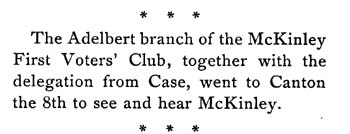
Active campaigning by the candidates did not become accepted practice until the early 1900s. The late nineteenth-century's "front porch" campaigns saw the candidates remaining at home to receive visiting delegations of supporters. One of William McKinley's (R) delegations was composed of the Adelbert College chapter of the McKinley First Voter's Club, joined by a group from Case.
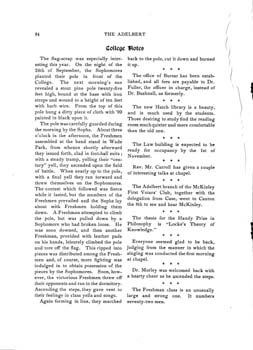
The October 1896 issue of the College's newspaper, The Adelbert (left), carried the modest report (right).
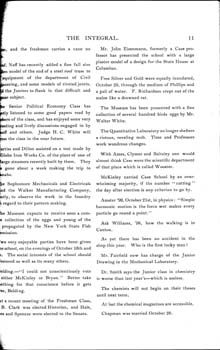
Equally restrained was the announcement (right) in the November 1896 Case School of Applied Science student publication, The Integral (left).Ohio Popular Vote
National Popular Vote
Electoral Vote
William McKinley (R)
525,991 (51.9%)
William J. Bryan (D,
People’s, National Silver)
477,497 (47.1%)
Joshua Levering (Prohibition)
5,068 (0.5%)
Charles Eugene Bentley (National)
2,716 (0.3%)
John M. Palmer (National Democratic)
1,858 (0.2%)
Charles Horatio Matchett (Socialist Labor)
1,165 (0.1%)William McKinley (R)
7,108,480 (51.01%)
William J. Bryan (D,
People’s, National Silver)
6,511,495 (46.73%)
John M. Palmer (National Democrat)
133,435 (0.96%)
Joshua Levering (Prohibition)
125,072 (0.9%)
Charles Horatio Matchett (Socialist Labor)
36,356 (0.26%)
Charles Eugene Bentley (National)
19,363 (0.14%)William McKinley (R)
271
William J. Bryan (D, People’s, National Silver)
176Information was compiled by staff of the Case Western Reserve University Archives, September 2004.
-
1
2026-03-31T14:39:42+00:00
1892: Early Activism
18
Campaigning at CWRU: Presidential Elections, 1892: Early Activism
plain
2026-04-23T12:47:01+00:00
1892
Information was compiled by staff of the Case Western Reserve University Archives, September 2004.
1892
The earliest student presidential campaign activity documented in the archives is 1892’s contest between Grover Cleveland (D) and Benjamin Harrison (R). WRU’s students rallied around the Republicans, while the country went Democratic.
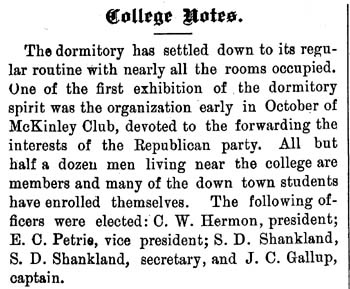
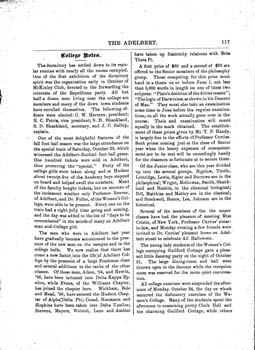
The snippet (right) taken from the Adelbert College student newspaper The Adelbert (left), reveals the sentiments of the majority of the undergraduate men students at WRU. William McKinley was the governor of Ohio at the time.
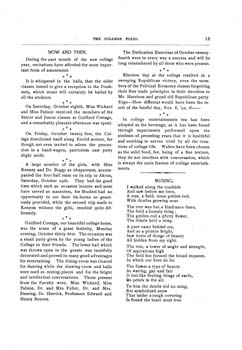
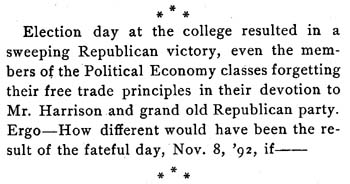
The women undergraduate students at WRU voted for the Republican ticket. This snippet (right) is taken from a page in The College Folio (left), student publication of the College for Women.Ohio Popular Vote
National Popular Vote
Electoral Vote
Benjamin Harrison (R)
405,187 (47.7%)
Grover Cleveland (D)
404,115 (47.5%)
John Bidwell (Prohibition)
26,012 (3.1%)
James B. Weaver (People’s)
14,850 (1.8%)Grover Cleveland (D)
5,551,883 (46.05%)
Benjamin Harrison (R)
5,179,244 (42.96%)
James B. Weaver (People’s)
1,024,280 (8.5%)
John Bidwell (Prohibition)
270,770 (2.25%)Grover Cleveland (D)
277
Benjamin Harrison (R)
145
James B. Weaver (People’s)
22
Information was compiled by staff of the Case Western Reserve University Archives, September 2004.
-
1
2026-03-31T19:12:09+00:00
1948: Upsets
18
Campaigning at CWRU: Presidential Elections, 1948: Upsets
plain
2026-04-23T17:42:13+00:00
1948
Information was compiled by staff of the Case Western Reserve University Archives, September 2004.
1948
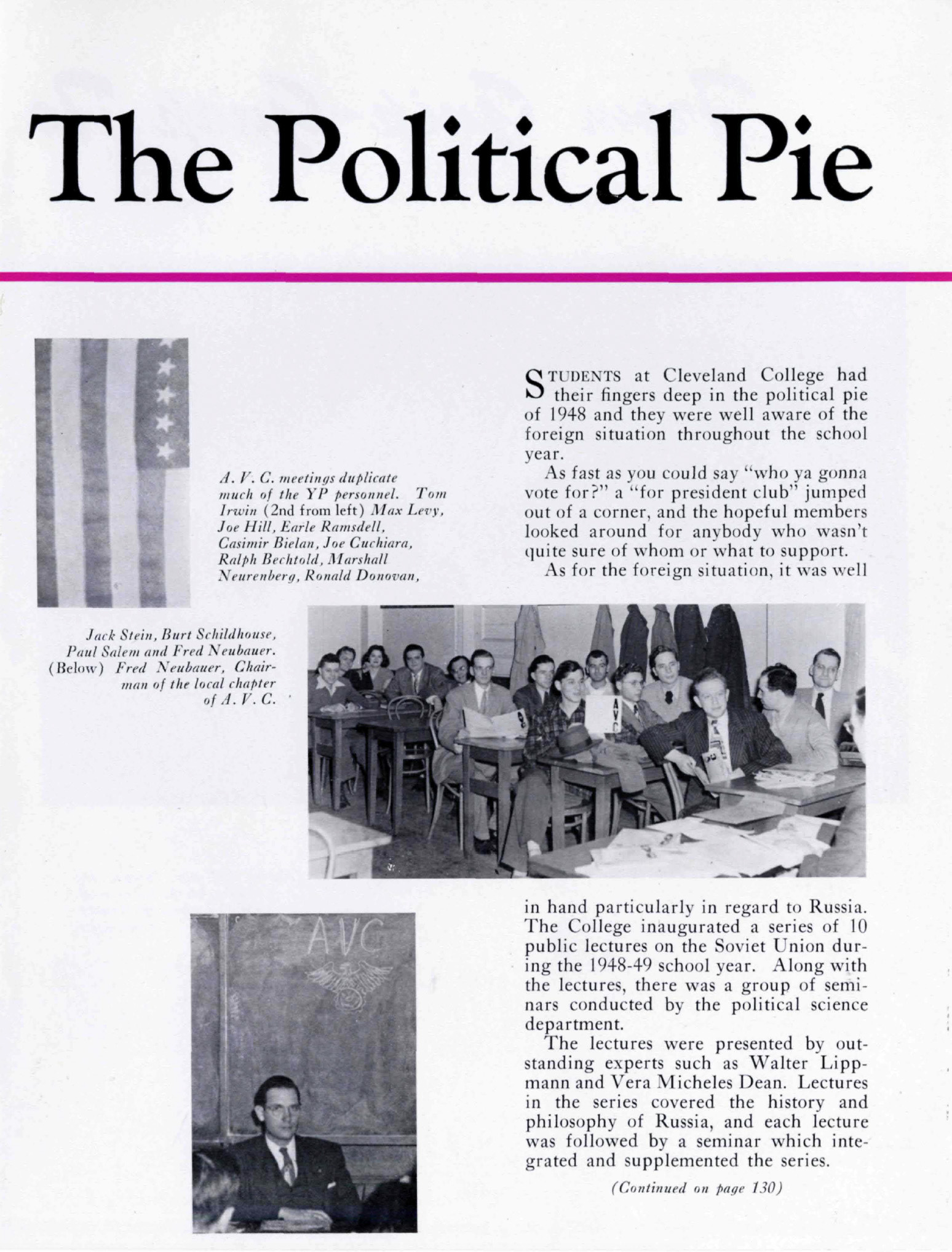
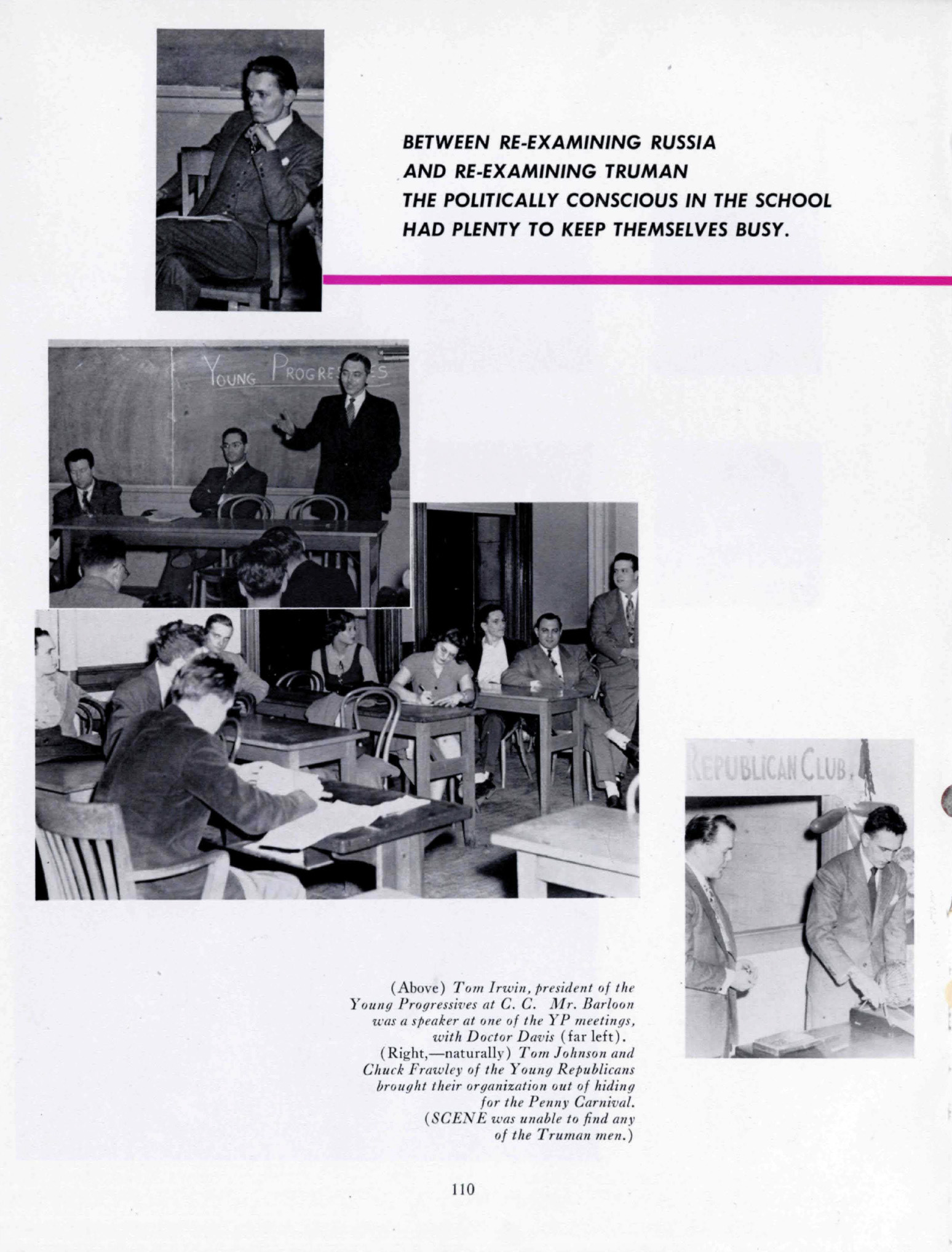
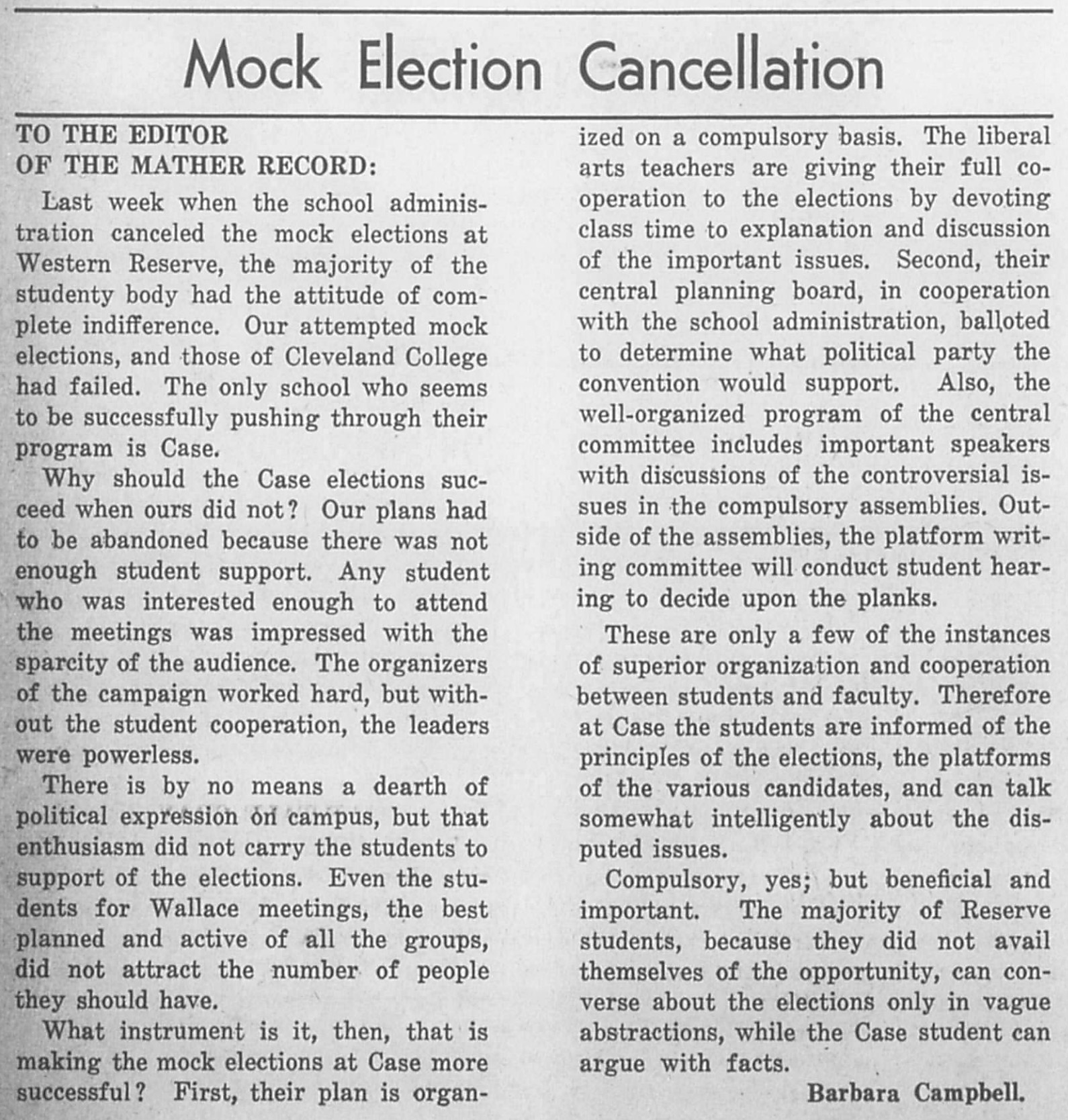
Cleveland College Dewey supporters shared in the general confidence that Republican Thomas E. Dewey would defeat Democrat Harry S Truman. As reported in the student yearbook, “Upon Truman’s nomination, his backers went into obscurity as if they had done something shameful. The College Deweyites relaxed and waited for the inauguration.” Young Republicans shared, also, in surprise at Truman’s victory, “The Young Republicans’ first job as a post-election club was to make a house-to-house canvass of the city to find out what had hit them,” offered the yearbook’s analyst, Gene Hersh. In a local upset, Case students held their first mock political convention, while WRU’s was cancelled for lack of student interest.
Cleveland College of WRU had several active political clubs: Truman-for-President Club, Stassen Club, Taft Club, Dewey Club, Young Progressives of America, the Young Republicans, and the non-partisan American Veterans Committee.
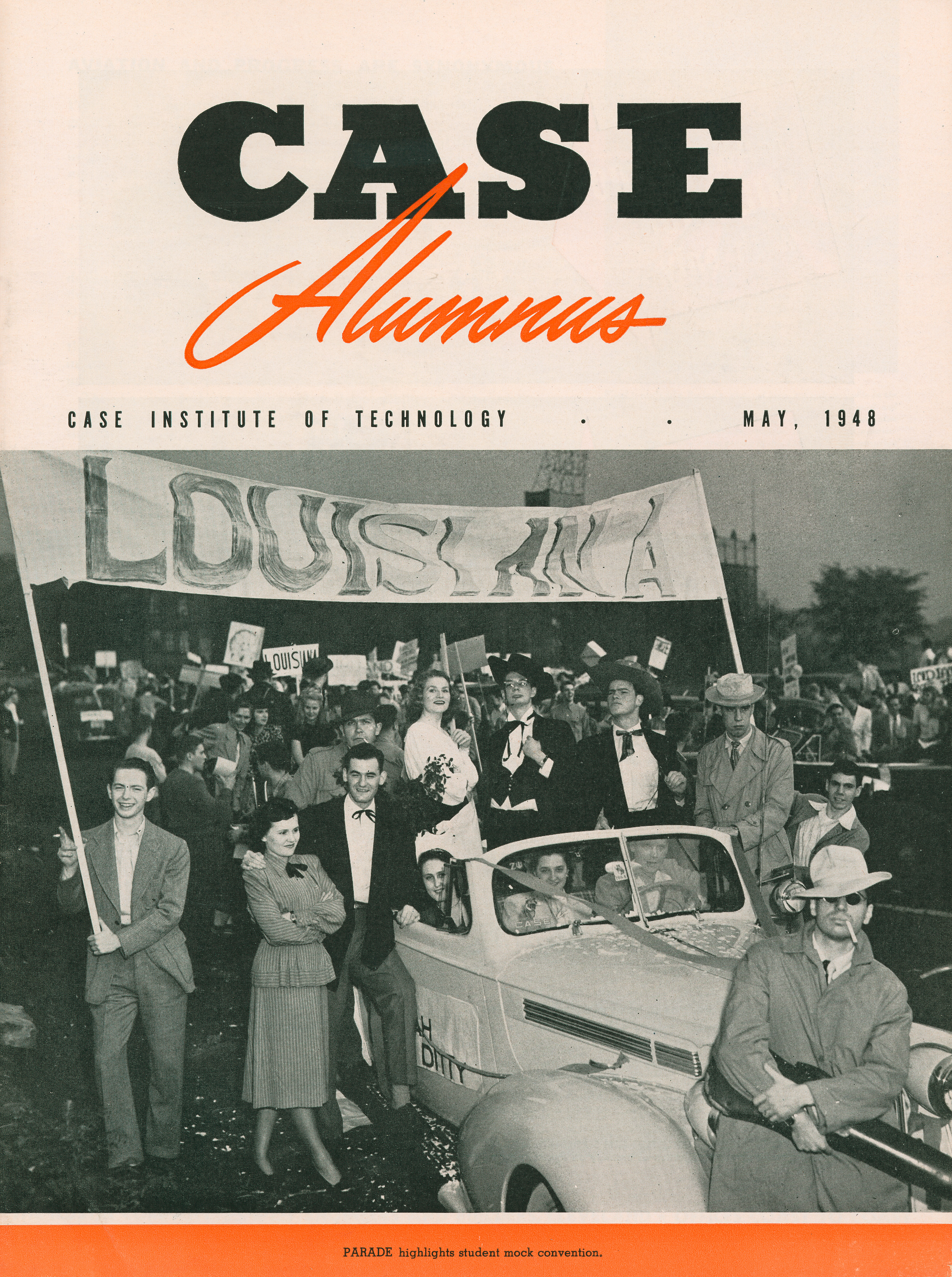
Students at Case held their first mock political convention.
The WRU mock political convention was cancelled.Ohio Popular Vote
National Popular Vote
Electoral Vote
Harry S Truman (D)
1,452,791 (49.5%)
Thomas E. Dewey (R)
1,445,684 (49.2%)
Henry A. Wallace (Progressive)
37,487 (1.3%)Harry S Truman (D)
24,105,587 (49.51%)
Thomas E. Dewey (R)
21,970,017 (45.12%)
J. Strom Thurmond (States’ Rights Democratic)
1,169,134 (2.4%)
Henry A. Wallace (Progressive)
1,157,057 (2.38%)Harry S Truman (D)
303
Thomas E. Dewey (R)
189
J. Strom Thurmond (States’ Rights Democratic)
39Information was compiled by staff of the Case Western Reserve University Archives, September 2004.
-
1
2026-03-31T14:50:20+00:00
1900: First Citizens
14
Campaigning at CWRU: Presidential Elections, 1900: First Citizens
plain
2026-04-23T19:46:48+00:00
1900
Information was compiled by staff of the Case Western Reserve University Archives, September 2004.
1900
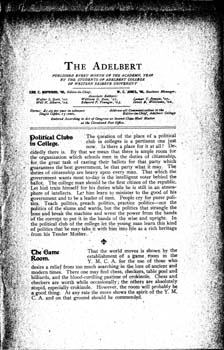
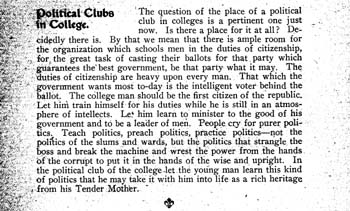
Adelbert College men were urged to political activism by the editors of their newspaper, “The college man should be the first citizen of the republic. Let him train himself for his duties while he is still in an atmosphere of intellects… Teach politics, preach politics, practice politics – not the politics of the slums and wards, but the politics that strangle the boss and break the machine and wrest the power from the hands of the corrupt and put it in the hands of the wise and upright.”
The Republican Club was a recognized student organization on the WRU campus.
This editorial (right) which appeared in the student publication, The Adelbert (left), argued that there was a place for political clubs on campus.Ohio Popular Vote
National Popular Vote
Electoral Vote
William McKinley (R)
543,918 (52.3%)
William J. Bryan (D,
People’s, Silver Republican)
474,882 (45.7%)
John G. Wooley (Prohibition)
10,203 (1%)
Eugene V. Debs (Social-Democratic)
4,847 (0.5%)
Seth Hockett Ellis (Union Reform)
4,284 (0.4%)
Joseph P. Malloney (Socialist Labor)
1,688 (0.2%)
Wharton Barker (People’s)
251William McKinley (R)
7,218,039 (51.67%)
William J. Bryan (D,
People’s, Silver Republican)
6,358,345 (45.51%)
John G. Wooley (Prohibition)
209,004 (1.5%)
Eugene V. Debs (Social-Democratic)
86,935(0.62%)
Wharton Barker (People’s)
50,340 (0.36%)
Joseph P. Malloney (Socialist Labor)
40,900 (0.29%)
Seth Hockett Ellis (Union Reform)
5,693 (0.04%)William McKinley (R)
292
William J. Bryan (D, People’s, Silver Republican)
155Information was compiled by staff of the Case Western Reserve University Archives, September 2004.
-
1
2026-03-31T19:24:33+00:00
1960: Candidates Visit
12
Campaigning at CWRU: Presidential Elections, 1960: Candidates Visit
plain
2026-04-23T18:39:02+00:00
1960
Information was compiled by staff of the Case Western Reserve University Archives, September 2004.
1960
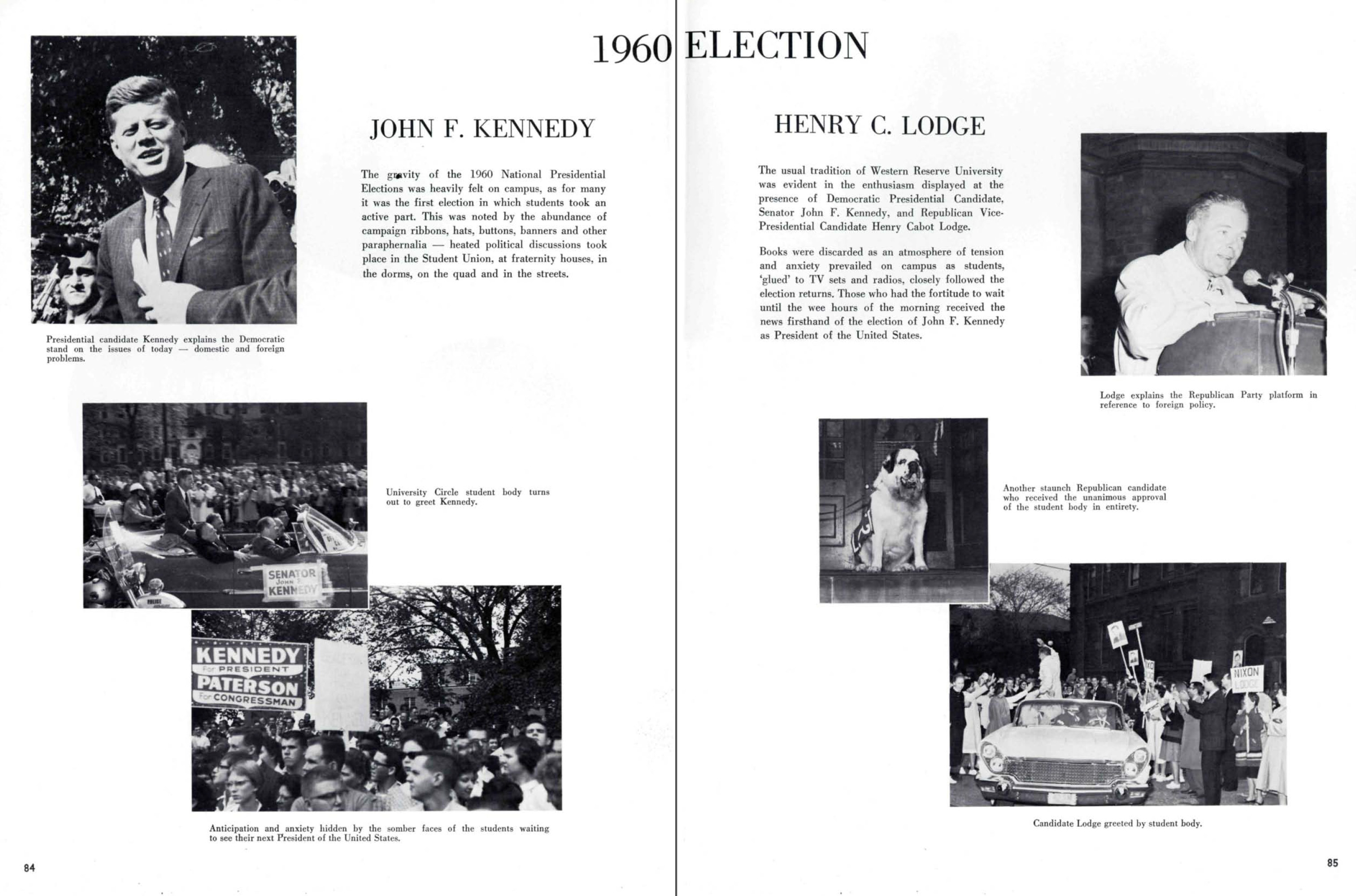
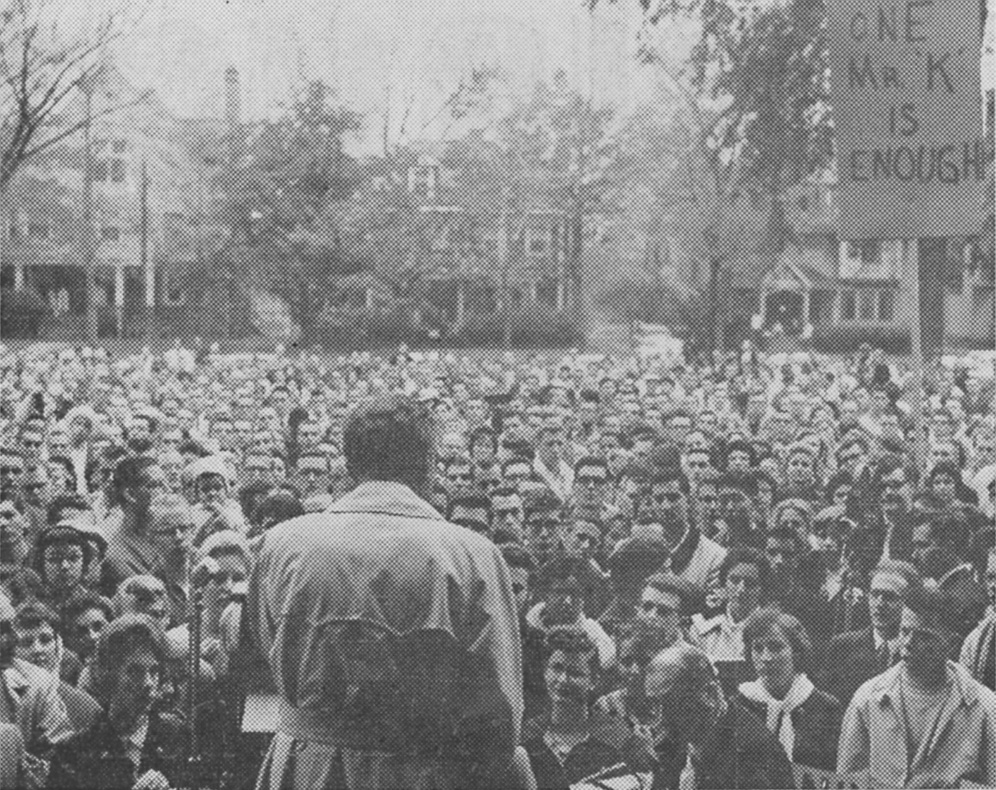
On September 26, students from WRU turned out to Cleveland's Lakefront Airport to greet John F. Kennedy and provided an "Honor Guard" for a rally at Euclid Beach Park. The next day, Kennedy's motorcade proceeded down Euclid Avenue in University Circle to a cheering crowd. One month later, on October 27, Henry Cabot Lodge, Republican vice presidential candidate, visited campus in an event sponsored by both WRU and Case. He spoke to an estimated crowd of 2,500 in front of Haydn Hall. Richard M. Nixon, Republican presidential candidate, spoke at Cleveland's Public Auditorium on October 6, where a contingent of the WRU Youth for Nixon-Lodge group was in attendance.
The WRU yearbook, Lux, covered the visits to Cleveland and the campus by the candidates: John F. Kennedy and Henry Cabot Lodge (below).
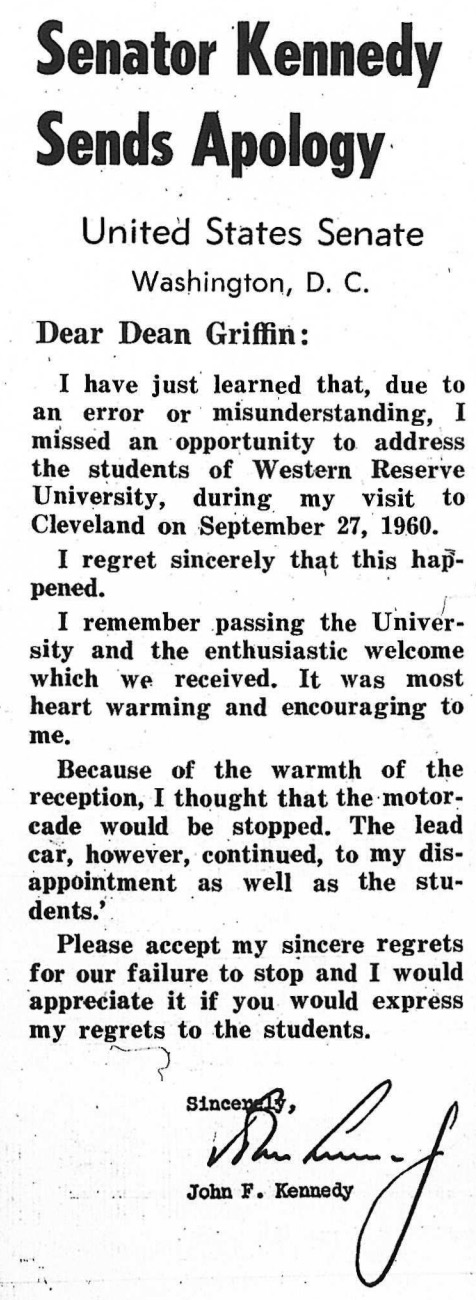
Kennedy's car did not stop on campus as expected. He sent a letter of apology to Dean Russell Griffin for the mistake.
Republican vice presidential candidate Lodge spoke to an estimated crowd of 2,500 on campus.
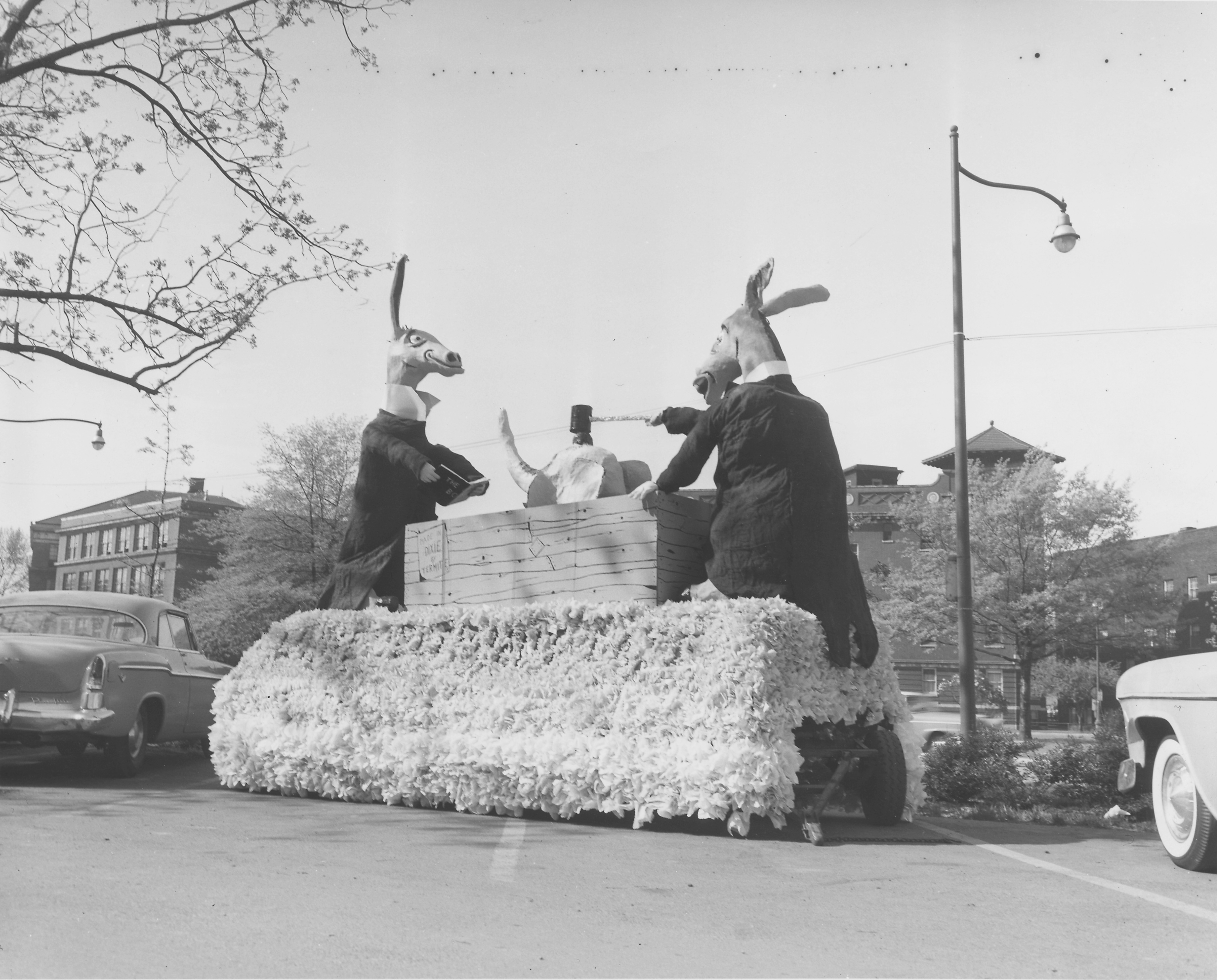
Parade float for the Case Mock Political Convention.
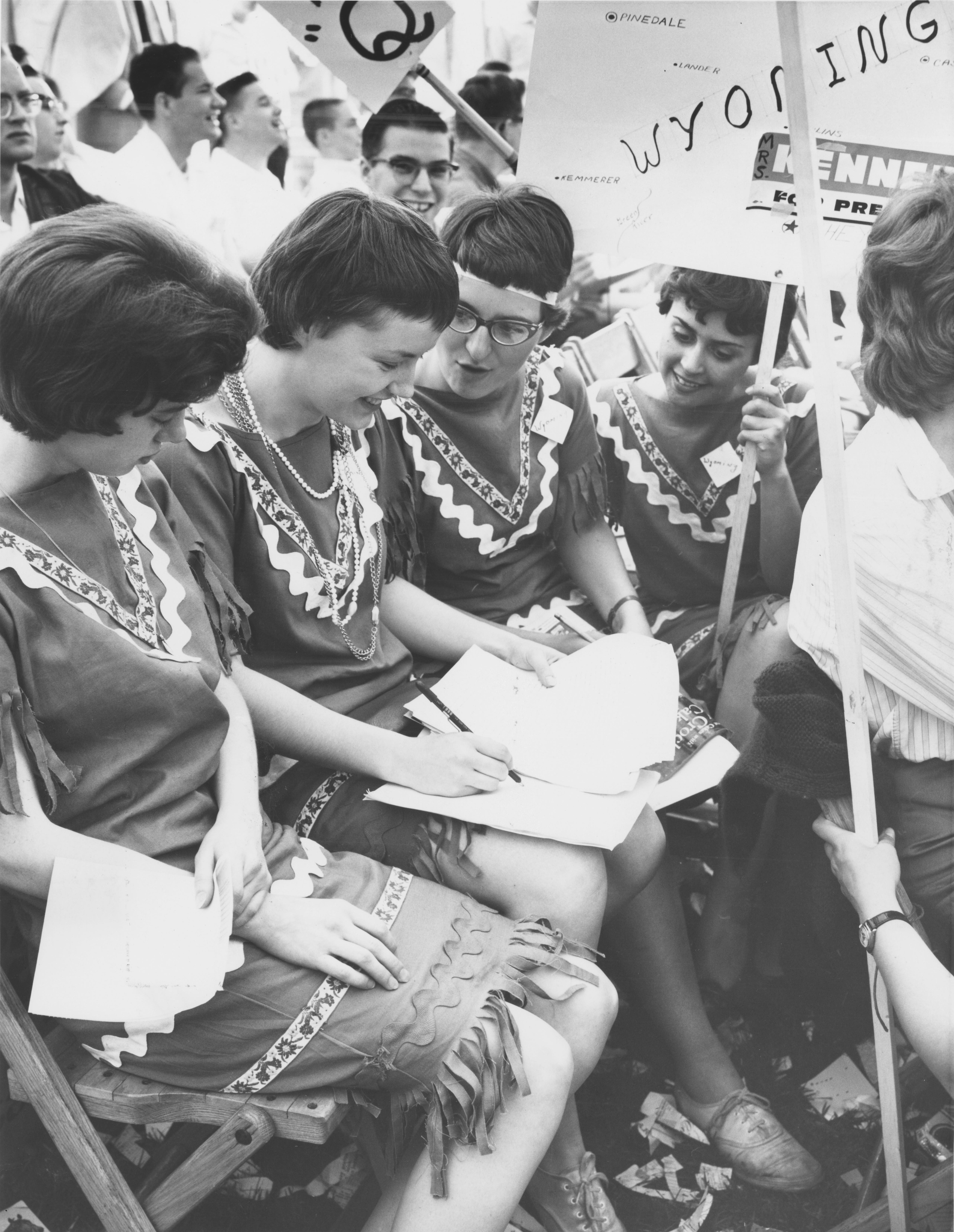
The Wyoming delegation, made up of nurses from St. Luke's Hospital, at the Case Mock Political Convention.
In addition to student-sponsored events, the University also sponsored events surrounding the presidential race.
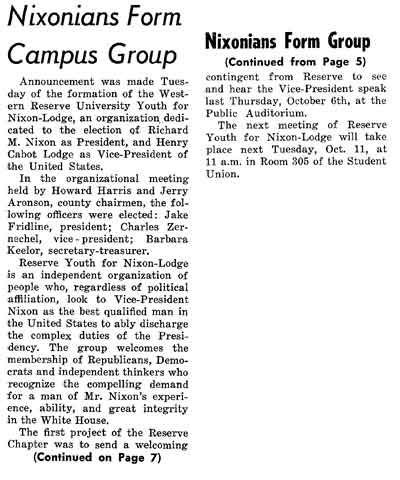
WRU students formed a club in support of Republican candidates Nixon and Lodge.Ohio Popular Vote
National Popular Vote
Electoral Vote
Richard M. Nixon (R)
2,217,611 (53.3%)
John F. Kennedy (D)
1,944,248 (46.7%)John F. Kennedy (D)
34,221,344 (49.72%)
Richard M. Nixon (R)
34,106,671 (49.55%)
Eric Hass (Socialist Labor)
47,522 (0.07%)John F. Kennedy (D)
303
Richard M. Nixon (R)
219
Harry F. Byrd
15Information was compiled by staff of the Case Western Reserve University Archives, September 2004.
-
1
2026-03-31T15:23:15+00:00
1928: Voting Machines
12
Campaigning at CWRU: Presidential Elections, 1928: Voting Machines
plain
2026-04-23T19:55:05+00:00
1928
Information was compiled by staff of the Case Western Reserve University Archives, September 2004.
1928
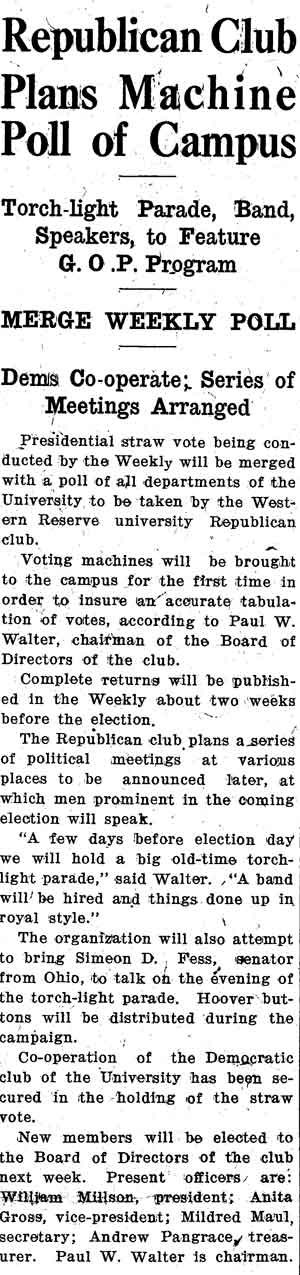
Voting machines were used in WRU’s straw vote for the first time. The campus Republican and Democratic clubs along with the student newspaper, The Reserve Weekly, sponsored the vote. The vote count, disputed or not, was not reported.
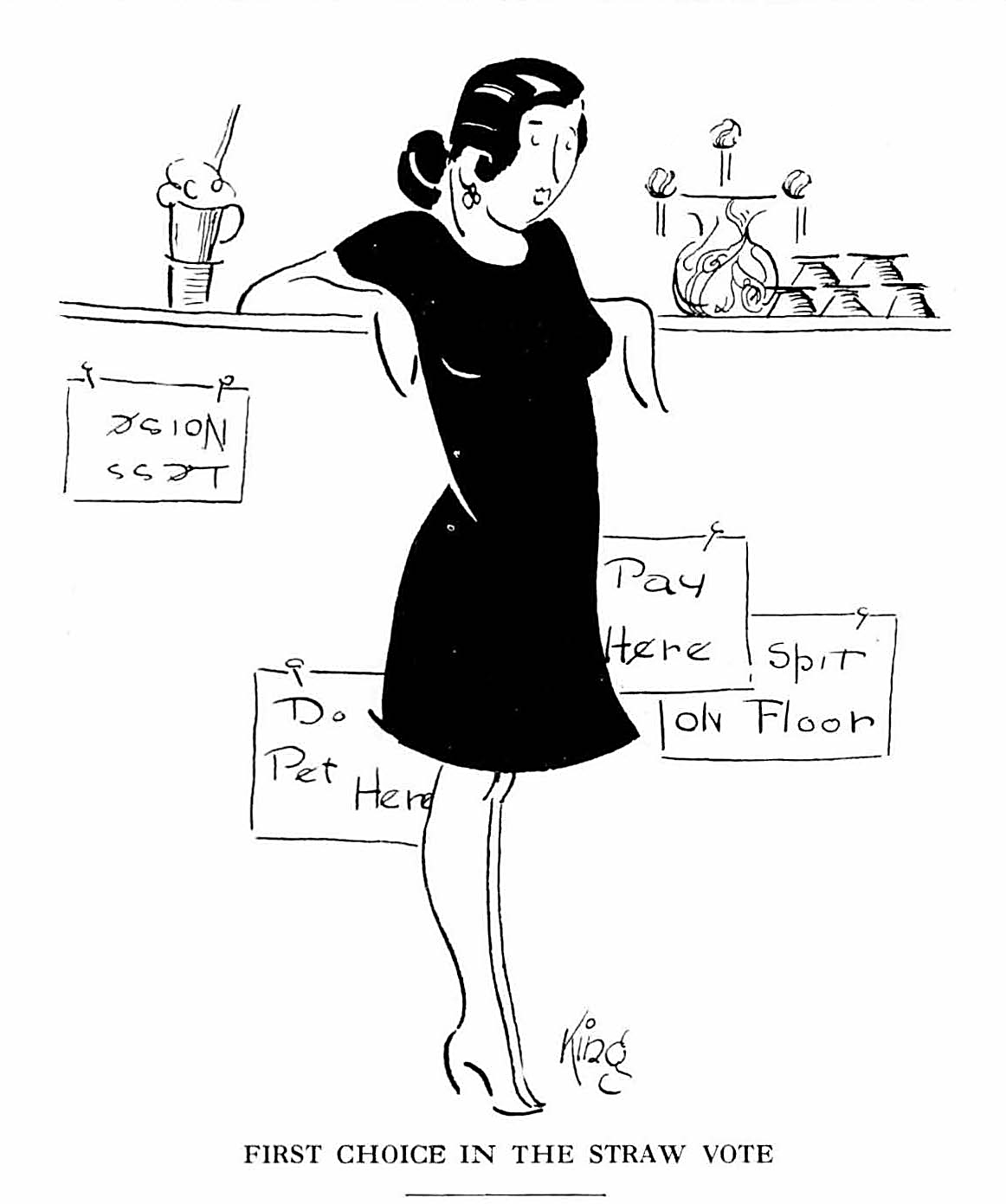
The Red Cat did a spoof of the first choice of the straw vote.
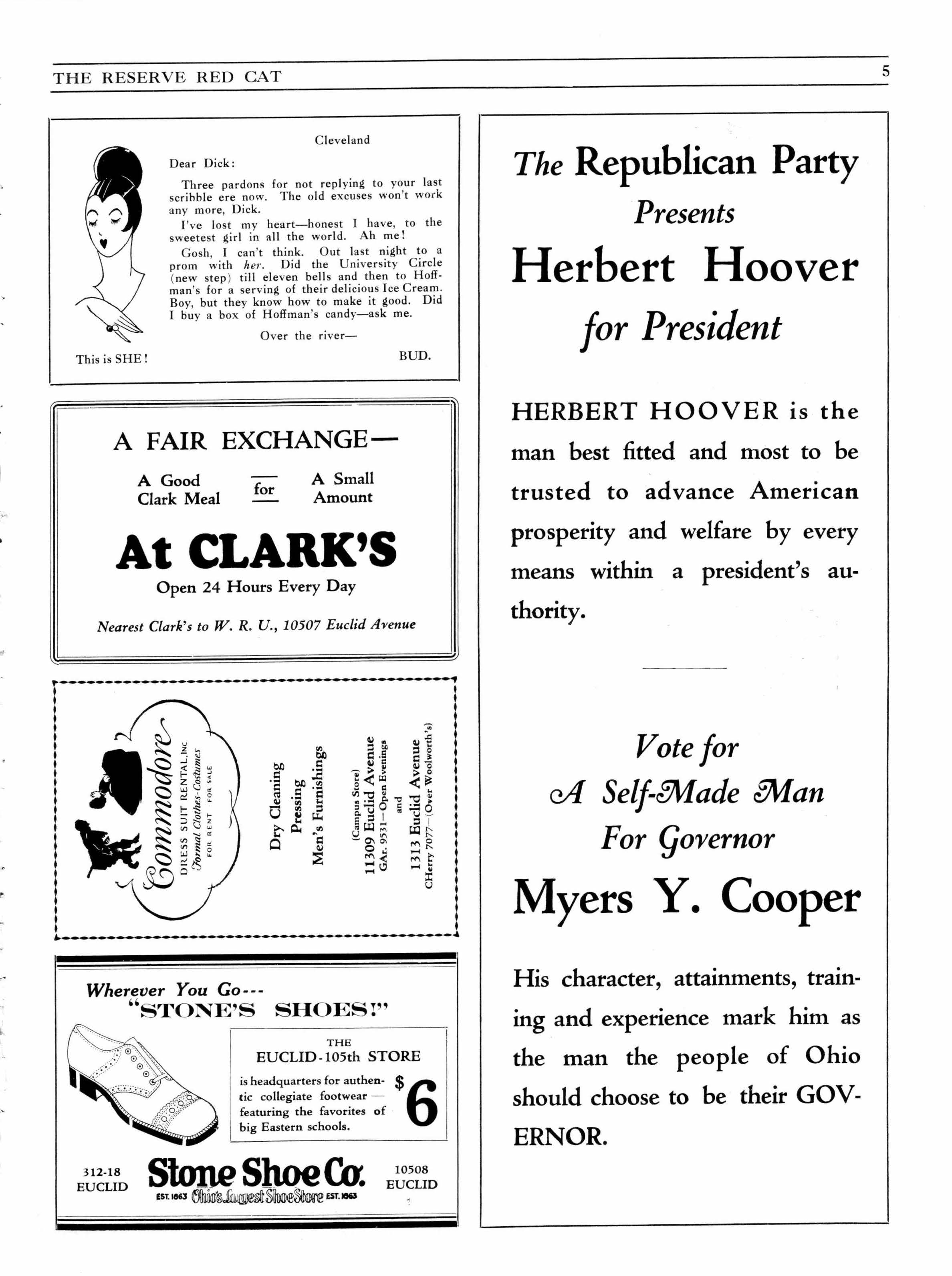
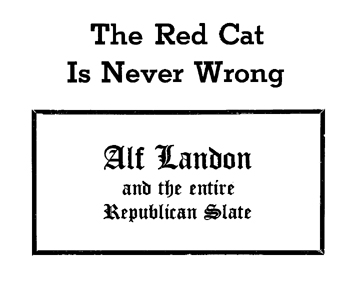
The Republican Party took out an ad for presidential candidate Herbert Hoover in the WRU humor publication, Red Cat.
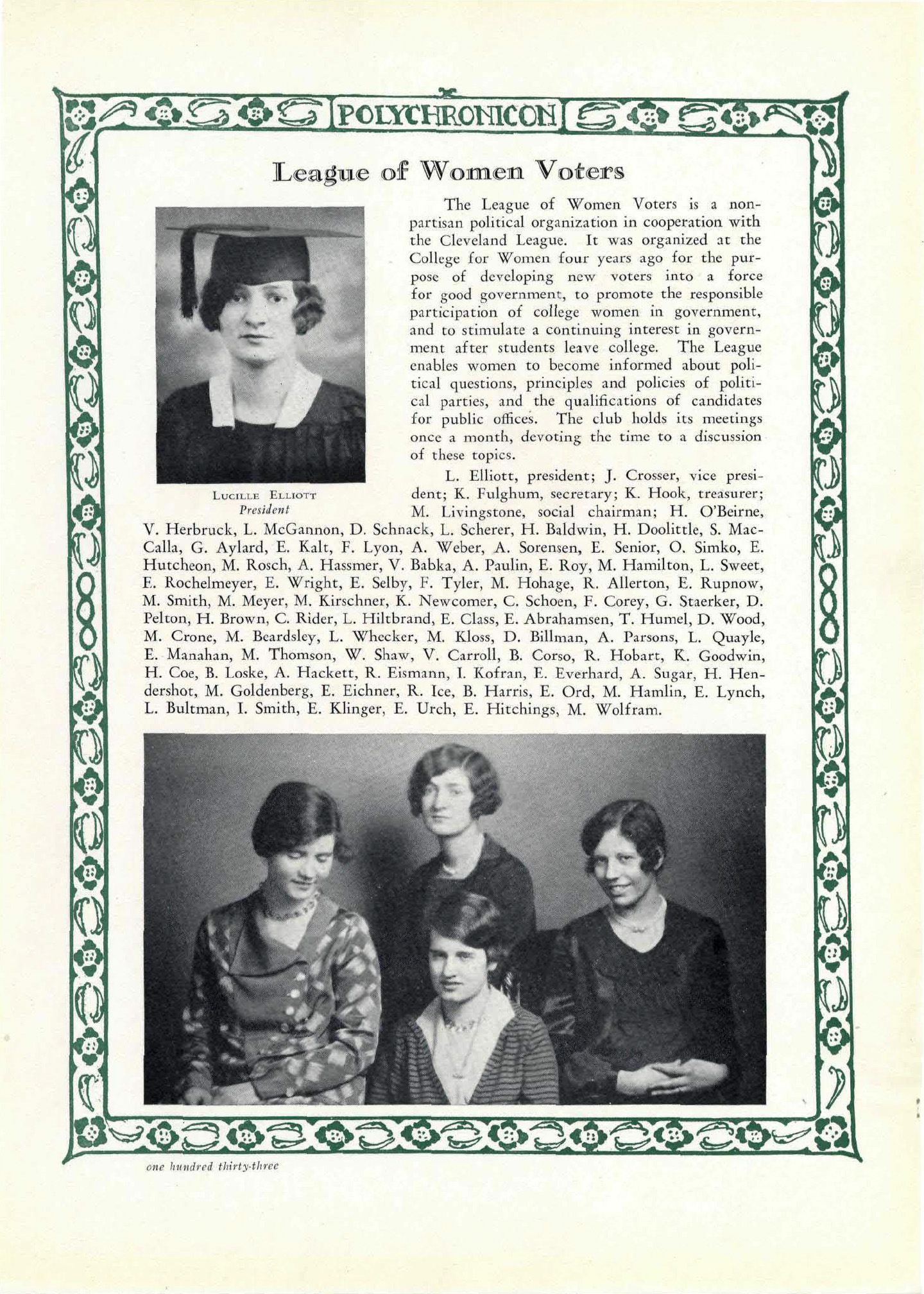
The League of Women Voters enabled women to become informed about political issues, political parties, and candidates for public office.
Voting machines were brought to campus for the first time to ensure an accurate tabulation of votes.Ohio Popular Vote
National Popular Vote
Electoral Vote
Herbert C. Hoover (R)
1,627,546 (64.9%)
Alfred E. Smith (D)
864,210 (34.5%)
Norman M. Thomas (Socialist)
8,683 (0.4%)
William Frederick Varney
(Prohibition)
3,556 (0.1%)
William Z. Foster
(Communist)
2,836 (0.1%)
Verne L. Reynolds
(Socialist Labor)
1,515 (0.1%)Herbert C. Hoover (R)
21,411,991 (58.2%)
Alfred E. Smith (D)
15,000,185 (40.77%)
Norman M. Thomas (Socialist)
266,453 (0.72%)
William Z. Foster
(Communist)
48,170 (0.13%)
William Frederick Varney
(Prohibition)
34,489 (.09%)
Verne L. Reynolds
(Socialist Labor)
21,608 (0.06%)Herbert C. Hoover (R)
442
Alfred E. Smith (D)
87Information was compiled by staff of the Case Western Reserve University Archives, September 2004.
-
1
2026-03-31T20:07:46+00:00
2000: “Hair-Raising Election”
11
Campaigning at CWRU: Presidential Elections, 2000: “Hair-Raising Election”
plain
2026-04-23T19:59:22+00:00
2000
Information was compiled by staff of the Case Western Reserve University Archives, September 2004.
2000
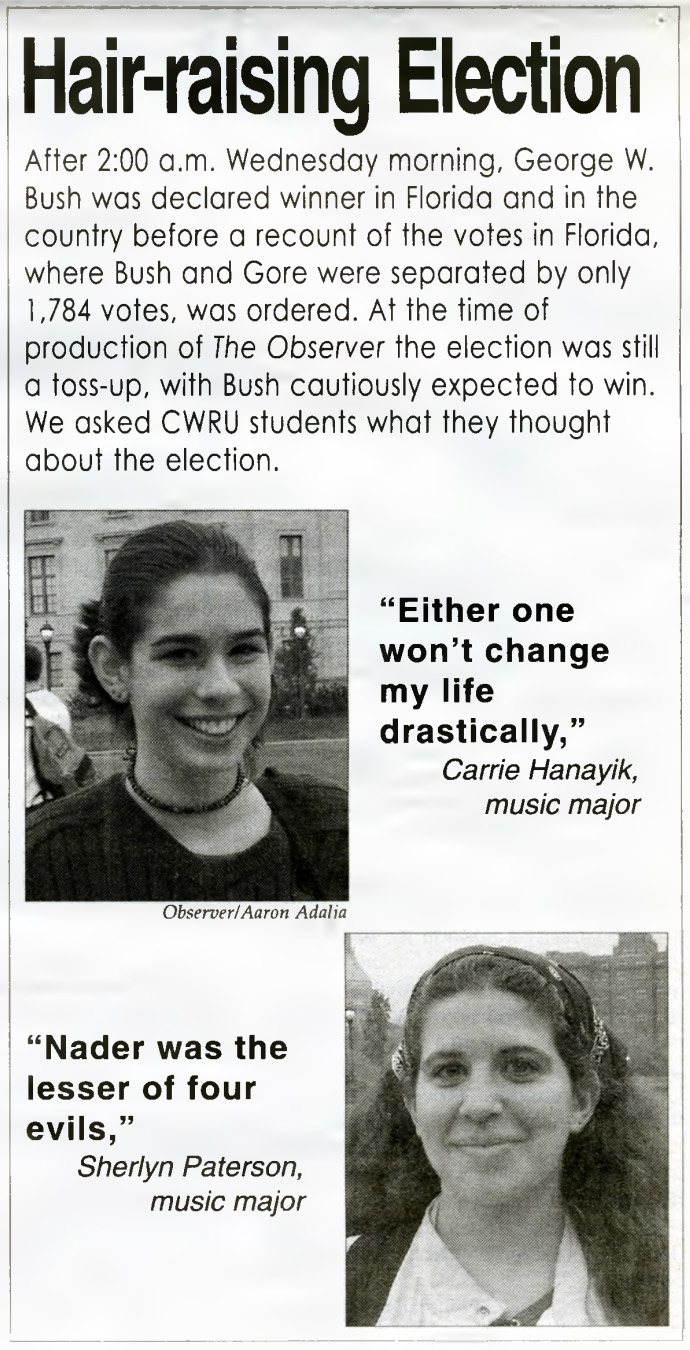
Five weeks of disputed election results eclipsed the campaign itself in the 2000 presidential election. The student newspaper, The Observer, asked students for their reactions. Opined Carrie Hanayik, “Either one won’t change my life drastically.”
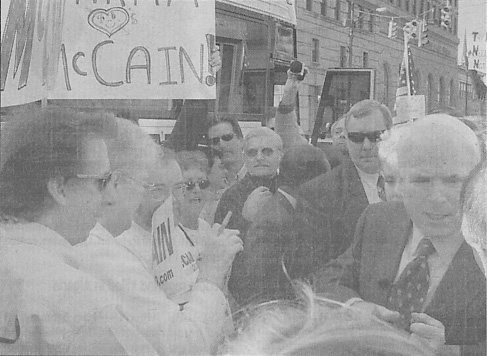
Republican hopeful John McCain visited Cleveland's West Side Market in February.
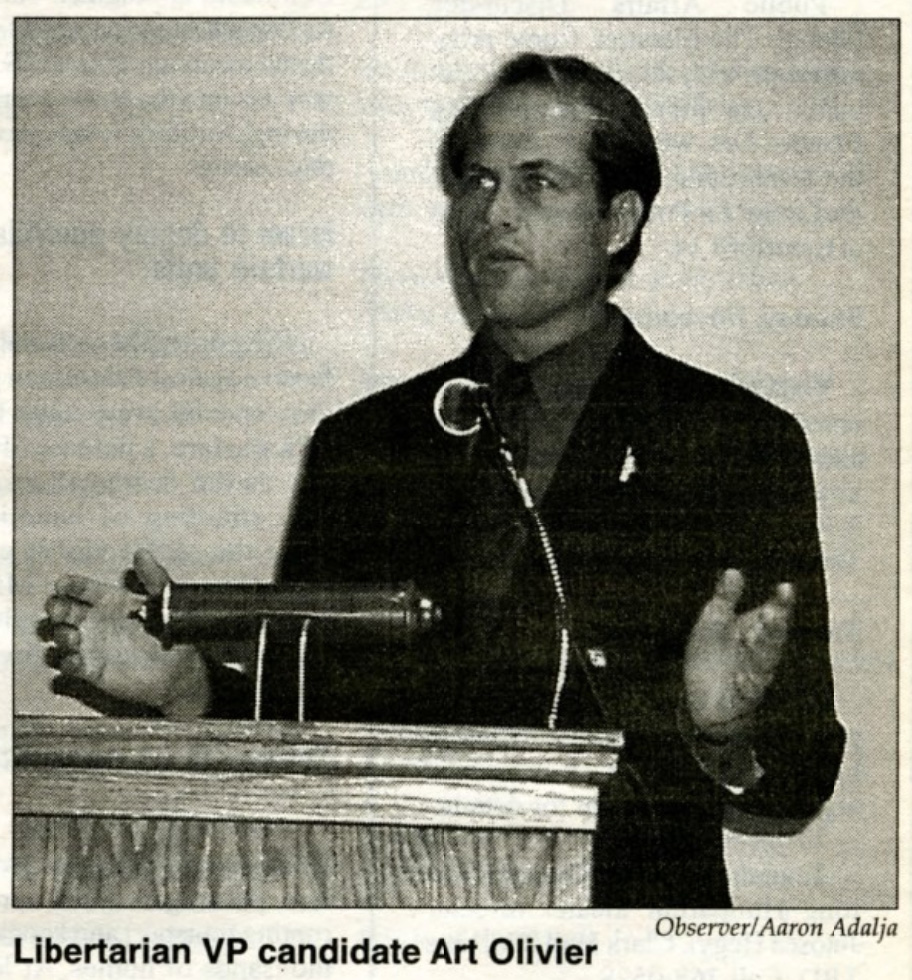
Libertarian vice presidential candidate Art Olivier visited campus in late October.
Student reactions to the contested presidential election.Ohio Popular Vote
National Popular Vote
Electoral Vote
George W. Bush (R)
2,351,209 (50%)
Albert Gore, Jr. (D)
2,186,190 (46.5%)
Ralph Nader (Green)
117,857 (2.5%)
Pat Buchanan (Reform)
26,724 (0.6%)
Harry Browne (Libertarian) 13,475 (0.3%)
John Hagelin (Natural Law) 6,169 (0.1%)
Howard Phillips
(U.S. Taxpayers)
3,823Albert Gore, Jr. (D)
50,996,582 (48.4%)
George W. Bush (R)
50,456,062 (47.9%)
Ralph Nader (Green)
2,882,955 (2.7%)
Pat Buchanan (Reform)
448,895 (0.4%)
Harry Browne (Libertarian) 384,431 (.36%)
Howard Phillips (U.S. Taxpayers) 98,020 (0.09%)
John Hagelin (Natural Law) 83,714 (0.08%)George W. Bush (R)
271
Albert Gore, Jr. (D)
266Information was compiled by staff of the Case Western Reserve University Archives, September 2004.
-
1
2026-03-31T15:27:58+00:00
1932: The New Deal
11
Campaigning at CWRU: Presidential Elections, 1932: The New Deal
plain
2026-04-23T19:05:53+00:00
1932
1932
Information was compiled by staff of the Case Western Reserve University Archives, September 2004.
Campus politicking started in the spring, with WRU's Mock Political Convention nominating Newton D. Baker, former mayor of Cleveland and Secretary of War and WRU Trustee. Both Case and WRU students held straw votes in October 1932. Case went for Herbert Hoover (R), with 263 votes to Franklin D. Roosevelt's (D) 105, Norman M. Thomas' (Socialist) 82, and William Z. Foster's (Communist) 13. WRU students also picked Hoover, with 1,119 votes to Roosevelt's 632, Upshaw's 8, and Reynolds' 1.
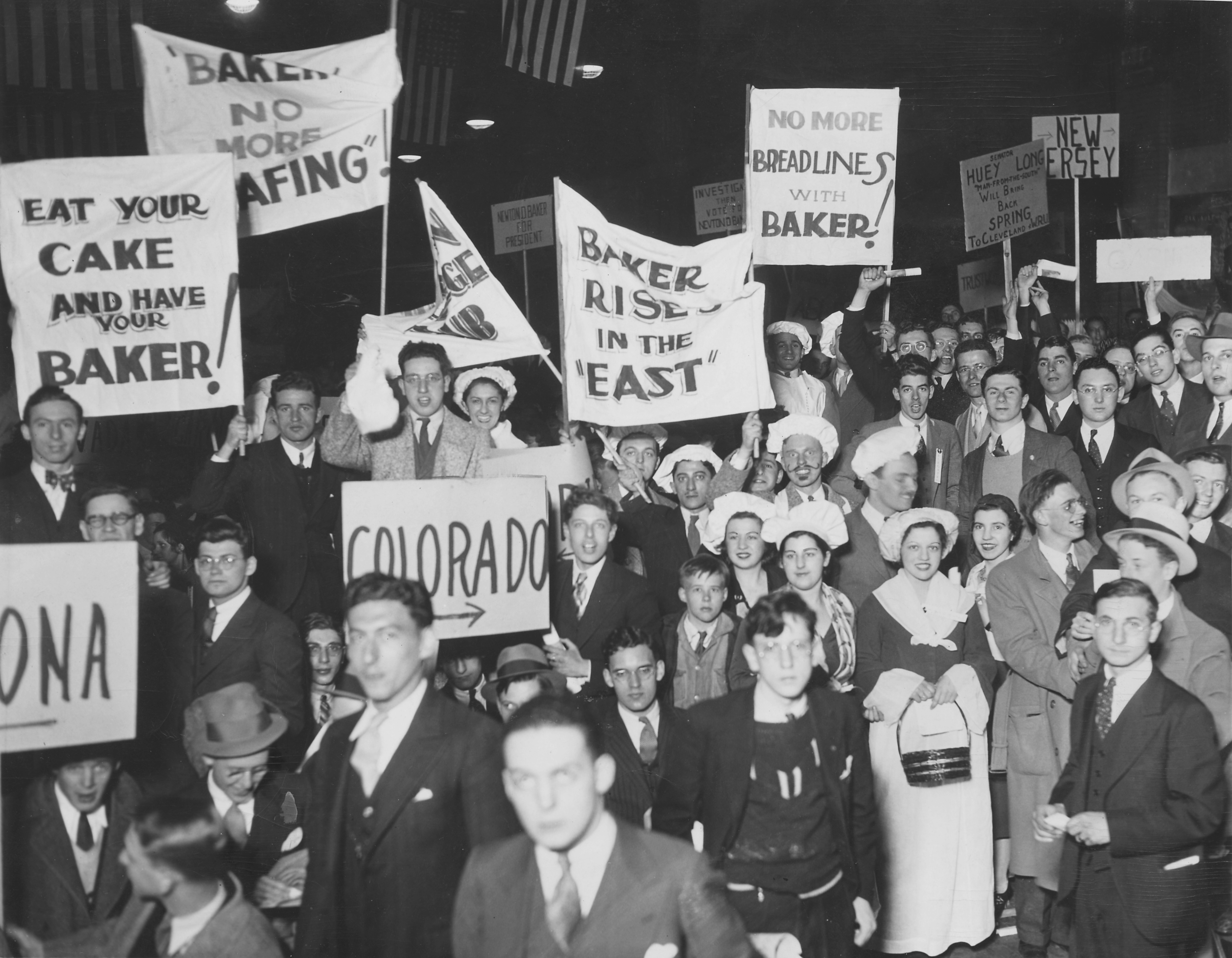
The floor of the WRU Mock Democratic Convention was a sea of signs; many of them for Newton D. Baker.
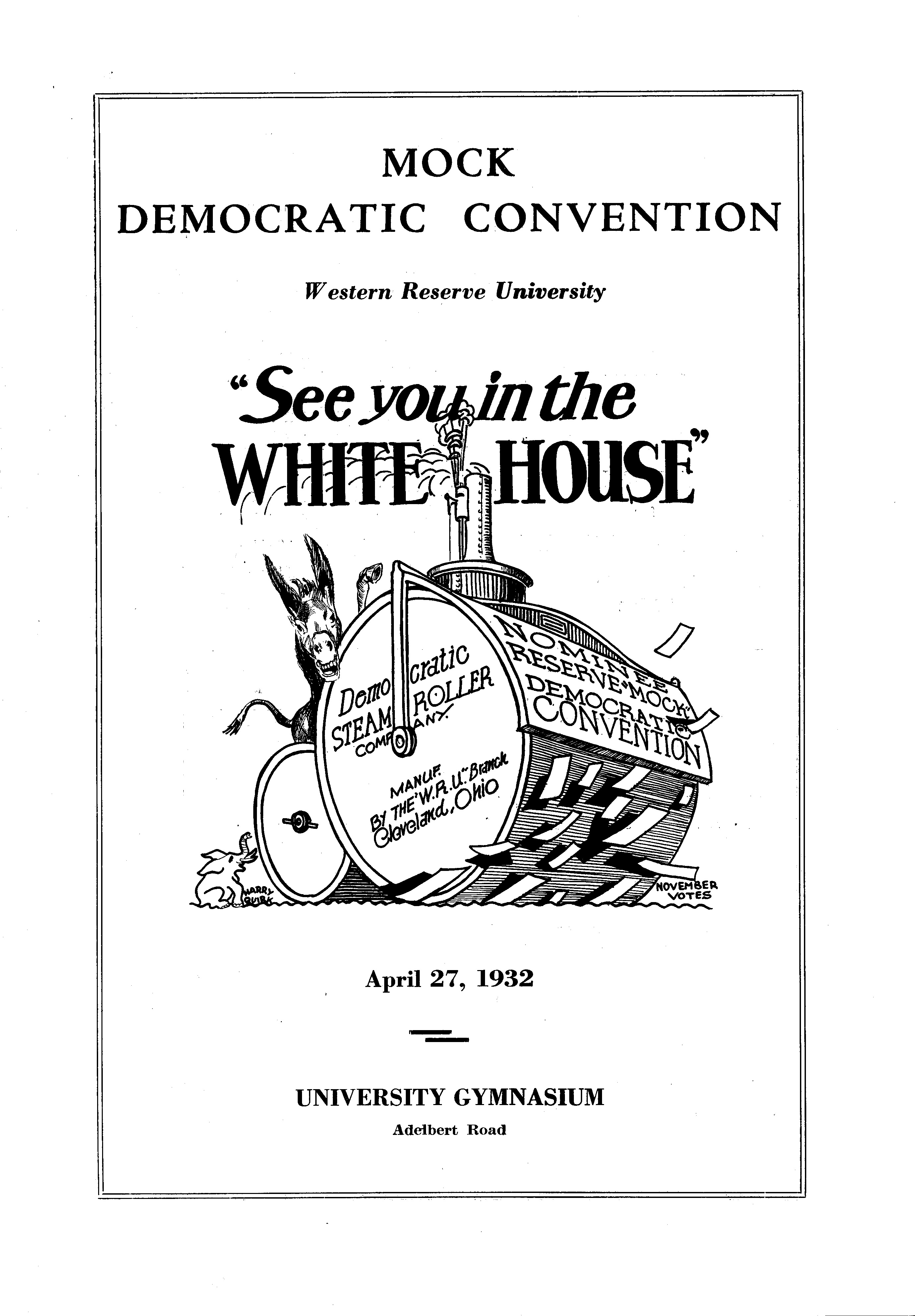
The cover of the program for the WRU Mock Democratic Convention featured the Democratic nominee steamrolling to the White House.
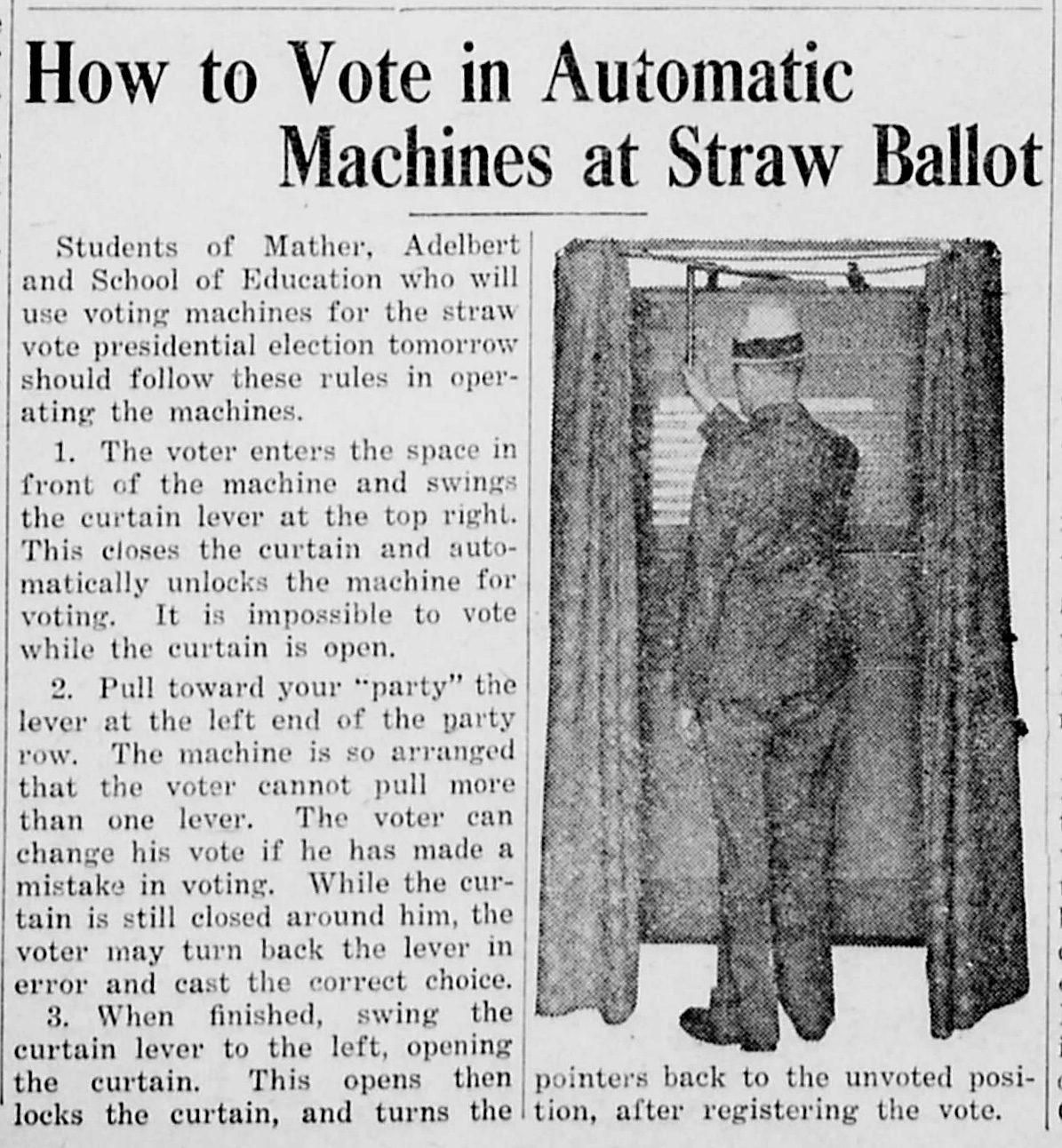
The article below explained how to use the automatic voting machines for the straw ballot at WRU.
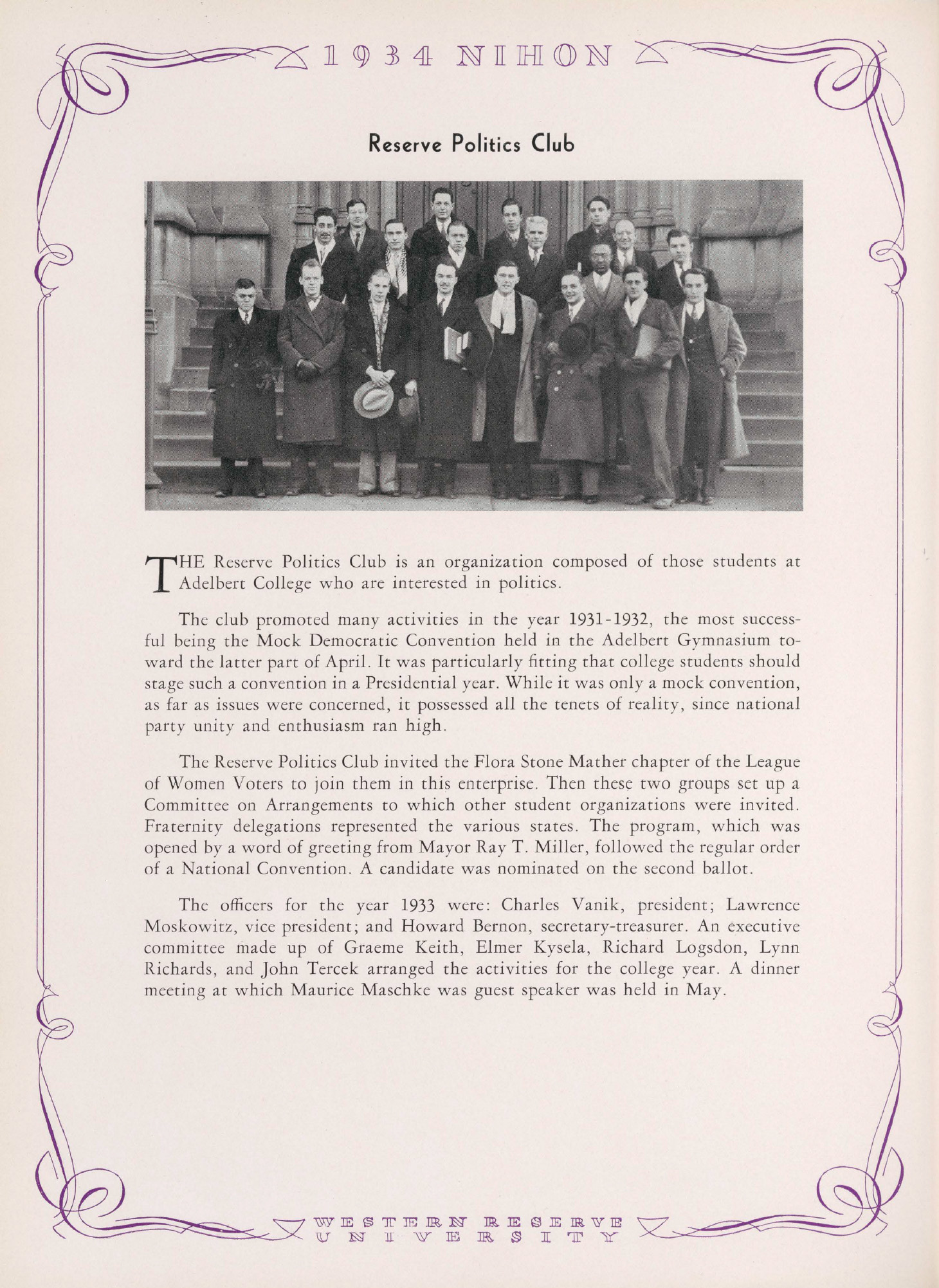
The Reserve Politics Club, with future Congressman Charles Vanik as president, co-sponsored the Mock Democratic Convention.
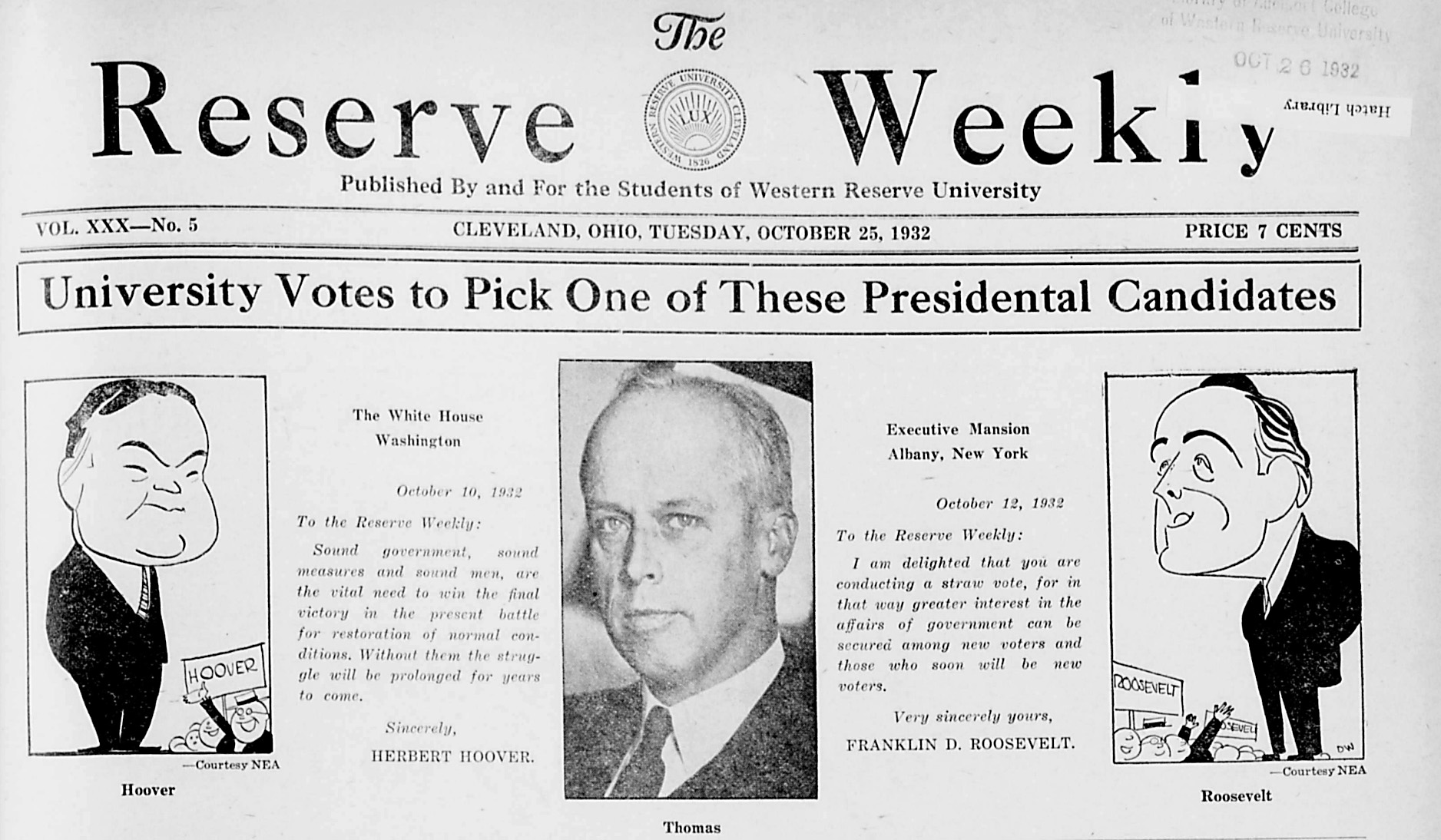
The issue of the Reserve Weekly below featured letters from Hoover and Roosevelt and images of Hoover, Roosevelt and Socialist Party candidate, Norman Thomas, before the straw vote.Ohio Popular Vote
National Popular Vote
Electoral Vote
Franklin D. Roosevelt (D)
1,301,695 (49.9%)
Herbert C. Hoover (R)
1,227,310 (47%)
Norman M. Thomas (Socialist)
64,094 (2.5%)
William David Upshaw (Prohibition)
7,421 (0.3%)
William Z. Foster (Communist)
7,231 (0.3%)
Verne L. Reynolds (Socialist Labor)
1,968 (0.1%)Franklin D. Roosevelt (D)
22,825,016 (57.42%)
Herbert C. Hoover (R)
15,758,397 (39.64%)
Norman M. Thomas (Socialist)
883,990 (2.22%)
William Z. Foster (Communist)
102,221 (0.26%)
William David Upshaw (Prohibition)
81,916 (0.21%)
Verne L. Reynolds (Socialist Labor)
34,028 (0.09%)Franklin D. Roosevelt (D)
472
Herbert C. Hoover (R)
59Information was compiled by staff of the Case Western Reserve University Archives, September 2004.
-
1
2026-03-31T15:13:02+00:00
1916: Straw Votes
11
Campaigning at CWRU: Presidential Elections, 1916: Straw Votes
plain
2026-04-23T13:12:35+00:00
1916
Information was compiled by staff of the Case Western Reserve University Archives, September 2004.
1916
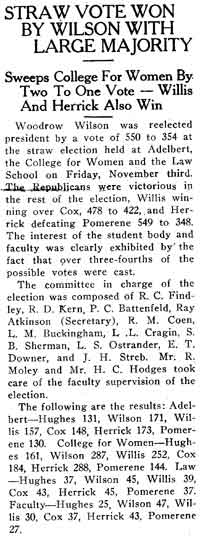
Few of the undergraduate men and none of the women could vote for President. They expressed their preferences in a straw vote which saw 75% turnout. Democrat Woodrow Wilson was handily re-elected with 550 votes to Republican Charles E. Hughes’ 354.
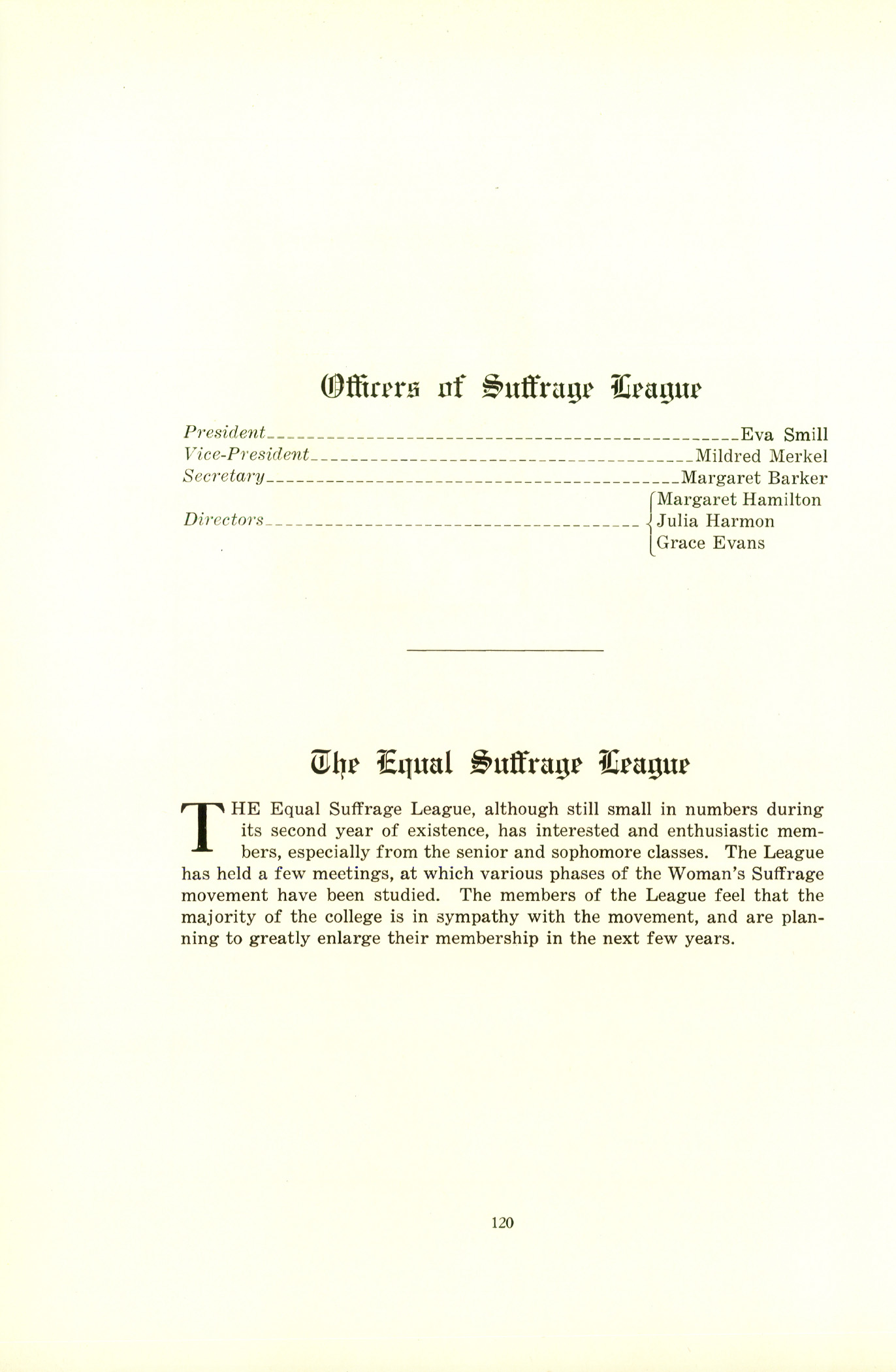
The Equal Suffrage League at the College for Women was in its second year of existence.
The Republican Club and Woodrow Wilson Club were active on the WRU campus with speeches, a debate, and participation in a straw vote.
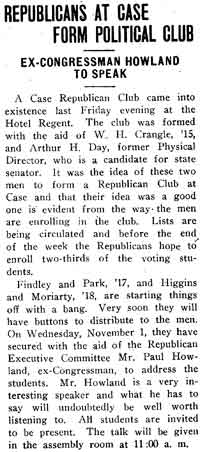
Case students formed a Republican Club. Paul Howland, ex-Congressman, addressed the students on November 1.
Woodrow Wilson was re-elected president in the straw vote at WRU.Ohio Popular Vote
National Popular Vote
Electoral Vote
Woodrow Wilson (D)
604,161 (51.9%)
Charles E. Hughes (R)
514,753 (44.2%)
Allan L. Benson (Socialist)
38,092 (3.3%)
J. Frank Hanly (Prohibition)
8,085 (0.7%)Woodrow Wilson (D) 9,126,300 (49.24%)
Charles E. Hughes (R)
8,546,789 (46.11%)
Allan L. Benson (Socialist)
589,924 (3.18%)
J. Frank Hanly (Prohibition)
221,030 (1.19%)Woodrow Wilson (D)
277
Charles E. Hughes (R)
254Information was compiled by staff of the Case Western Reserve University Archives, September 2004.
-
1
2026-03-31T14:55:26+00:00
1904: The Quiet Year
10
Campaigning at CWRU: Presidential Elections, 1904: The Quiet Year
plain
2026-04-23T19:53:36+00:00
1904
Information was compiled by staff of the Case Western Reserve University Archives, September 2004.
1904
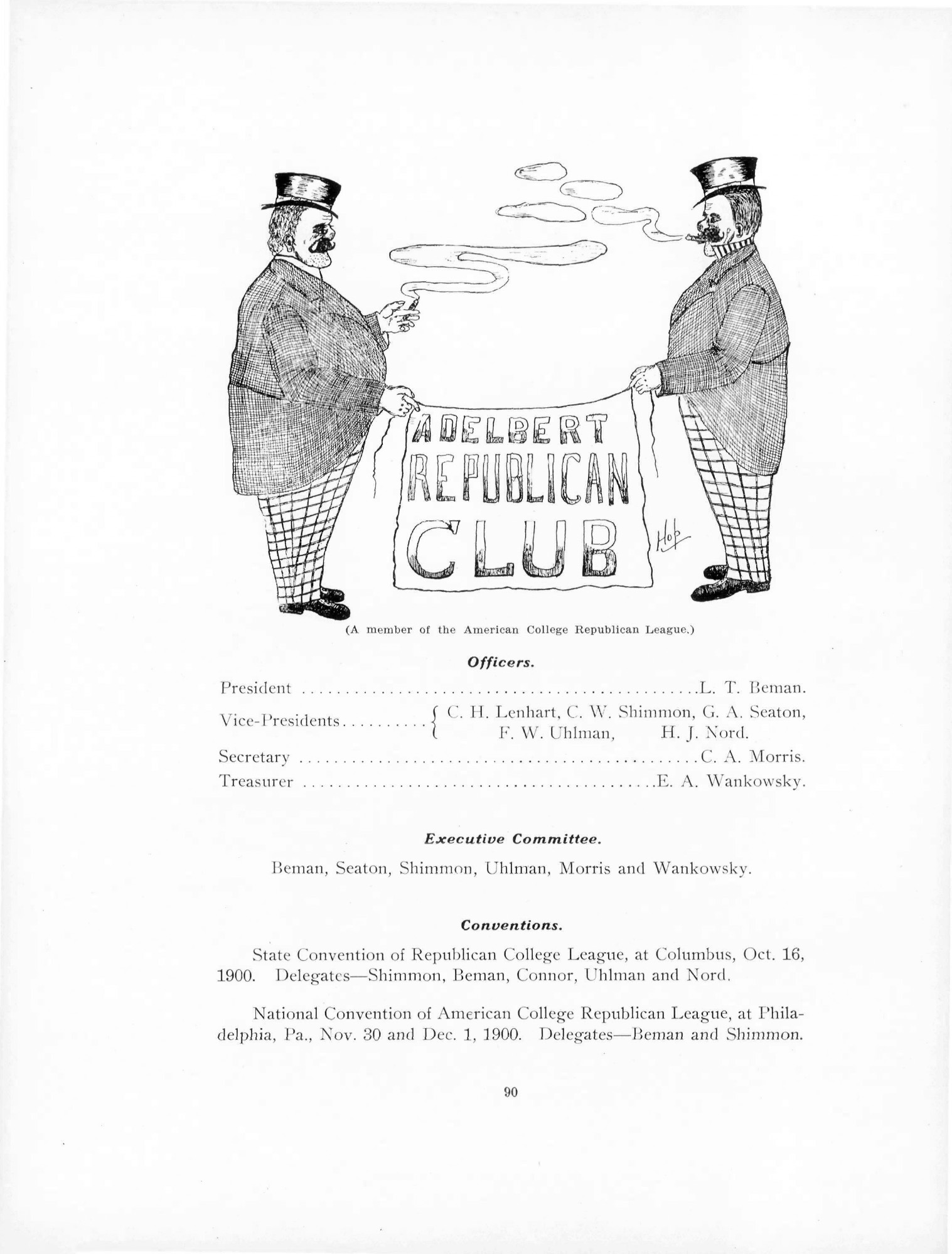
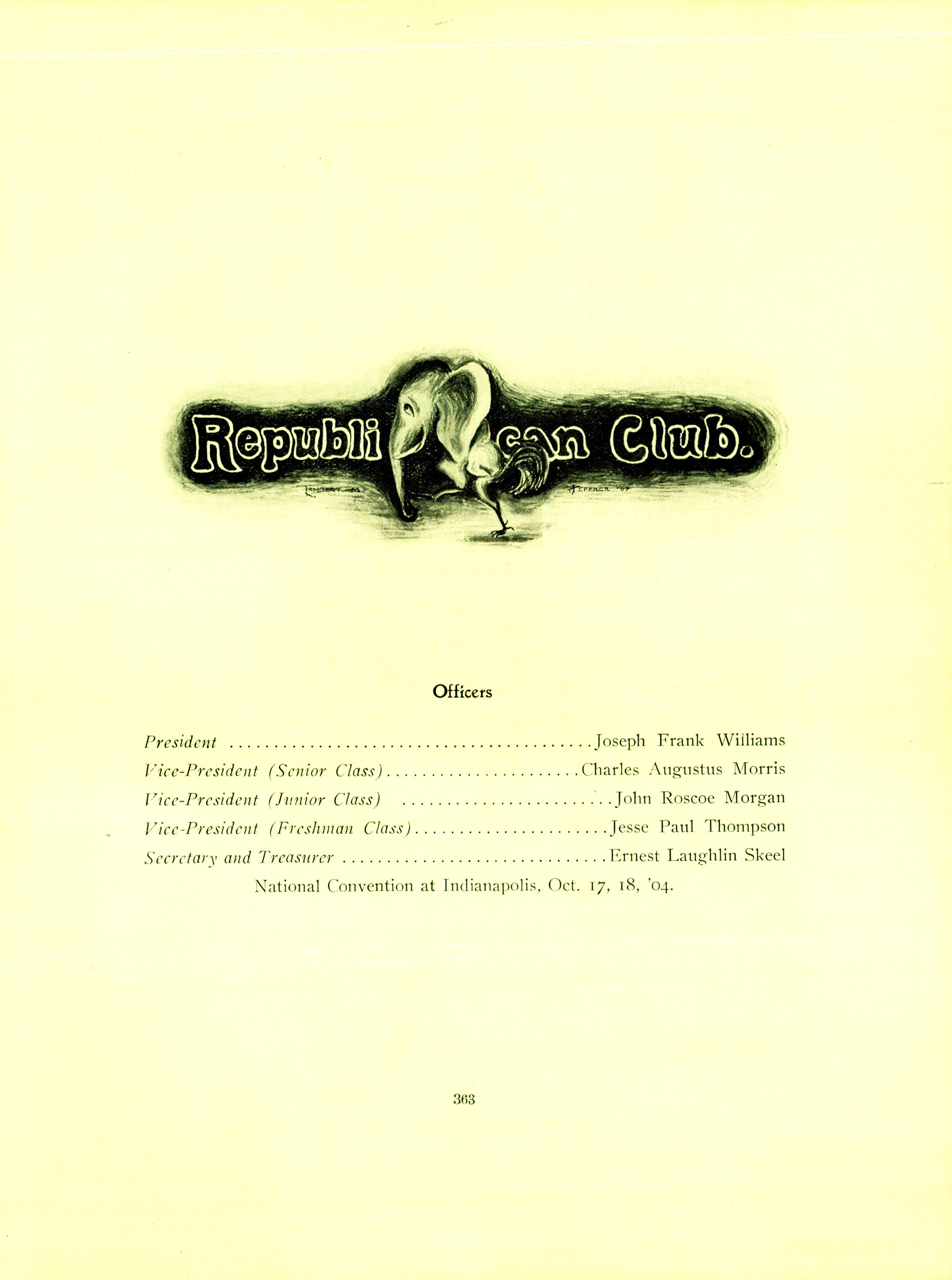
Reflecting the low-key national campaign, the only student political activity documented in the archives is the existence of the Law School’s Republican Club.
The WRU student yearbook featured the Law School's Republican Club.Ohio Popular Vote
National Popular Vote
Electoral Vote
Theodore Roosevelt (R)
600,095 (59.8%)
Alton Parker (D)
344,674 (34.3%)
Eugene V. Debs (Socialist)
36,260 (3.6%)
Silas C. Swallow (Prohibition)
19,339 (1.9%)
Charles Hunter Corregan (Socialist Labor)
2,635 (0.3%)
Thomas Edward Watson (People’s)
1,392 (0.1%)Theodore Roosevelt (R)
7,626,593 (56.41%)
Alton Parker (D)
5,082,898 (37.6%)
Eugene V. Debs (Socialist)
402,489 (2.98%)
Silas C. Swallow (Prohibition)
258,596 (1.91%)
Thomas Edward Watson (People’s)
114,051 (0.84%)
Charles Hunter Corregan (Socialist Labor)
33,156 (0.25%)Theodore Roosevelt (R)
336
Alton Parker (D)
140
Information was compiled by staff of the Case Western Reserve University Archives, September 2004. -
1
2026-03-31T19:58:14+00:00
1988: Analytical Frameworks
10
Campaigning at CWRU: Presidential Elections, 1988: Analytical Frameworks
plain
2026-04-23T15:13:02+00:00
1988
Information was compiled by staff of the Case Western Reserve University Archives, September 2004.
1988
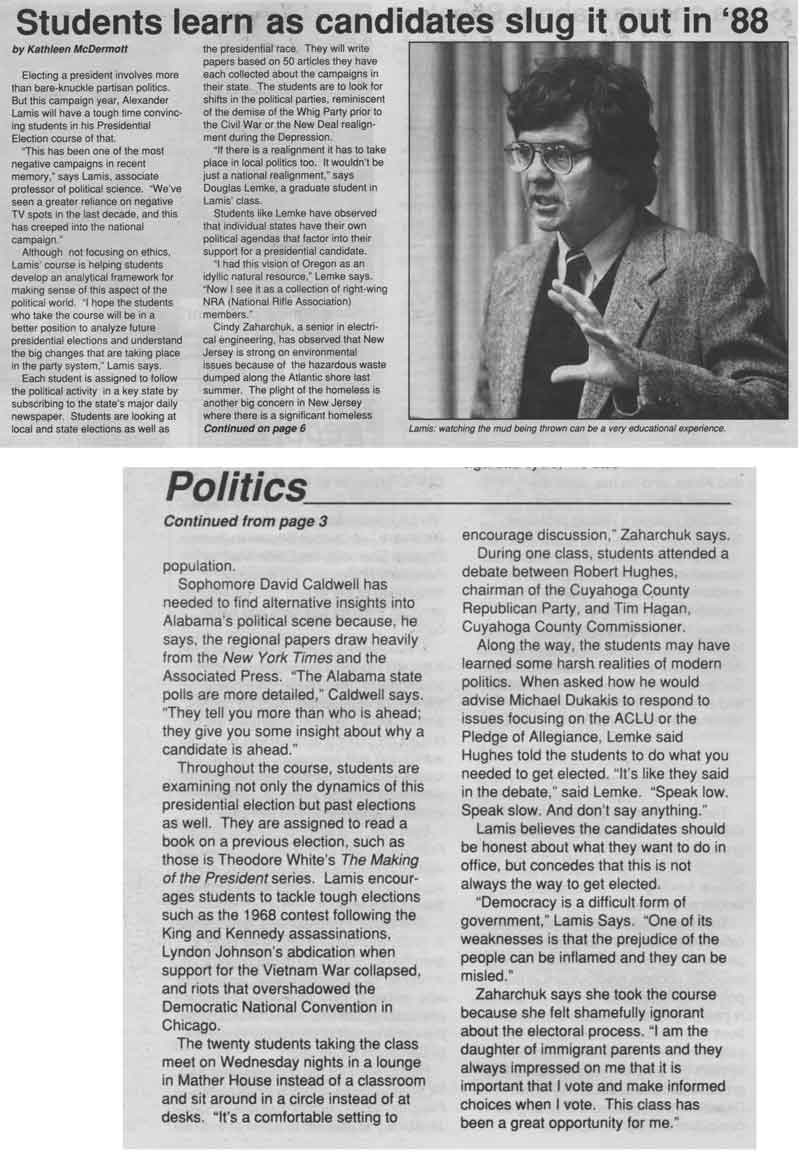
Political Science 320, The Presidential Election, taught by Associate Professor Alexander Lamis, required students to follow local and national political activity in a key state. Assignments included subscribing to the major daily newspaper in the state and attending a debate between Cuyahoga County Democratic and Republican Party leaders. Explained Lamis to Campus News reporter Kathleen McDermott, “I hope the students… will be in a better position to analyze future presidential elections and understand the big changes that are taking place in the party system.”
Democrat Michael Dukakis led Republican George Bush in a campus poll.
Political Science associate professor Alexander Lamis (below) had students follow the campaign in a key state.Ohio Popular Vote
National Popular Vote
Electoral Vote
George H.W. Bush (R)
2,416,549 (55%)
Michael S. Dukakis (D)
1,939,629 (44.1%)
Lenora B. Fulani (New Alliance)
12,017 (0.3%)
Ron Paul (Libertarian)
11,989 (0.3%)
Lyndon H. LaRouche
(National Economic Recovery)
7,733 (0.2%)
Ed Winn (Workers League)
5,432 (0.1%)
Larry Holmes (Workers World)
134George H.W. Bush (R)
48,886,097 (53.4%)
Michael S. Dukakis (D)
41,809,074 (45.6%)
Ron Paul (Libertarian)
432,179 (0.5%)
Lenora B. Fulani (New Alliance)
217,219 (0.2%)
Lyndon H. LaRouche (National Economic Recovery)
25,562
Ed Winn (Workers League)
18,693
Larry Holmes (Workers World)
7,846George H.W. Bush (R)
426
Michael S. Dukakis (D)
111
Lloyd Bentsen (D)
1Information was compiled by staff of the Case Western Reserve University Archives, September 2004.
-
1
2026-03-31T14:59:54+00:00
1912: Three Parties
10
Campaigning at CWRU: Presidential Elections, 1912: Three Parties
plain
2026-04-23T12:54:28+00:00
1912
Information was compiled by staff of the Case Western Reserve University Archives, September 2004.
1912
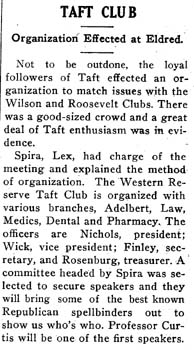
Republican, Democratic, and Progressive parties each had a student club at WRU. All brought speakers to campus, the Taft Club promising, “some of the best known Republican spellbinders out to show us who’s who.”
The WRU student newspaper reported on campus political activities.Ohio Popular Vote
National Popular Vote
Electoral Vote
Woodrow Wilson (D)
424,834 (41%)
William H. Taft (R)
278,168 (26.8%)
Theodore Roosevelt (Progressive)
229,807 (22.2%)
Eugene V. Debs (Socialist)
90,164 (8.7%)
Eugene W. Chafin (Prohibition)
11,511 (1.1%)
Arthur E. Reimer (Socialist Labor)
2,630 (0.3%)Woodrow Wilson (D)
6,293,152 (41.84%)
Theodore Roosevelt (Progressive)
4,119,207 (27.39%)
William H. Taft (R)
3,486,333 (23.18%)
Eugene V. Debs (Socialist)
900,369 (5.99%)
Eugene W. Chafin (Prohibition)
207,972 (1.38%)
Arthur E. Reimer (Socialist Labor)
29,374 (0.2%)Woodrow Wilson (D)
435
Theodore Roosevelt (Progressive)
88
William H. Taft (R)
8Information was compiled by staff of the Case Western Reserve University Archives, September 2004.
-
1
2026-03-31T19:37:32+00:00
1976: Campaigns in the Classroom
10
Campaigning at CWRU: Presidential Elections, 1976: Campaigns in the Classroom
plain
2026-04-23T18:18:11+00:00
1976
Information was compiled by staff of the Case Western Reserve University Archives, September 2004.
1976
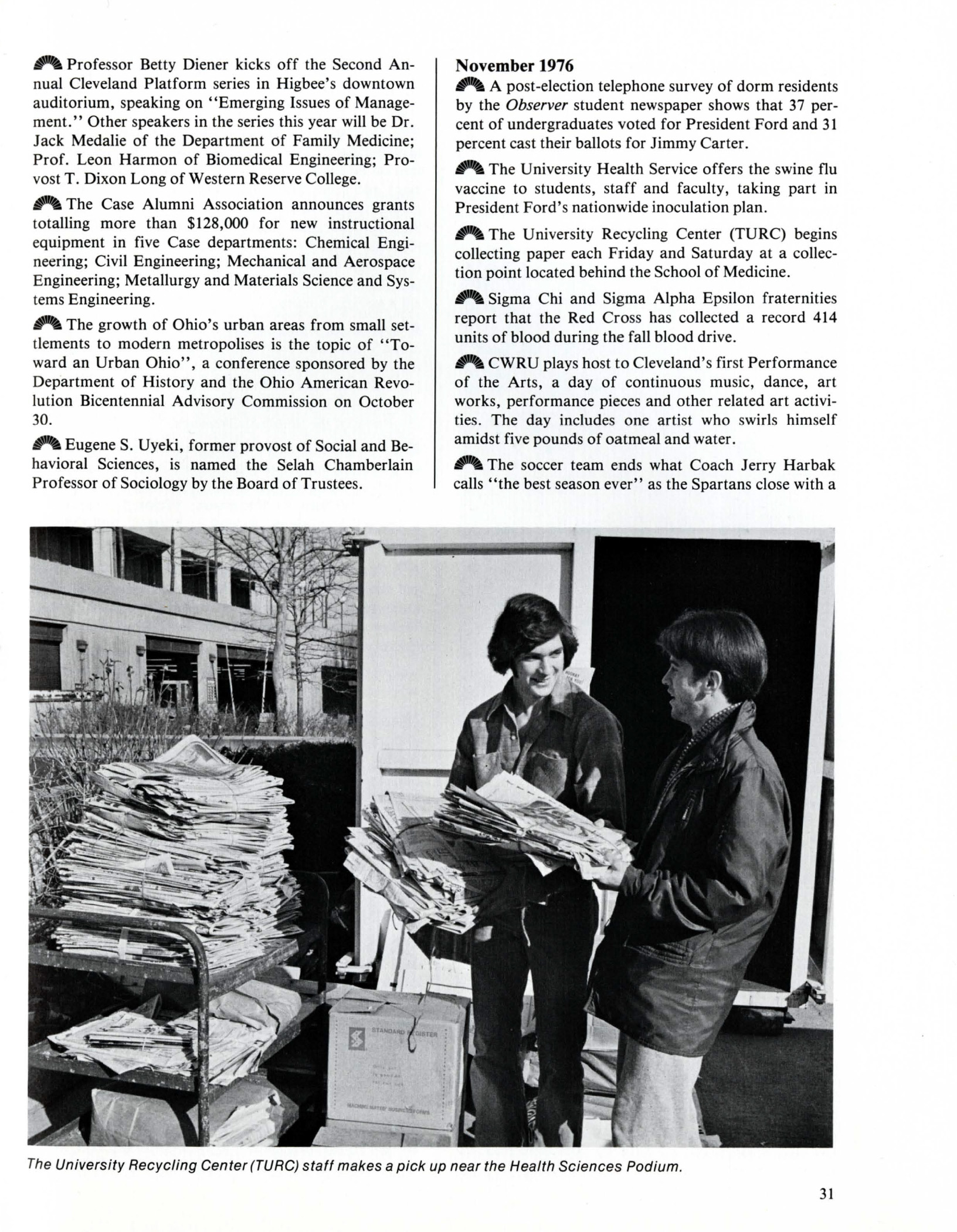
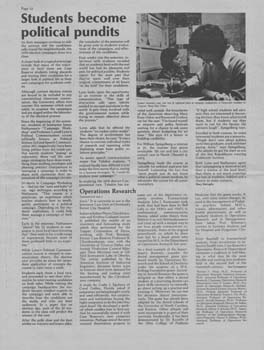
For the eleven students enrolled in POSC 323, the 1976 elections were not just an academic exercise. James Nathanson’s Political Science class, Campaign Workshop, required students to participate in and write about a local political campaign. Students explored the structure of political debate and campaigns, the role of professional campaign organizations, and political fund raising.
Two classes had students get involved with real political races.
As reported in the University's 1976/1977 Annual Report (left), students preferred Gerald Ford to Jimmy Carter in a telephone survey (right).Ohio Popular Vote
National Popular Vote
Electoral Vote
Jimmy Carter (D)
2,011,621 (48.9%)
Gerald R. Ford (R)
2,000,505 (48.7%)
Eugene J. McCarthy
(Independent)
58,258 (1.4%)
Lester Maddox (American Independent)
15,529 (0.4%)
Roger MacBride (Libertarian)
8,961 (0.2%)
Gus Hall (Communist)
7,817 (0.2%)
Peter Camejo
(Socialist Workers)
4,717 (0.1%)
Lyndon H. LaRouche
(U.S. Labor)
4,335 (0.1%)
Jules Levin
(Socialist Labor)
68
Benjamin C. Bubar
(Prohibition)
62Jimmy Carter (D)
40,830,763 (50.1%)
Gerald R. Ford (R)
39,147,793 (48%)
Eugene J. McCarthy (Independent)
756,691 (0.9%)
Roger MacBride (Libertarian)
173,011 (0.2%)
Lester Maddox (American Independent)
170,531 (0.2%)
Peter Camejo (Socialist Workers)
91,314 (0.1%)
Gus Hall (Communist)
58,992 (0.07%)
Lyndon H. LaRouche (U.S. Labor)
40,043 (0.05%)
Benjamin C. Bubar (Prohibition)
15,934 (0.02%)
Jules Levin (Socialist Labor)
9,616 (0.01%)Jimmy Carter (D)
297
Gerald R. Ford (R)
240
Ronald Reagan (R)
1Information was compiled by staff of the Case Western Reserve University Archives, September 2004.
-
1
2026-03-31T15:15:08+00:00
1920: Women Vote
10
Campaigning at CWRU: Presidential Elections, 1920: Women Vote
plain
2026-04-23T13:15:04+00:00
1920
Information was compiled by staff of the Case Western Reserve University Archives, September 2004.
1920
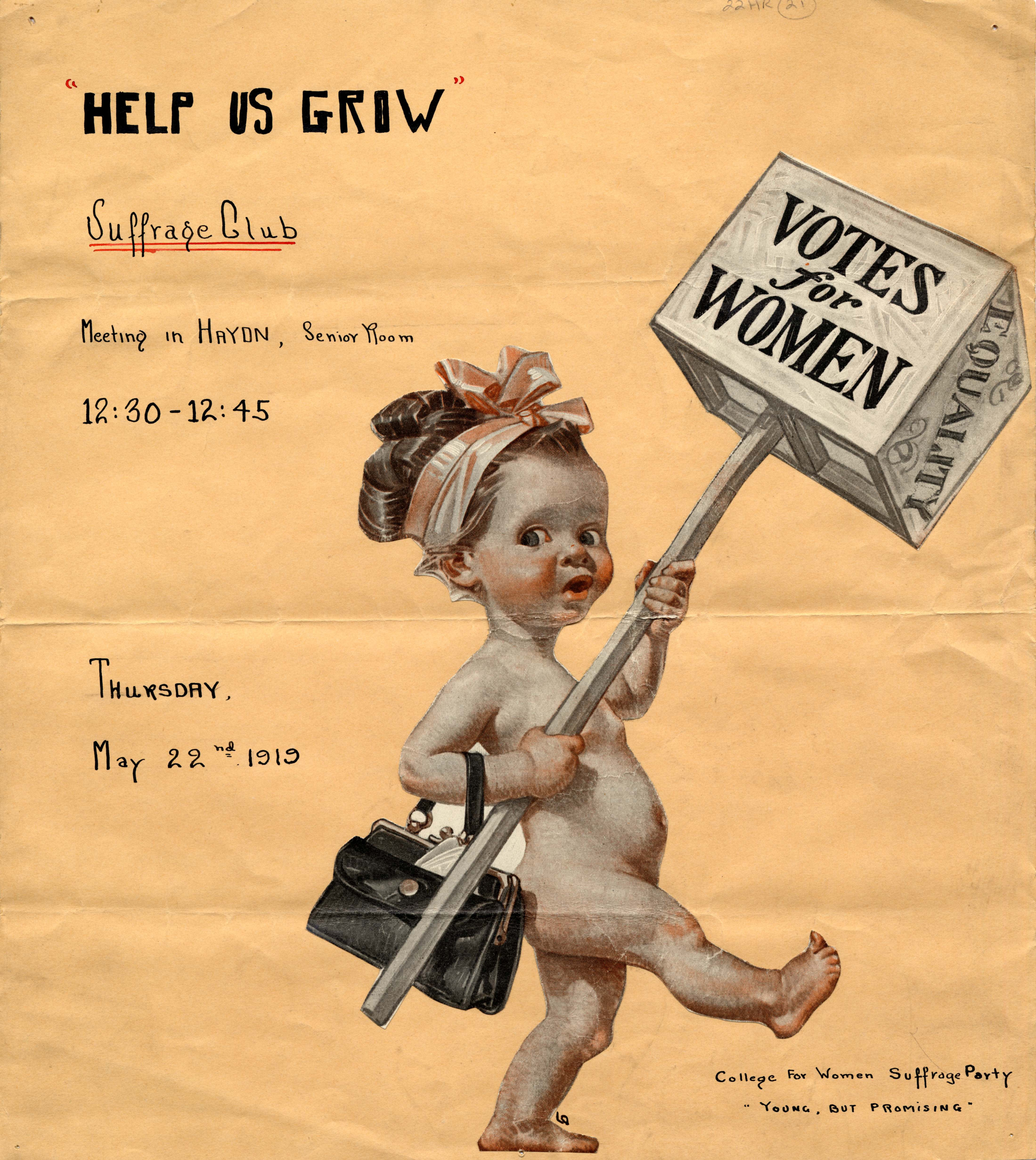
College for Women students had been part of the effort to win full suffrage for women since at least 1916, when they formed their Equal Suffrage League. The student chapters of the YMCA and the YWCA assisted students unable to return home to vote, helping them register and request and cast their absentee ballots, “Thus every voter in the University has had a chance to vote without being put to any great inconvenience.”
The Suffrage Club at the College for Women sought the right to vote.
Below is the first page of the script of The Taming of the Anti, produced by The Equal Suffrage League. It features a dialogue between Herbert and Gertrude Jones about the perils of female suffrage.
Democratic vice presidential candidate Franklin D. Roosevelt visited the WRU campus.Ohio Popular Vote
National Popular Vote
Electoral Vote
Warren G. Harding (R)
1,182,022 (58.5%)
James M. Cox (D)
780,037 (38.6%)
Eugene V. Debs (Socialist)
57,147 (2.8%)
Robert Colvin Macauley
(Single Tax) 2,153 (0.1%)Warren G. Harding (R)
16,133,314 (60.3%)
James M. Cox (D)
9,140,884 (34.17%)
Eugene V. Debs (Socialist)
913,664 (3.42%)
Parley P. Christensen (Farmer Labor)
264,540 (0.99%)
Robert Colvin Macauley (Single Tax)
5,690 (0.02%)Warren G. Harding (R)
404
James M. Cox (D)
127Information was compiled by staff of the Case Western Reserve University Archives, September 2004.
-
1
2026-03-31T14:57:54+00:00
1908: Mock Conventions
10
Campaigning at CWRU: Presidential Elections, 1908: Mock Conventions
plain
2026-04-23T19:53:02+00:00
1908
Information was compiled by staff of the Case Western Reserve University Archives, September 2004.
1908
A recurring element of student political activity was the spring mock political convention, in which students mimicked the (pre-primary) work of the party conventions of drafting platforms and selecting nominees. The WRU student choice for the Republican Party nominee in 1908 was Robert LaFollette, Wisconsin Senator. The students’ choice was not echoed by the delegates to the Republican Party convention, who selected William H. Taft.
This first mock political convention held by either Case or WRU nominated Robert LaFollette of Wisconsin for president.
The Republican Party continued its previous support on the WRU campus with the resurrection of the Republican Club.
Ohio Popular Vote
National Popular Vote
Electoral Vote
William H. Taft (R)
572,312 (51%)
William J. Bryan (D)
502,721 (44.8%)
Eugene V. Debs (Socialist)
33,795 (3%)
Eugene W. Chafin
(Prohibition)
11,402 (1%)
August Gilhaus
(Socialist Labor)
721 (0.1%)
Thomas L. Hisgen (Independence)
439
Thomas Edward Watson (People’s)
162William H. Taft (R)
7,676,258 (51.58%)
William J. Bryan (D)
6,406,801 (43.05%)
Eugene V. Debs (Socialist)
420,380 (2.82%)
Eugene W. Chafin (Prohibition)
252,821 (1.7%)
Thomas L. Hisgen (Independence)
82,537 (0.55%)
Thomas Edward Watson (People’s)
28,376 (0.19%)
August Gilhaus (Socialist Labor)
14,018 (0.09%)William H. Taft (R)
321
William J. Bryan (D)
162Information was compiled by staff of the Case Western Reserve University Archives, September 2004.
-
1
2026-03-31T19:17:11+00:00
1956: Fundraising
10
Campaigning at CWRU: Presidential Elections, 1956: Fundraising
plain
2026-04-23T18:26:40+00:00
1956
Information was compiled by staff of the Case Western Reserve University Archives, September 2004.
1956
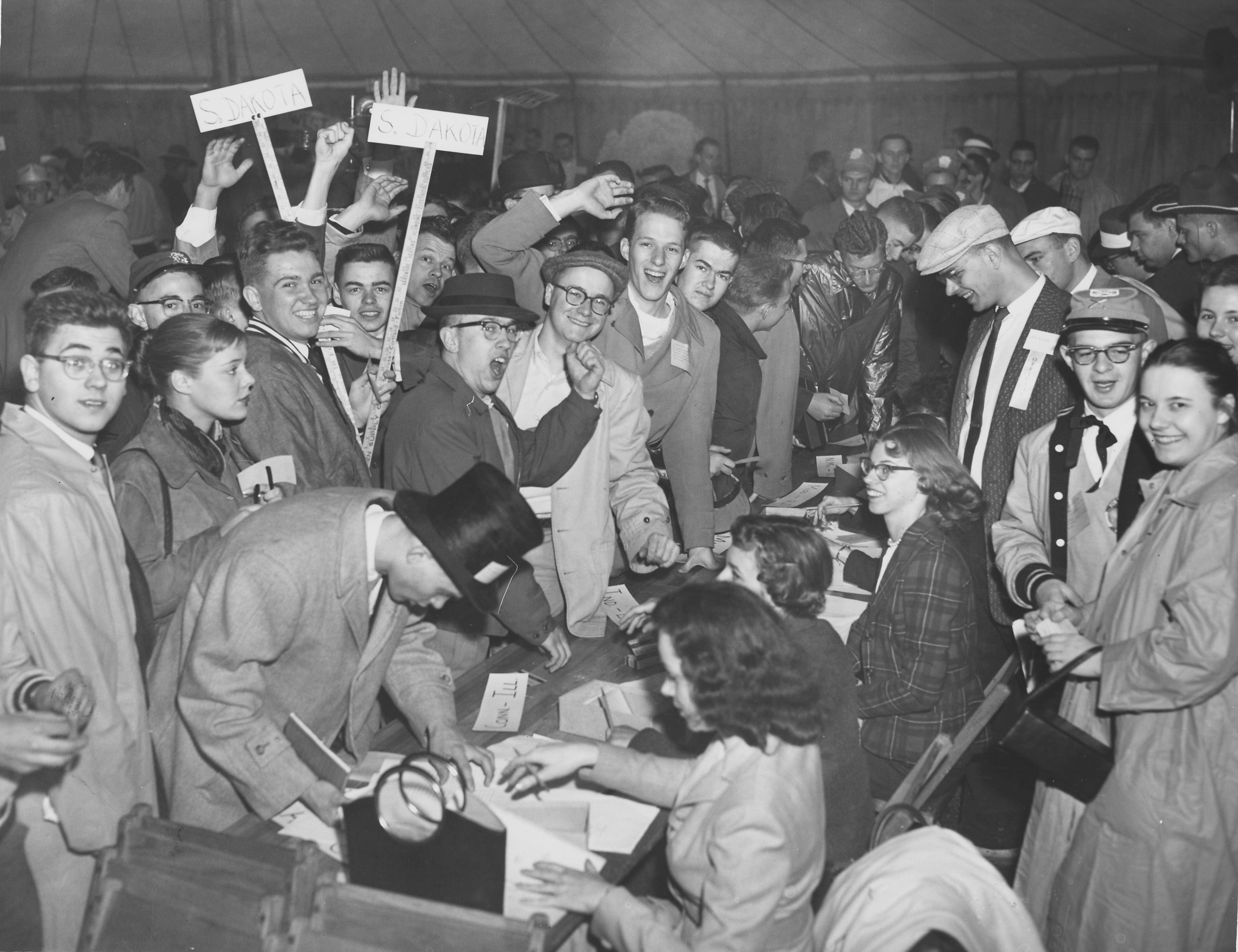
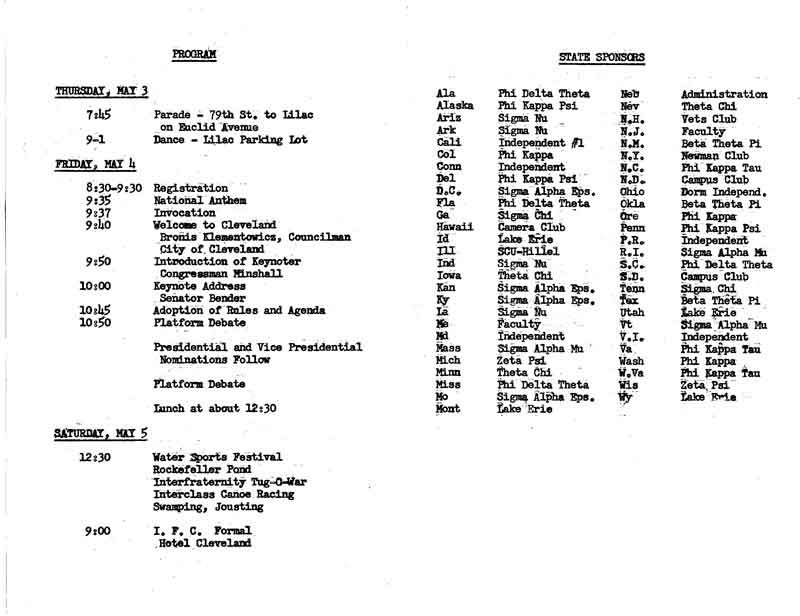
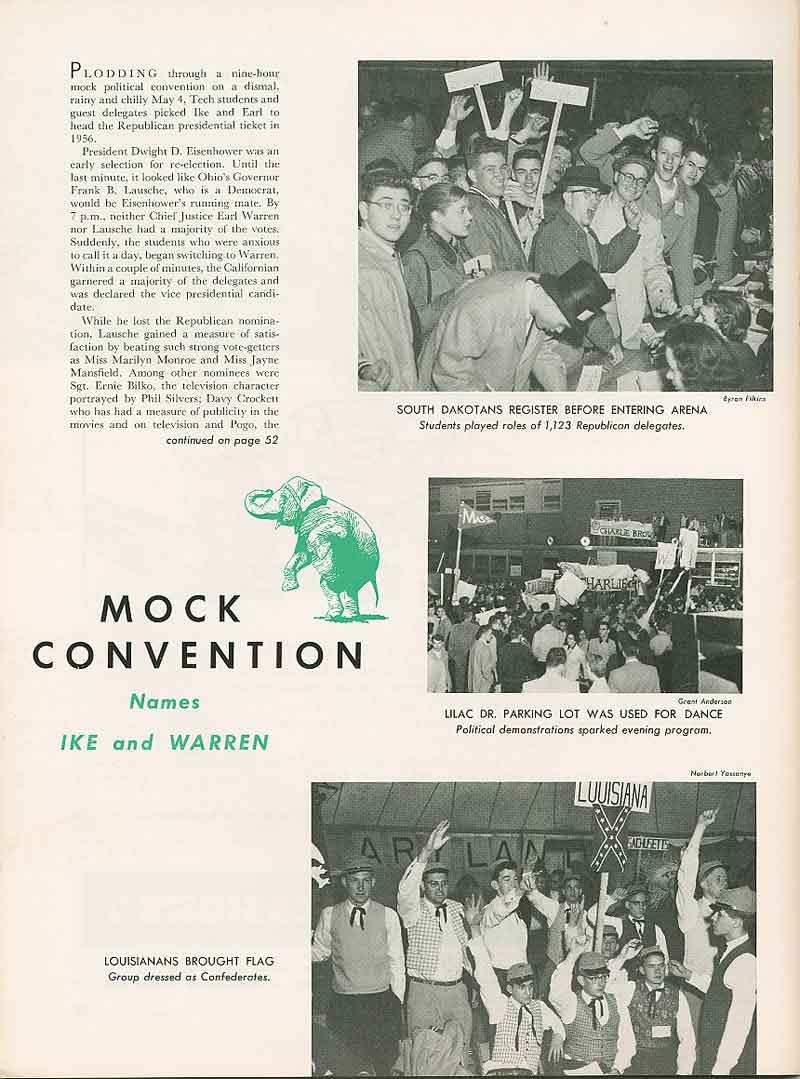
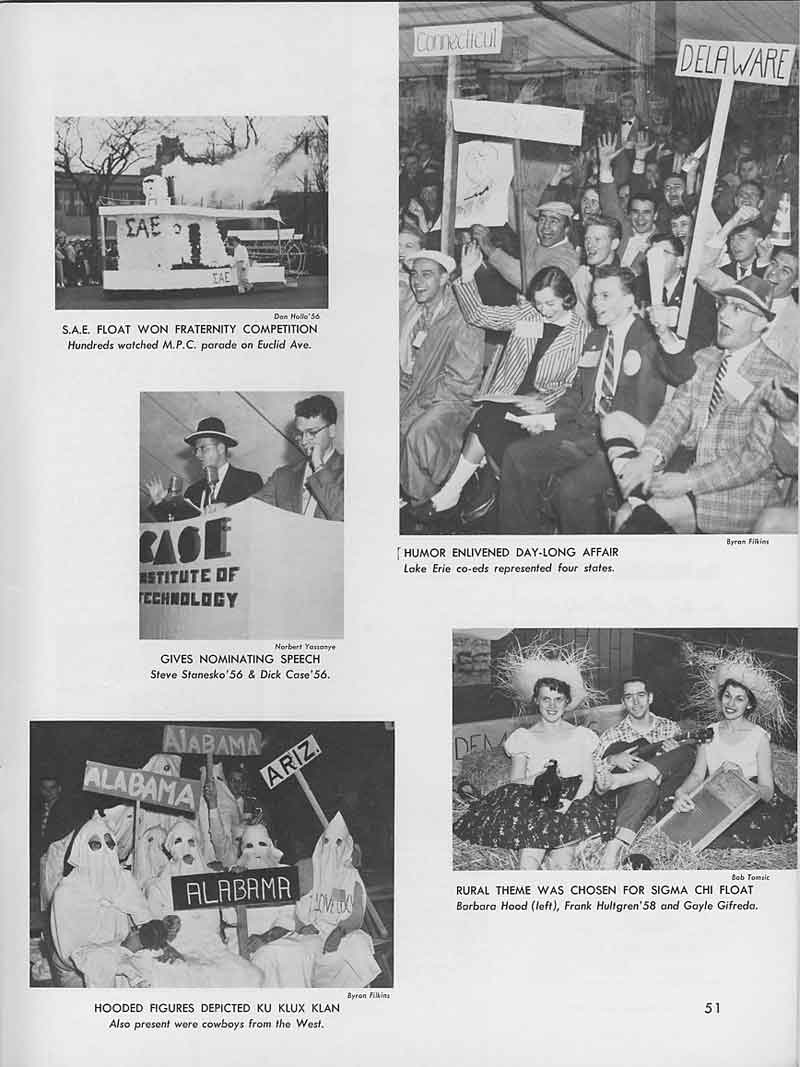
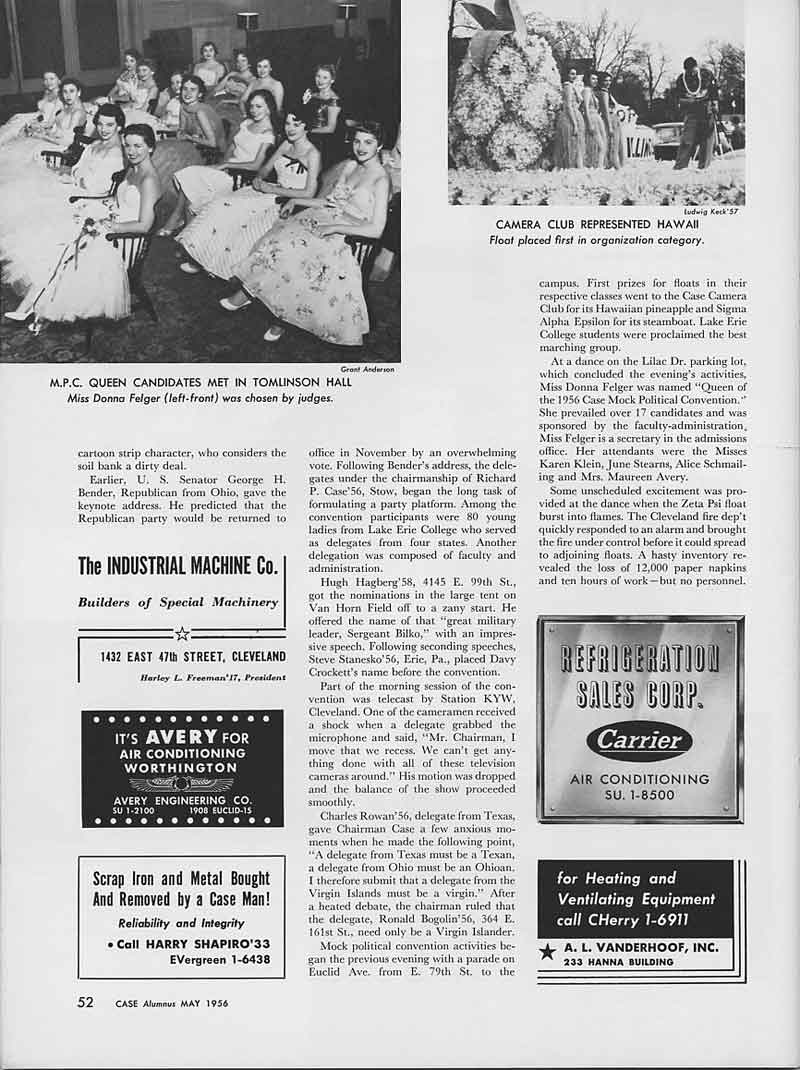
WRU’s Volunteers for Stevenson and Kefauver raised money to “keep Stevenson on TV” by collecting tax stamps, selling Stevenson buttons, and ringing doorbells on “D” (Dollars for Democracy) Day, October 16. At Case’s mock political convention state delegations were made up by Case student clubs, Lake Erie College students, and Case faculty and administration. Part of the proceedings were televised by Cleveland station KYW. A dance preceded the convention and Donna Felger, a secretary in the Admissions Office, was named Queen of the 1956 Case Mock Political Convention.
Enthusiastic delegates at Case's Mock Political Convention.
Mock Political Convention events and state delegation sponsors.
(Below) Case Alumnus coverage of the 9-hour Mock Political Convention. In a show of bi-partisanship remarkable at a Party convention, for several hours, Democratic Ohio Governor Frank B. Lausche led the balloting for Republican presidential nominee Dwight Eisenhower's running mate.
As usual at Case's Mock Political Convention, queens and floats were part of the festivities.
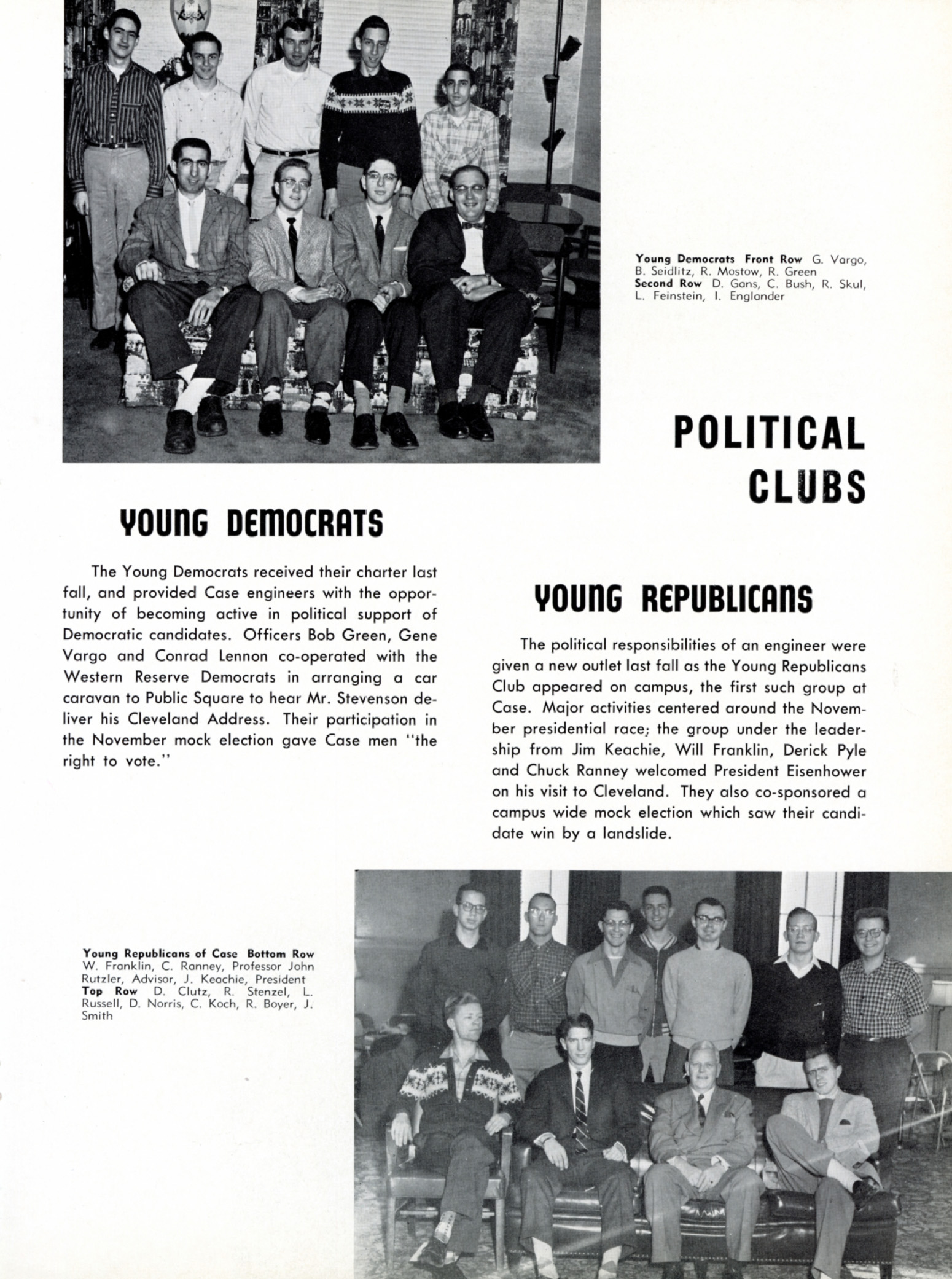
The Mock Political Convention was not the only student politicking at Case, as evidenced by the Case Differential coverage of Young Democrats and Young Republicans.Ohio Popular Vote
National Popular Vote
Electoral Vote
Dwight D. Eisenhower (R)
2,262,610 (61.1%)
Adlai E. Stevenson (D)
1,439,655 (38.9%)Dwight D. Eisenhower (R)
35,585,245 (57.37%)
Adlai E. Stevenson (D)
26,030,172 (41.97%)
T. Coleman Andrews (States’ Rights Party)
108,055 (0.17%)
Eric Hass (Socialist Labor)
44,300 (0.07%)Dwight D. Eisenhower (R)
457
Adlai E. Stevenson (D)
73
Walter B. Jones
1Information was compiled by staff of the Case Western Reserve University Archives, September 2004.
-
1
2026-03-31T19:51:44+00:00
1984: Campus Debates
9
Campaigning at CWRU: Presidential Elections, 1984: Campus Debates
plain
2026-04-23T19:30:31+00:00
1984
Information was compiled by staff of the Case Western Reserve University Archives, September 2004.
1984
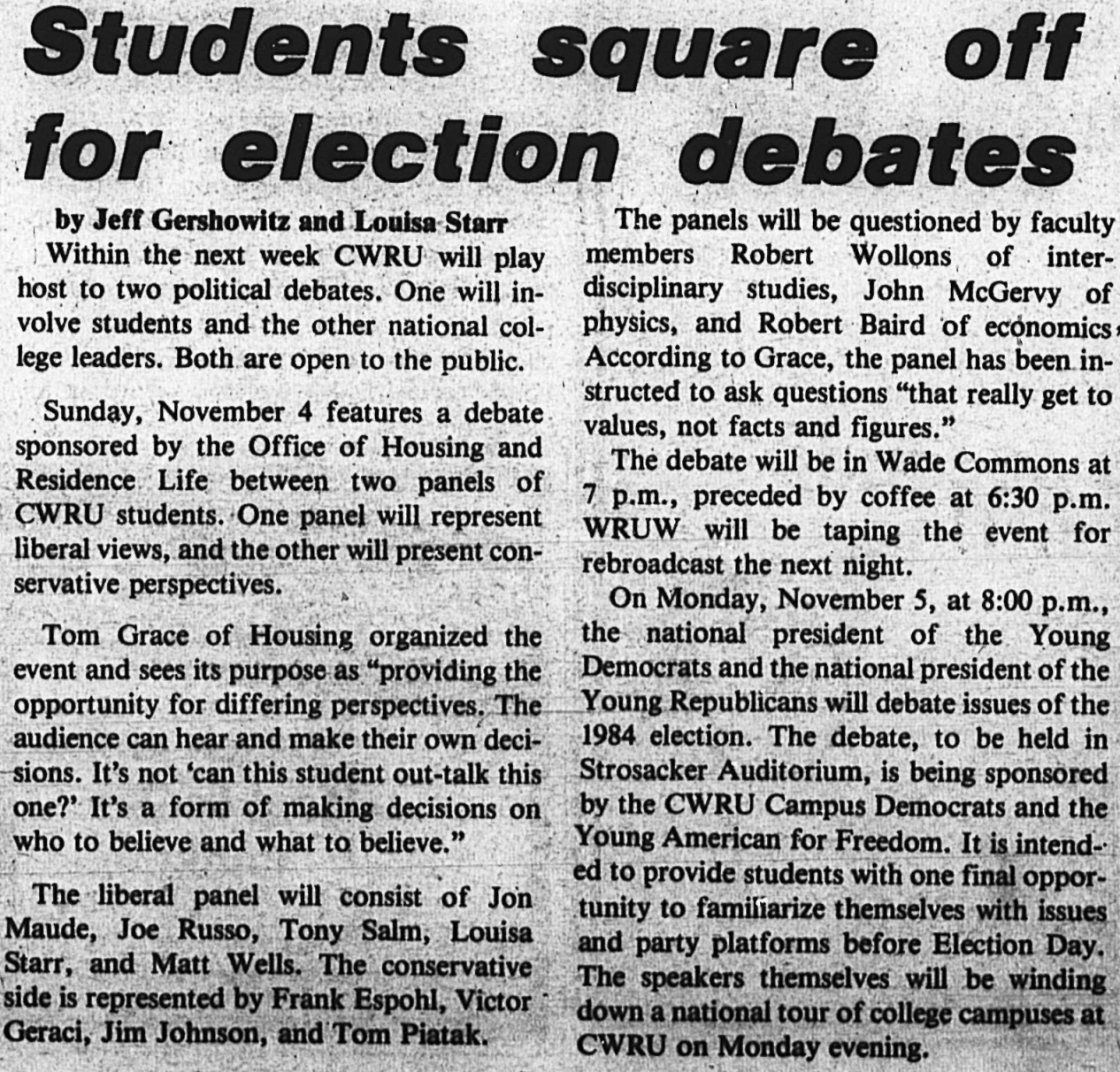
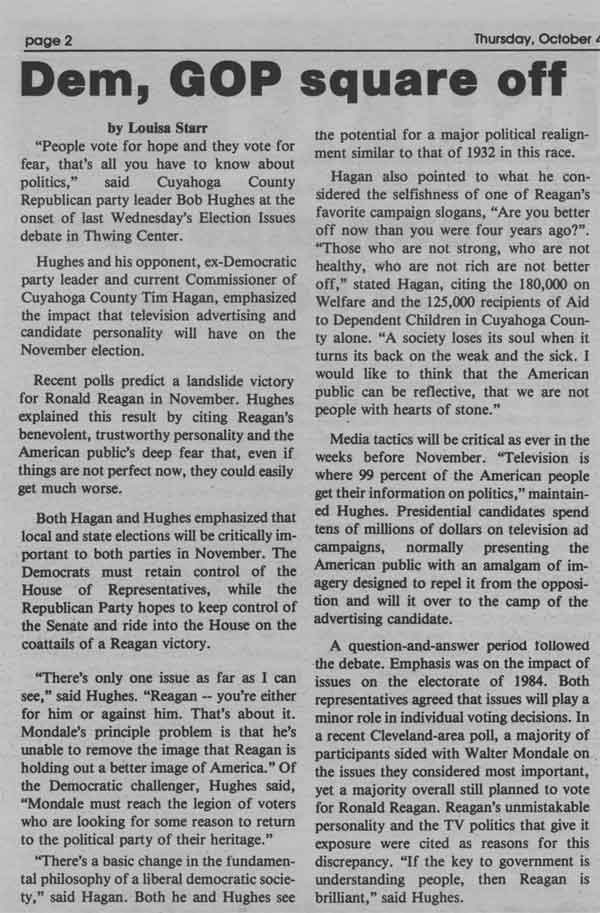
At least three debates were held on campus. Cuyahoga County Republican Party Chairman Bob Hughes debated Cuyahoga County Commissioner, Democrat, Tim Hagan. A liberal student panel faced a conservative student panel. National Young Democrats president debated national Young Republicans president.
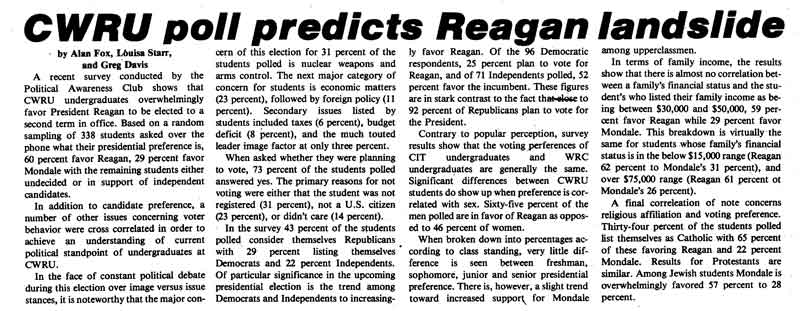
A poll conducted by the Political Awareness Club correctly predicted a Reagan victory.
A two-panel debate and two-person debate were held on campus.
Cuyahoga County Republican leader Bob Hughes and Democratic County Commissioner Tim Hagan faced off in a debate.Ohio Popular Vote
National Popular Vote
Electoral Vote
Ronald Reagan (R)
2,678,560 (58.9%)
Walter F. Mondale (D)
1,825,440 (40.1%)
Dennis L. Serrette
(Independent Alliance)
12,090 (0.3%)
Lyndon H. LaRouche (Independent)
10,693 (0.2%)
David Bergland (Libertarian)
5,886 (0.1%)
Gus Hall (Communist)
4,438 (0.1%)
Mel Mason (Socialist Workers)
4,344 (0.1%)
Ed Winn (Workers League)
3,565 (0.1%)
Gavrielle Holmes (Workers World)
2,565 (0.1%)
Earl F. Dodge (Prohibition)
4Ronald Reagan (R)
54,455,075 (58.8%)
Walter F. Mondale (D)
37,577,185 (40.6%)
David Bergland (Libertarian)
228,314 (0.2%)
Lyndon H. LaRouche (Independent)
78,807 (0.1%)
Dennis L. Serrette (Independent Alliance)
46,852 (0.05%)
Gus Hall (Communist)
36,386 (0.04%)
Mel Mason (Socialist Workers)
24,706 (0.03%)
Ed Winn (Workers League)
10,801 (0.01%)
Earl F. Dodge (Prohibition)
4,242
Gavrielle Holmes (Workers World)
2,656Ronald Reagan (R)
525
Walter F. Mondale (D)
13Information was compiled by staff of the Case Western Reserve University Archives, September 2004.
-
1
2026-03-31T20:00:26+00:00
1992: Politics and the Internet
9
Campaigning at CWRU: Presidential Elections, 1992: Politics and the Internet
plain
2026-04-23T14:48:35+00:00
1992
Information was compiled by staff of the Case Western Reserve University Archives, September 2004.
1992
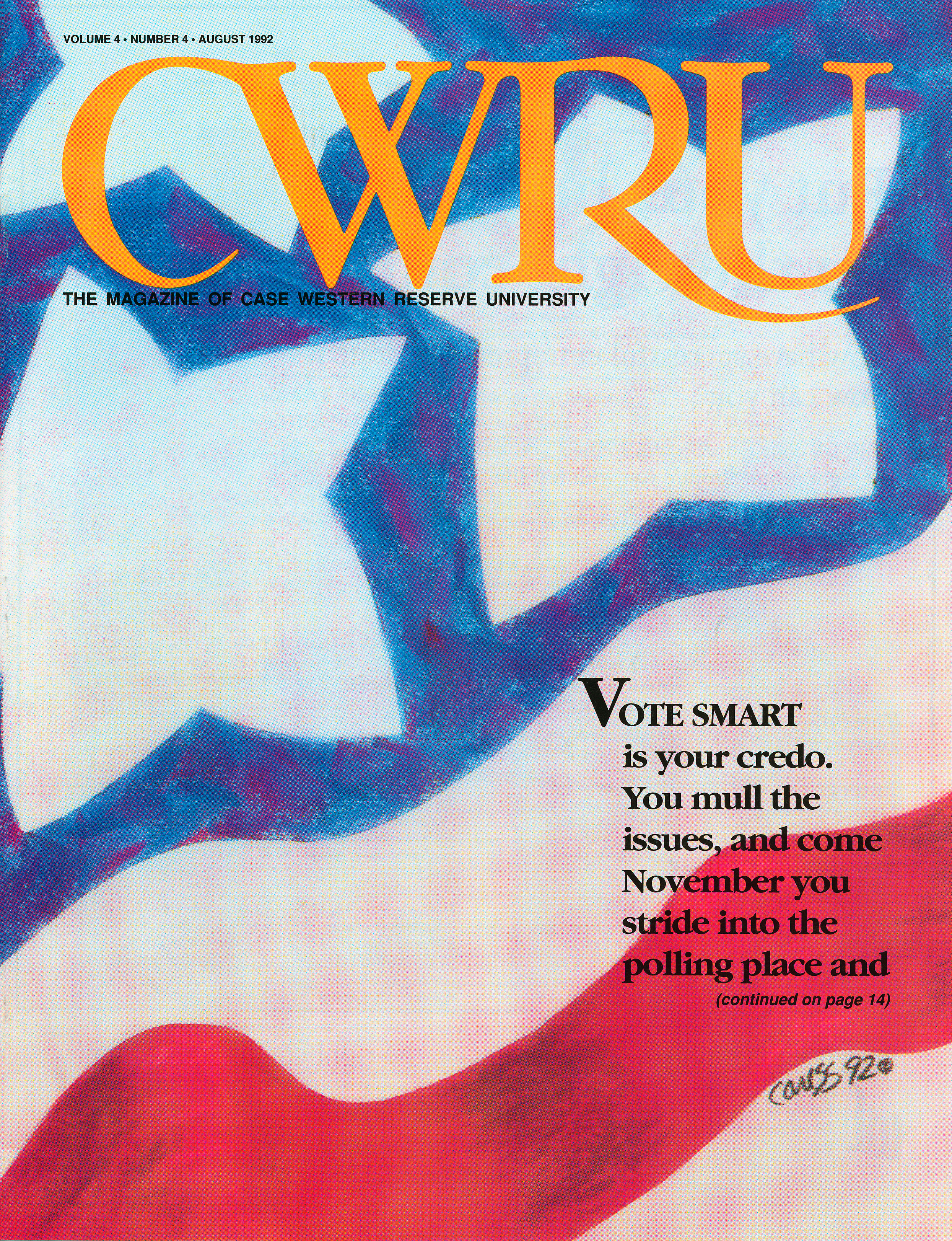
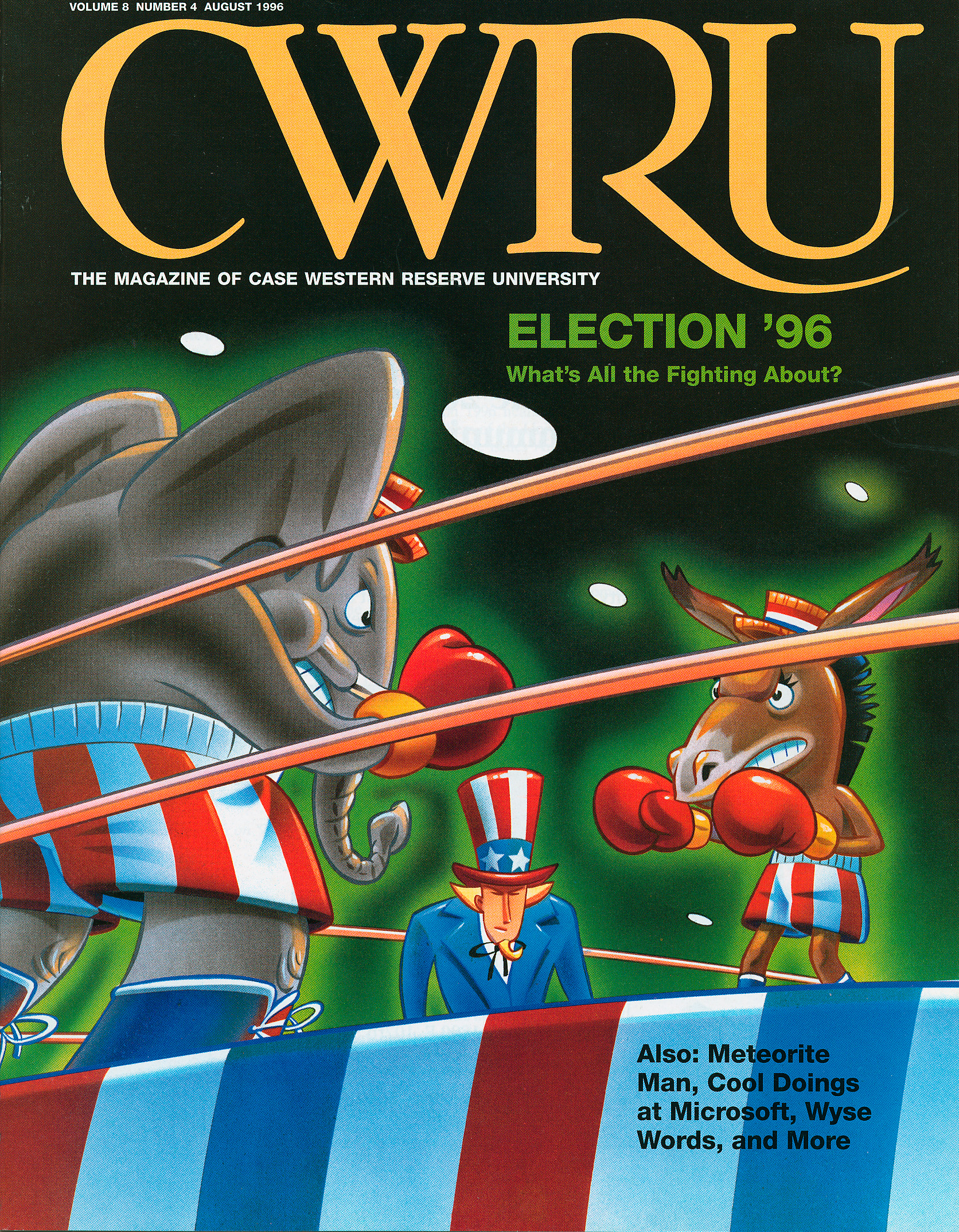
Free-Net, the CWRU-sponsored first free, open-access community computer system, posted Democratic and Republican speeches and platforms. CWRU Magazine featured faculty analyses of campaign issues in health care, education, crime, the economy, foreign affairs, and environmental affairs.
CWRU Magazine featured an article on the election.
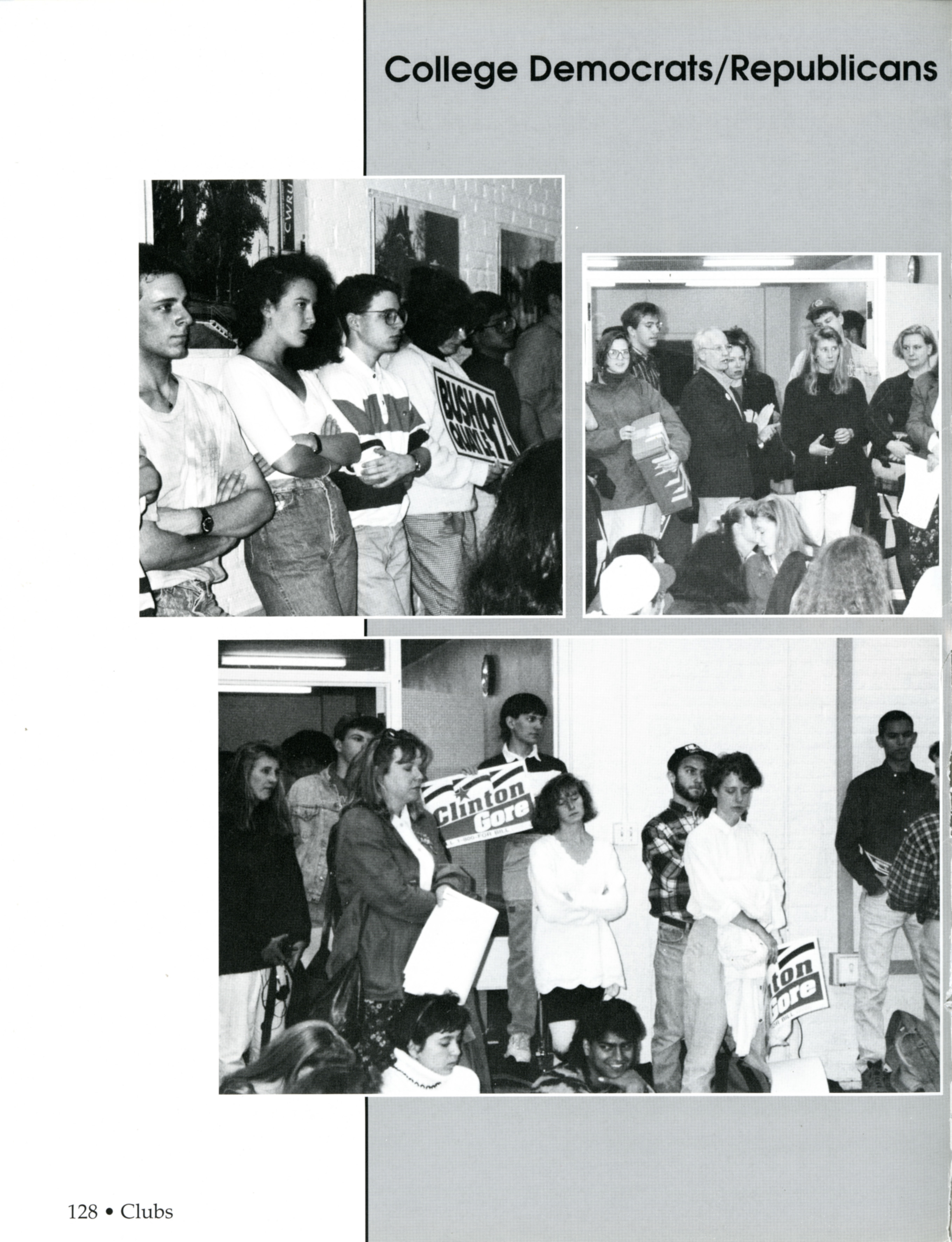
The student yearbook provided coverage of the the Democrat and Republican clubs.
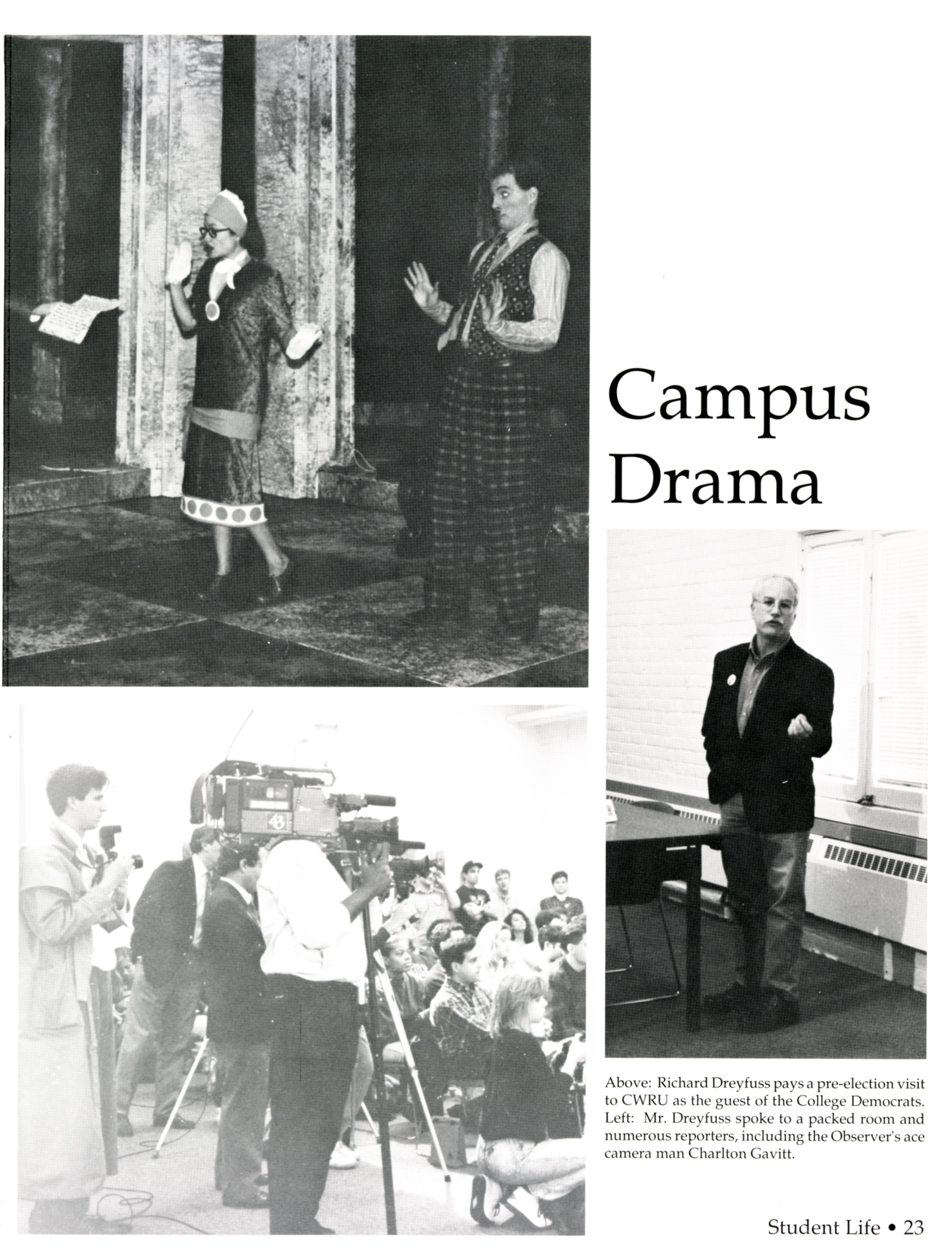
Actor Richard Dreyfuss (below) visited campus in support of Bill Clinton and the Democrats.Ohio Popular Vote
National Popular Vote
Electoral Vote
William J. Clinton (D)
1,984,942 (40.2%)
George H.W. Bush (R)
1,894,310 (38.3%)
H. Ross Perot (Independent)
1,036,426 (21%)
Andre Marrou (Libertarian) 7,252 (0.1%)
Lenora B. Fulani (New Alliance) 6,413
Bo Gritz (Populist)
4,699
John Hagelin (Natural Law)
3,437
Lyndon H. LaRouche Jr. (Economic Recovery)
2,446William J. Clinton (D)
44,909,326 (43%)
George H.W. Bush (R)
39,103,882 (37.4%)
H. Ross Perot (Independent) 19,741,657 (18.9%)
Andre V. Marrou (Libertarian) 291,627 (0.3%)William J. Clinton (D)
370
George H.W. Bush (R)
168Information was compiled by staff of the Case Western Reserve University Archives, September 2004.
-
1
2026-03-31T20:03:41+00:00
1996: Rallies, Roundtables and Debates
8
Campaigning at CWRU: Presidential Elections, 1996: Rallies, Roundtables and Debates
plain
2026-04-23T14:09:54+00:00
1996
Information was compiled by staff of the Case Western Reserve University Archives, September 2004.
1996
Activism and analysis characterized the 1996 presidential election on campus. Young Democrats organized volunteers for local and national candidates. College Libertarians hosted presidential candidate Harry Browne. Young Republicans were at Dole and Kemp rallies. CWRU Magazine sponsored a faculty roundtable to discuss election issues. And everyone watched the Clinton-Dole debate.
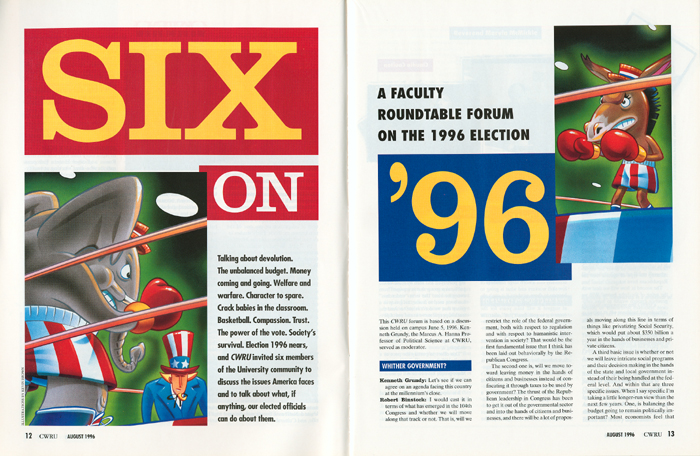
CWRU Magazine had a special feature on the election.
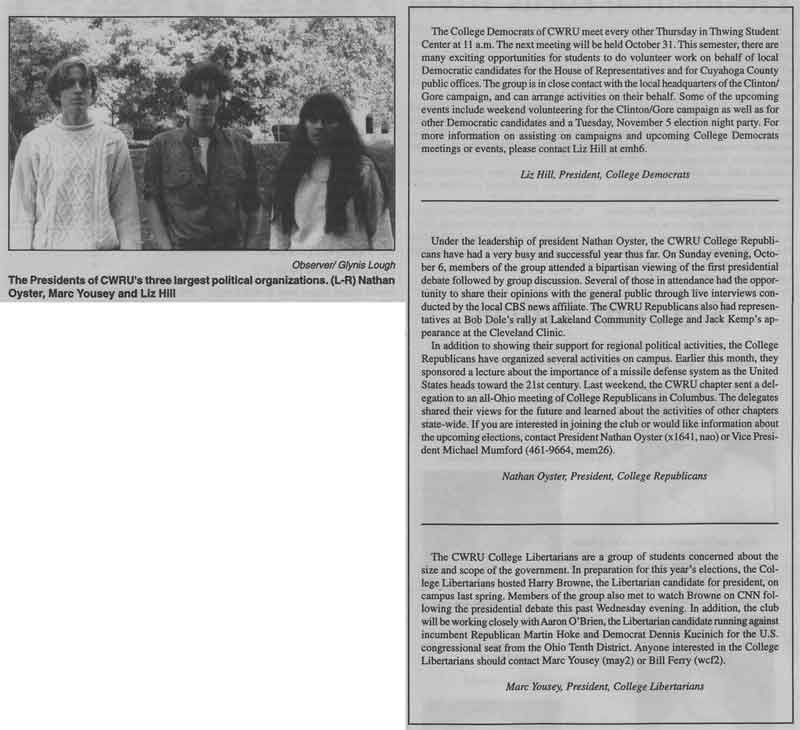
The three largest campus political organizations and their presidents were featured in The Observer.
As part of the main feature, CWRU Magazine invited six members of the faculty to discuss the issues America faced.Ohio Popular Vote
National Popular Vote
Electoral Vote
William J. Clinton (D)
2,148,222 (47.4%)
Bob Dole (R)
1,859,883 (41%)
H. Ross Perot (Reform)
483,207 (10.7%)
Harry Browne (Libertarian)
12,851 (0.28%)
Monica Moorehead
(Workers World)
10,813 (0.24%)
John Hagelin (Natural Law)
9,120 (0.20%)
Howard Phillips
(U.S. Taxpayers)
7,361 (0.16%)
Ralph Nader (Write-In)
2,962William J. Clinton (D)
47,402,357 (49.24%)
Bob Dole (R)
39,198,755 (40.7%)
H. Ross Perot (Reform)
8,085,402 (8.4%)
Ralph Nader (Green)
685,128 (0.7%)
Harry Browne (Libertarian)
485,798 (0.5%)
Howard Phillips
(U.S. Taxpayers)
184,820 (0.19%)
John Hagelin (Natural Law)
113,670 (0.12%)
Monica Moorehead
(Workers World)
29,083 (0.03%)William J. Clinton (D)
379
Bob Dole (R)
159Information was compiled by staff of the Case Western Reserve University Archives, September 2004.
-
1
2026-03-31T19:32:15+00:00
1968: Demonstrations
8
Campaigning at CWRU: Presidential Elections, 1968: Demonstrations
plain
2026-04-23T13:39:36+00:00
1968
Information was compiled by staff of the Case Western Reserve University Archives, September 2004.
1968
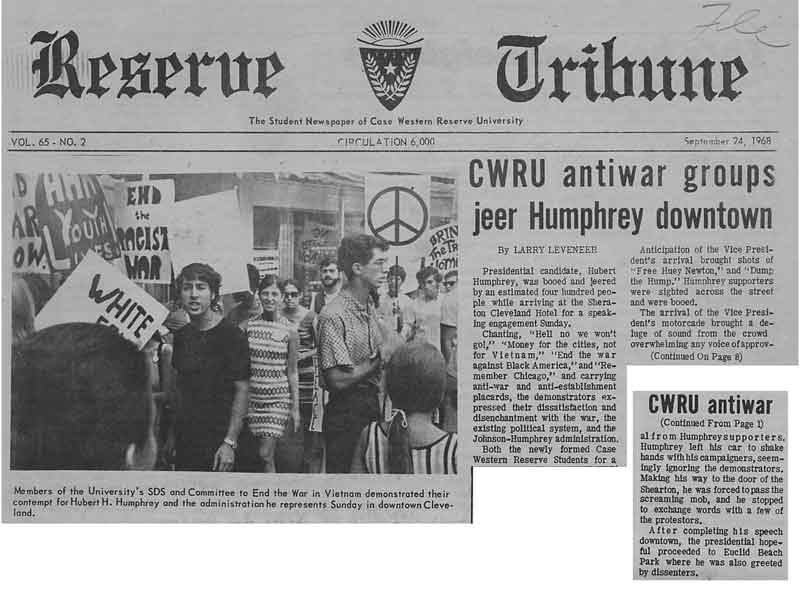
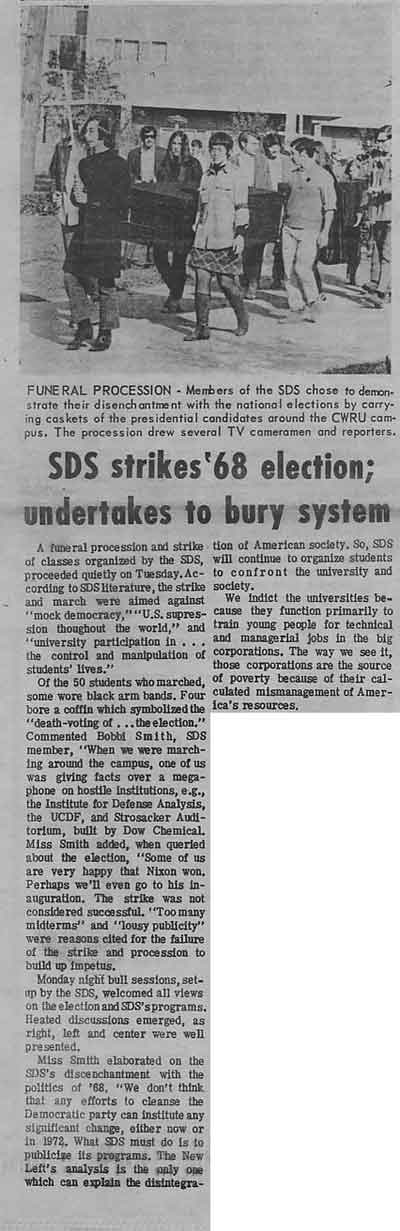
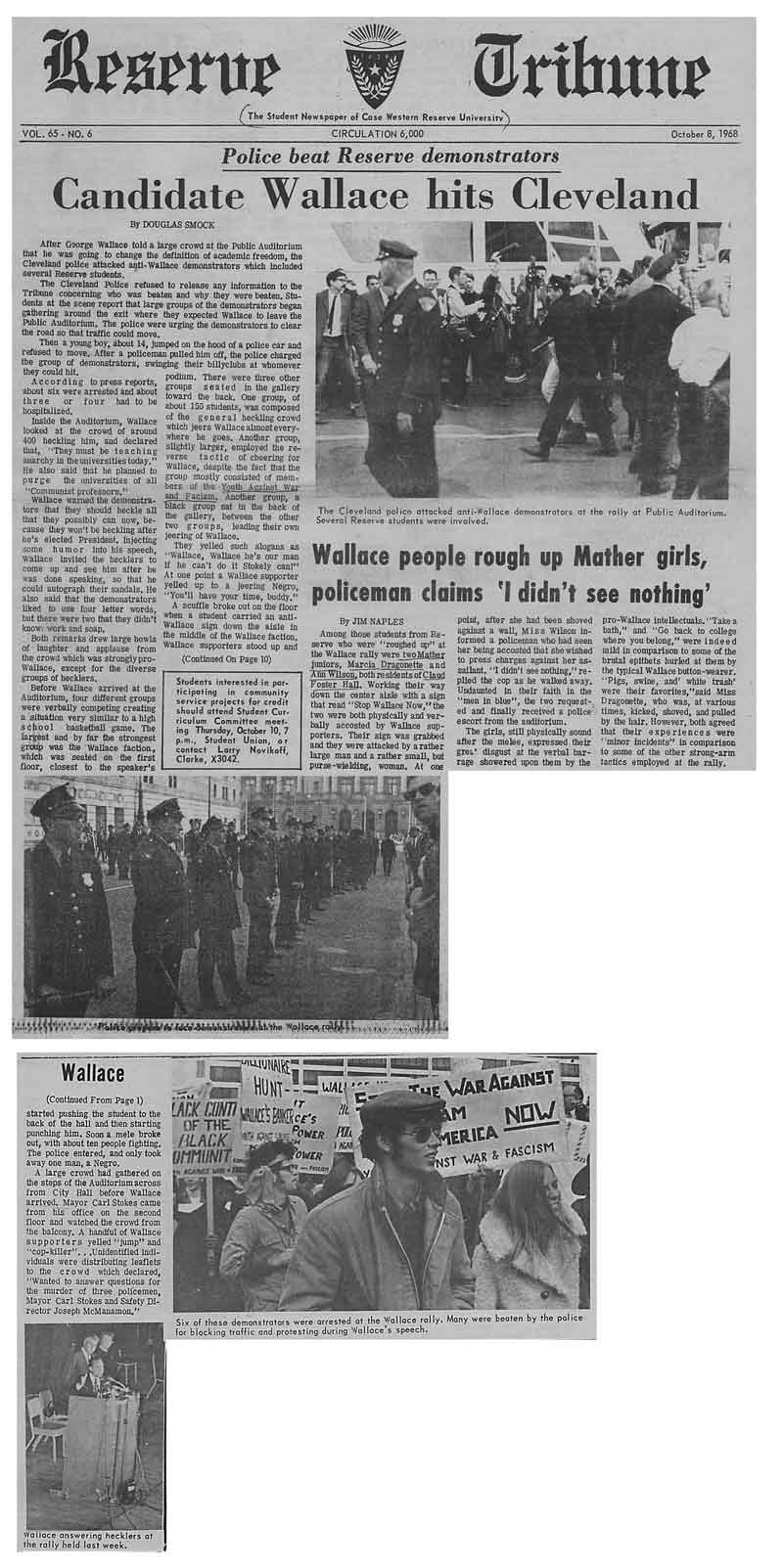
Students demonstrated, picketed, and heckled during Cleveland appearances by Hubert Humphrey (D), George C. Wallace (American Independent), and Richard M. Nixon (R). “They must be teaching anarchy in the universities today,” was Wallace’s response to hecklers. On November 1, Students for a Democratic Society (SDS) protested the presidential election. Carrying two caskets, meant to symbolize the Democratic and Republican parties, they expressed their disenchantment with the national elections.
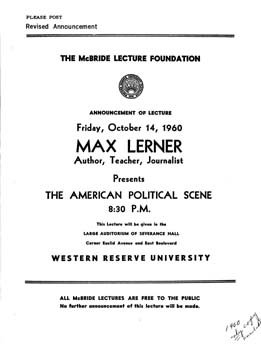
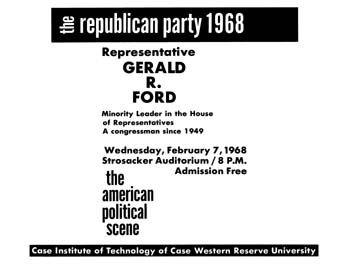
Congressman (and future president) Gerald R. Ford gave a lecture on "The American Political Scene."
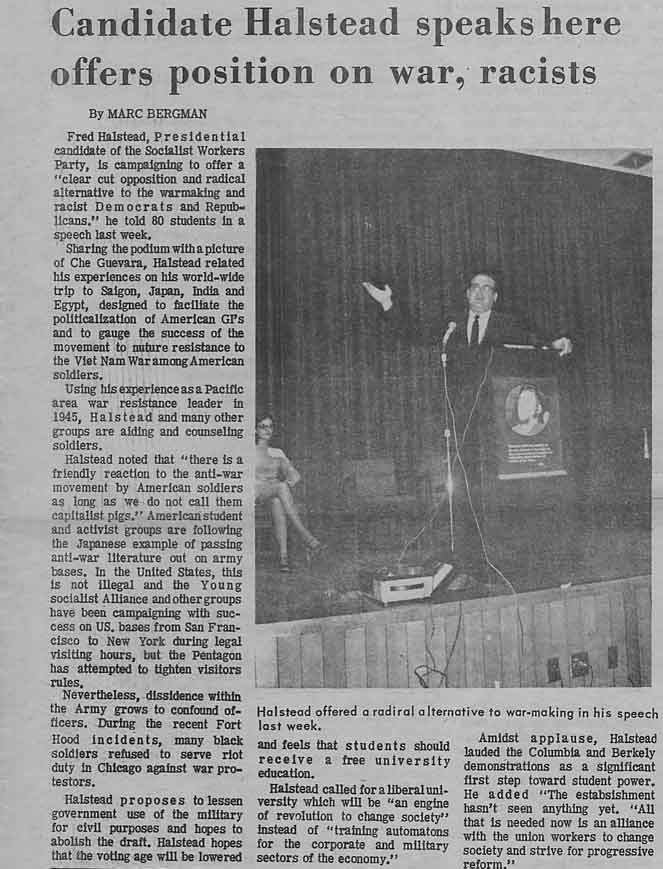
Socialist Workers Party presidential candidate Fred Halstead spoke on campus.
Students protested at an appearance by Vice President Humphrey in downtown Cleveland.
Members of SDS protested the 1968 election with a mock funeral procession.
Anti-Wallace demonstrators were attacked and arrested during a George Wallace rally at Cleveland's Public Auditorium. Several Mather students were assaulted.Ohio Popular Vote
National Popular Vote
Electoral Vote
Richard M. Nixon (R)
1,791,014 (45.2%)
Hubert H. Humphrey (D)
1,700,586 (43%)
George C. Wallace (American Independent)
467,495 (11.8%)
Dick Gregory (Peace and Freedom)
372
Henning A. Blomen (Socialist Labor)
120
Fred Halstead (Socialist Workers)
69
Charlene Mitchell
(Communist)
23
E. Harold Munn
(Prohibition)
19Richard M. Nixon (R)
31,785,148 (43.42%)
Hubert H. Humphrey (D)
31,274,503 (42.72%)
George C. Wallace (American Independent)
9,901,151 (13.53%)
Henning A. Blomen (Socialist Labor)
52,591 (0.07%)
Dick Gregory (Peace and Freedom)
47,097 (0.06%)
Fred Halstead (Socialist Workers)
41,390 (0.06%)
E. Harold Munn (Prohibition)
14,915 (0.02%)
Charlene Mitchell (Communist)
1,076Richard M. Nixon (R)
301
Hubert H. Humphrey (D)
191
George C. Wallace (American Independent)
46Information was compiled by staff of the Case Western Reserve University Archives, September 2004.
-
1
2026-03-31T20:12:50+00:00
2004: The Race at Case
8
Campaigning at CWRU: Presidential Elections, 2004: The Race at Case
plain
2026-04-23T14:28:33+00:00
2004
Information was compiled by staff of the Case Western Reserve University Archives, October 2008.
2004
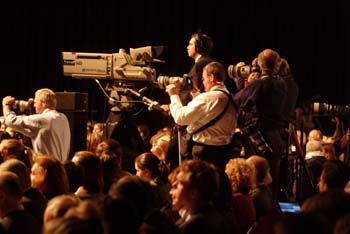
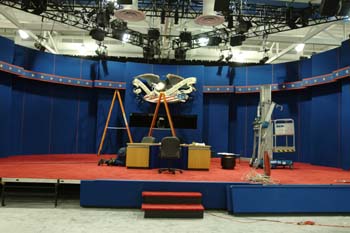
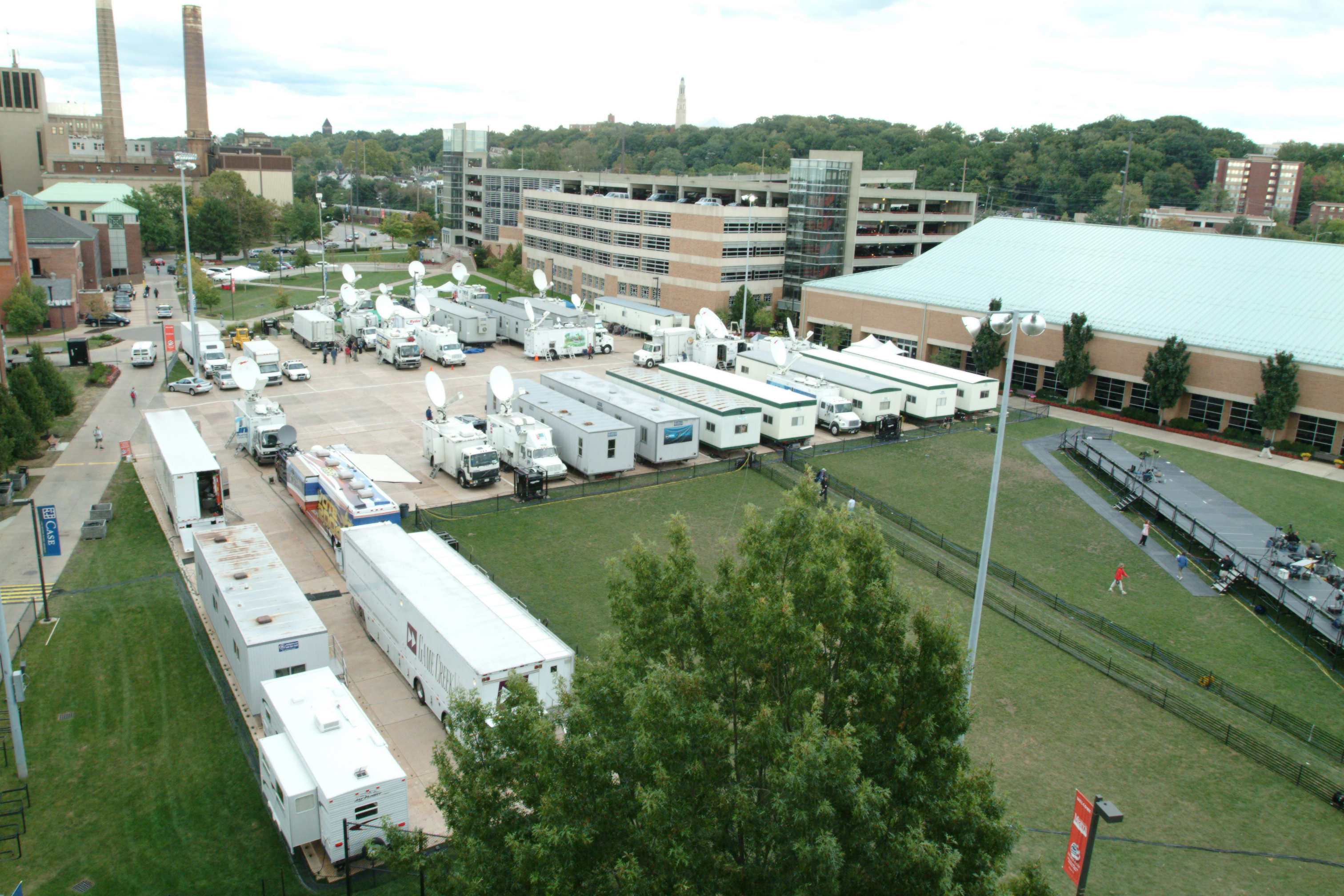
On October 5, 2004, CWRU hosted the Vice Presidential debate. About 1,500 media representatives covered the debate, which was seen by approximately 64 million TV viewers. More than 300 volunteers participated. Panel discussions, protests, parody, and parties were among the events surrounding the debate.
Republican candidate Dick Cheney and Democratic candidate John Edwards with moderator Gwen Ifill.
CWRU played host to extensive media coverage of the debate.
Preparations for the debate began weeks ahead of October 5.
Van Horn Field was used as a staging area for media trucks.Ohio Popular Vote
National Popular Vote
Electoral Vote
George W. Bush (R)
2,859,768 (50.81%)
John F. Kerry (D)
2,741,167 (48.71%)
Michael Badnarik (Libertarian)
14,676 (0.26%)
Michael A. Peroutka (Constitution)
11,939 (0.21%)George W. Bush (R)
62,040,610 (50.73%)
John F. Kerry (D)
59,028,444 (48.27%)
Michael Badnarik (Libertarian)
397,265 (0.32%)
Michael A. Peroutka (Constitution)
143,630 (0.12%)George W. Bush (R)
286
John F. Kerry (D)
251Information was compiled by staff of the Case Western Reserve University Archives, October 2008.
-
1
2026-03-31T19:34:59+00:00
1972: The Youth Vote
8
Campaigning at CWRU: Presidential Elections, 1972: The Youth Vote
plain
2026-04-23T13:44:38+00:00
1972
Information was compiled by staff of the Case Western Reserve University Archives, September 2004.
1972
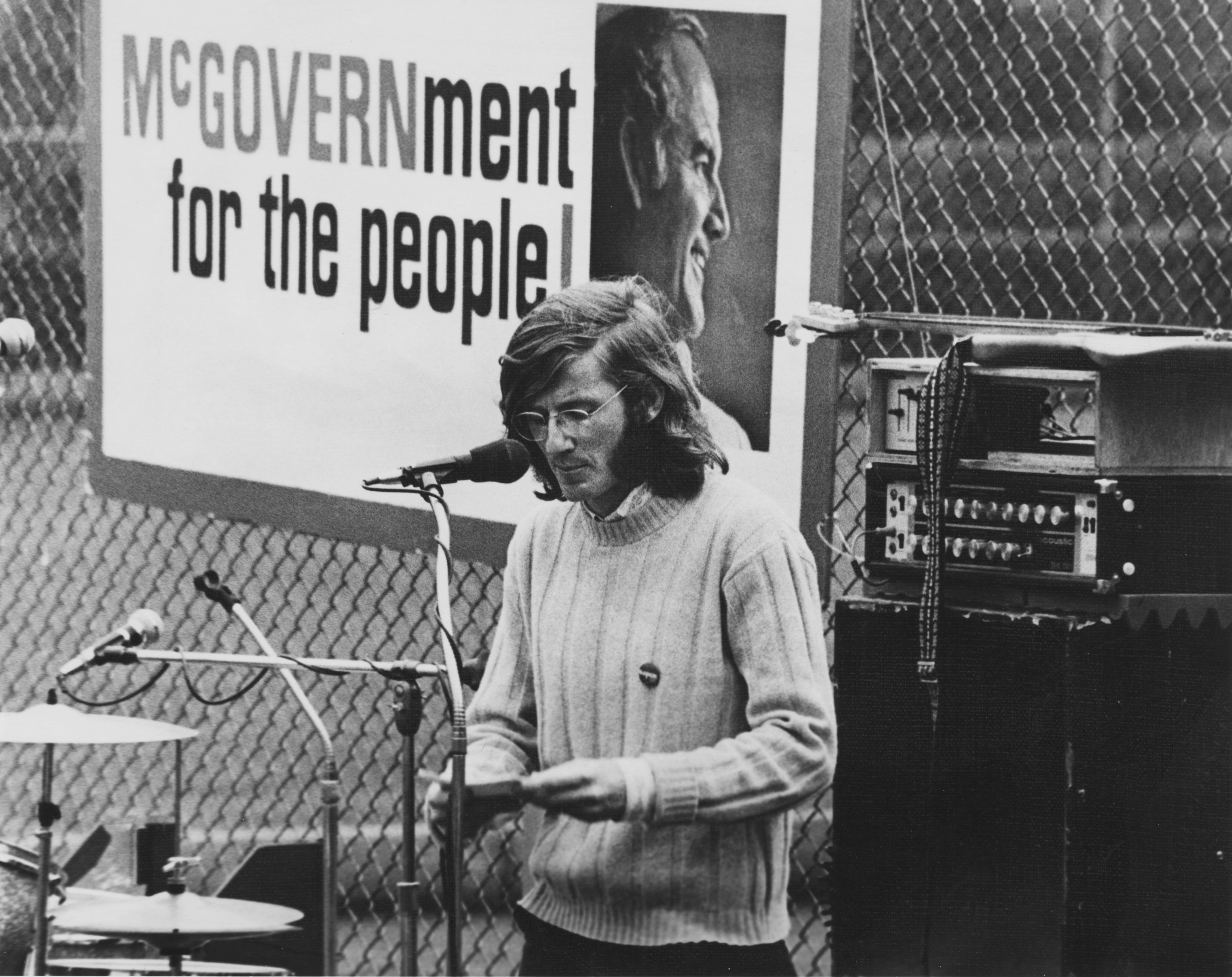
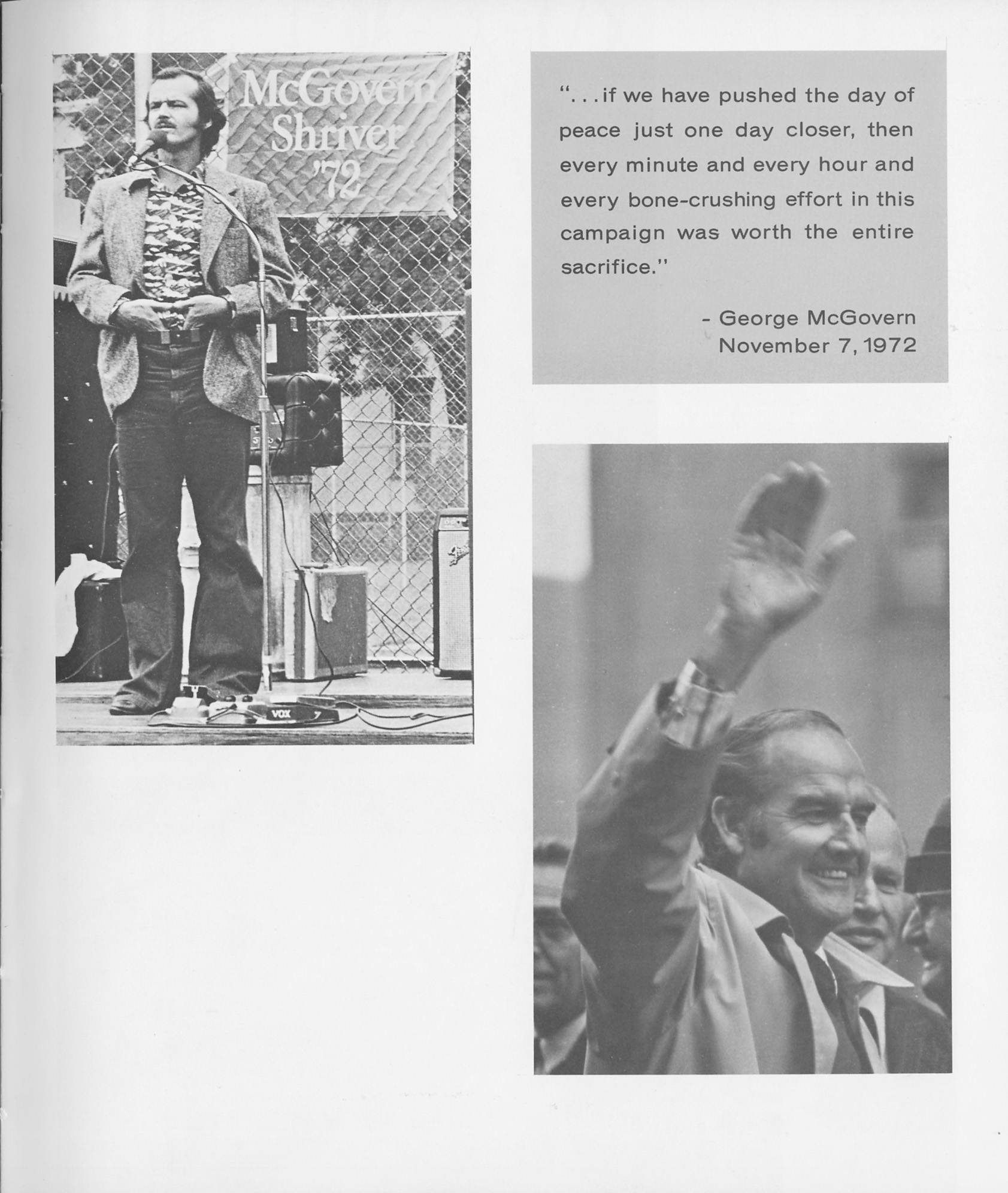
The Twenty-sixth Amendment to the U.S. Constitution enfranchised 18-to-20 year-olds. CWRU Students for McGovern sought donations for window cards, to be put in the windows of student dormitory rooms. Former faculty member (School of Medicine 1955-1965) Dr. Benjamin Spock, was the presidential candidate of the People’s Party.
A rally for McGovern was held on campus (below).
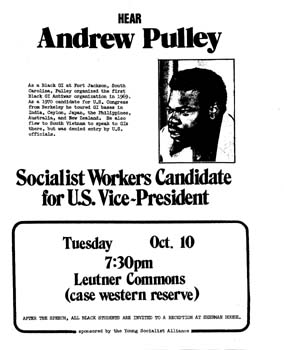
Socialist Workers vice presidential candidate Andrew Pulley spoke on campus.
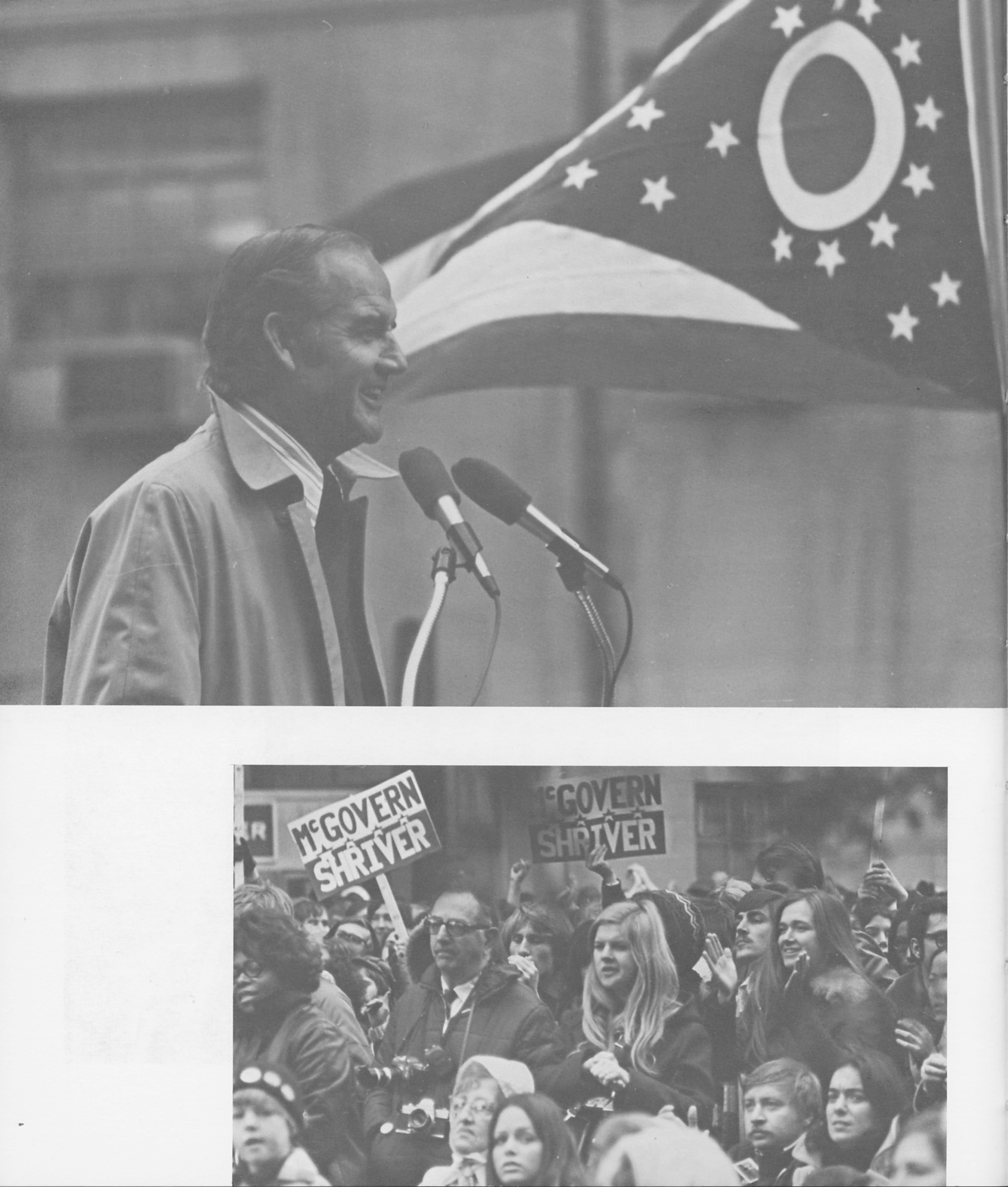
The student yearbook featured coverage of the McGovern visit to Cleveland State University. Actor Jack Nicholson also visited the CWRU campus in support of McGovern.
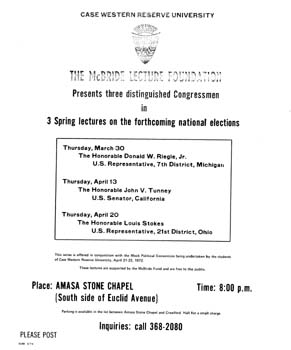
The University sponsored lectures by three distinguished congressmen.
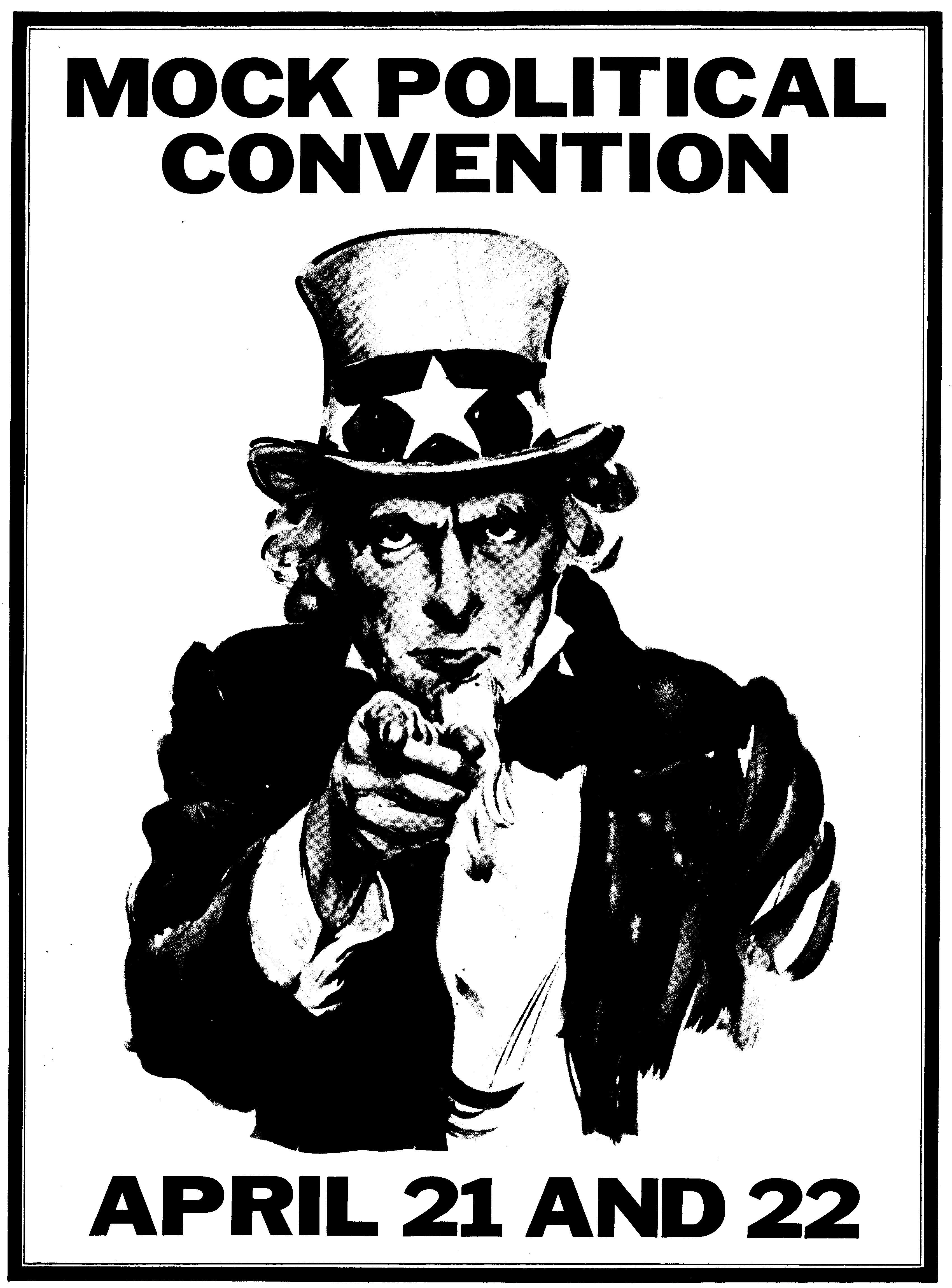
The mock political convention was held once again.Ohio Popular Vote
National Popular Vote
Electoral Vote
Richard M. Nixon (R)
2,441,827 (59.6%)
George S. McGovern (D)
1,558,889 (38.1%)
John G. Schmitz
(American Independent)
80,067 (2%)
Louis Fisher
(Socialist Workers)
7,107 (0.2%)
Gus Hall (Communist)
6,437 (0.2%)
Edward A. Wallace
460Richard M. Nixon (R)
47,170,179 (60.69%)
George S. McGovern (D)
29,171,791 (37.53%)
John G. Schmitz
(American Independent)
1,098,670 (1.4%)
Benjamin Spock
(People’s)
78,751 (0.1%)
Louis Fisher
(Socialist Workers)
53,811 (0.07%)
Gus Hall (Communist)
25,343 (0.03%)
Edward A. Wallace
460Richard M. Nixon (R)
520
George S. McGovern (D)
17
John Hospers (Libertarian)
1Information was compiled by staff of the Case Western Reserve University Archives, September 2004.
-
1
2026-03-31T15:33:47+00:00
1940: Speakers, Straw Votes and Polls
8
Campaigning at CWRU: Presidential Elections, 1940: Speakers, Straw Votes and Polls
plain
2026-04-23T19:23:13+00:00
1940
Information was compiled by staff of the Case Western Reserve University Archives, September 2004.
1940
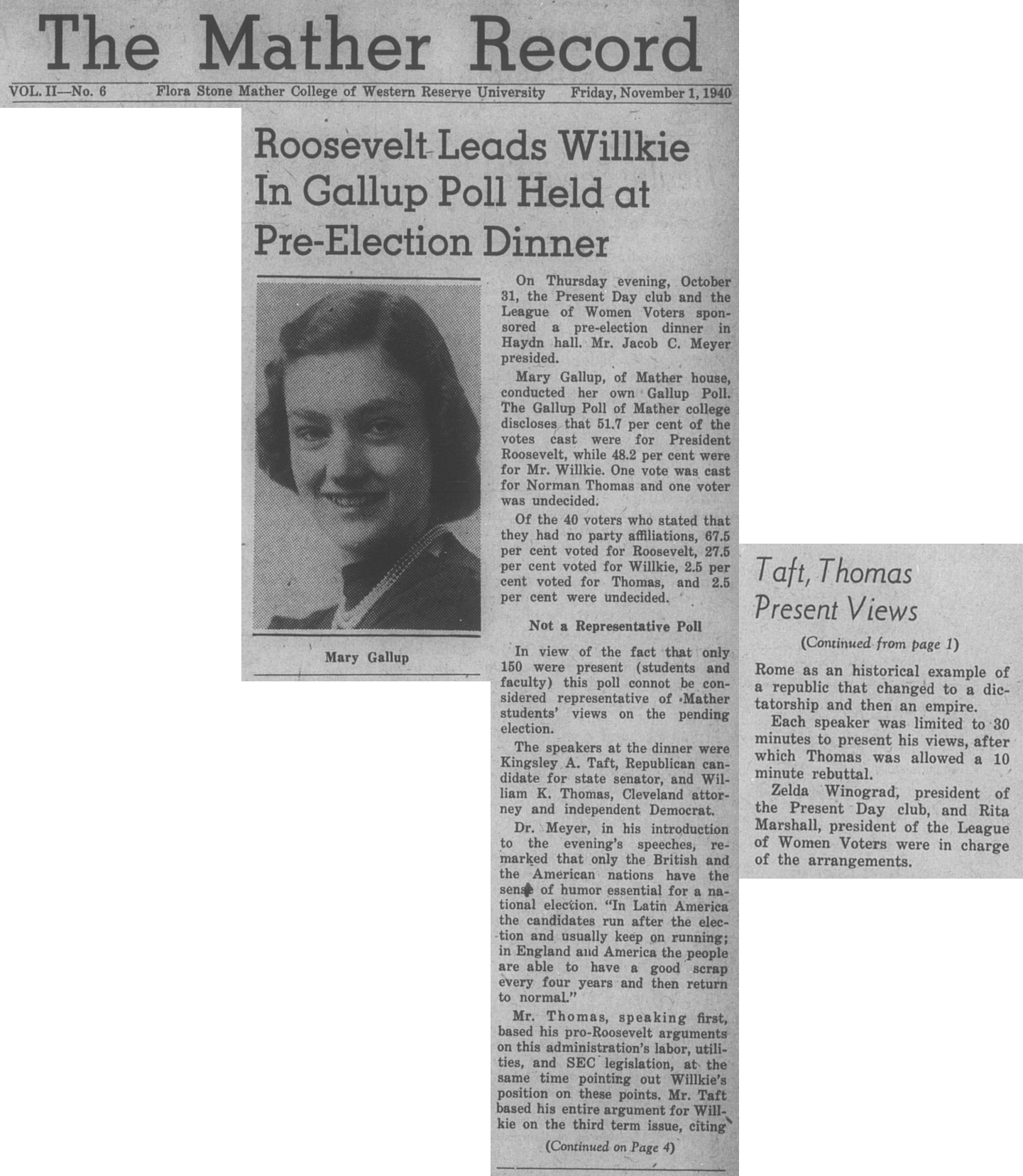
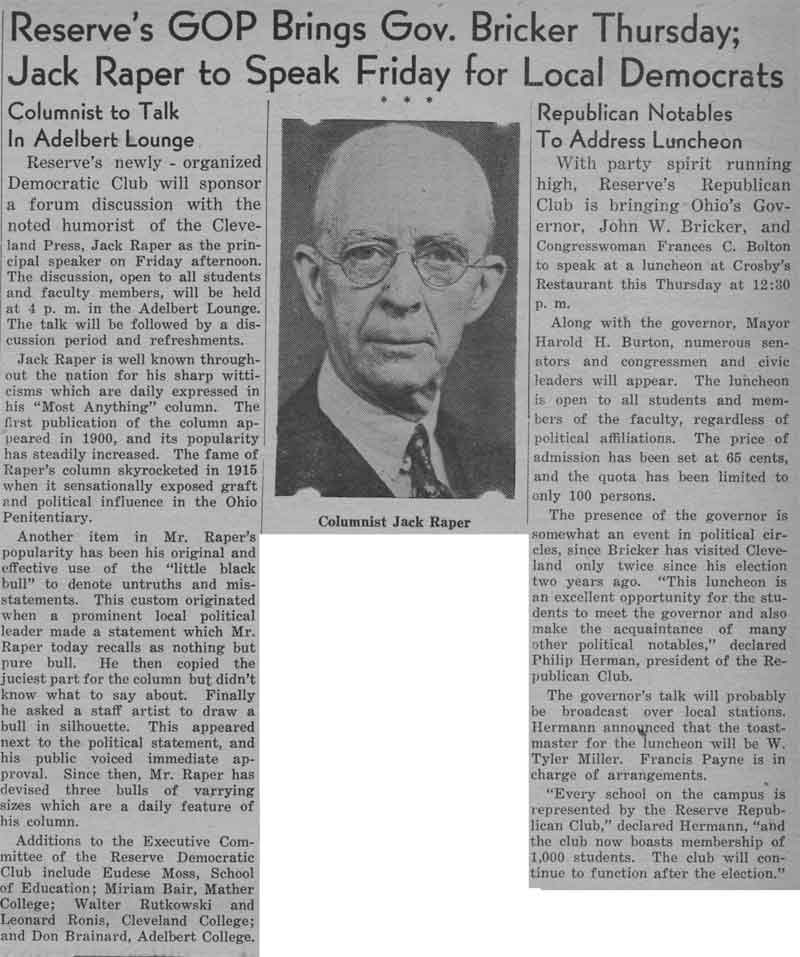
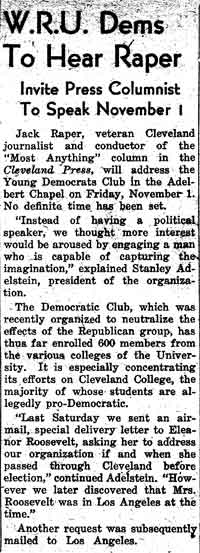
WRU’s Republican Club hosted an appearance by Ohio Governor John W. Bricker, Congresswoman Frances Bolton, and Cleveland Mayor Harold Burton. The Young Democrats explained their speaker choice, Cleveland columnist Jack Raper, “Instead of having a political speaker, we thought more interest would be aroused by engaging a man who is capable of capturing the imagination.”
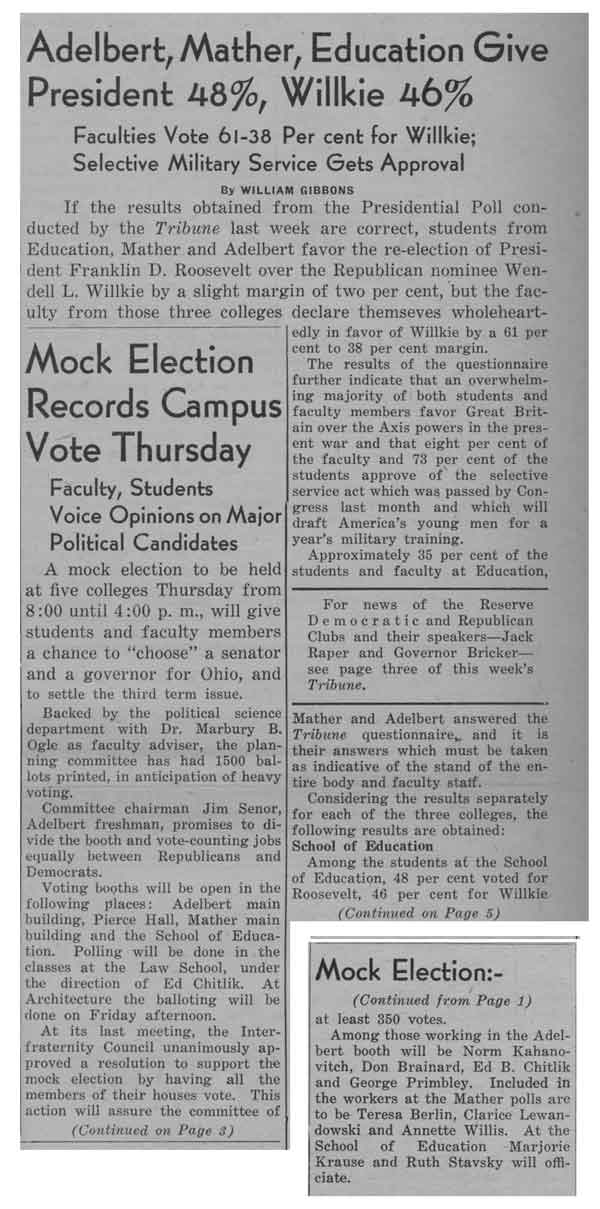
Roosevelt led Willkie in the "Gallup Poll" of Mather College 51% to 48%.
The poll conducted by The Reserve Tribune had Roosevelt lead Willkie 48% to 46%.
Cleveland journalist Jack Raper was principal speaker at a forum sponsored by the Democratic Club.Ohio Popular Vote
National Popular Vote
Electoral Vote
Franklin D. Roosevelt (D)
1,733,139 (52.2%)
Wendell Willkie (R)
1,586,773 (47.8%)Franklin D. Roosevelt (D)
27,263,448 (54.7%)
Wendell Willkie (R)
22,336,260 (44.82%)
Norman M. Thomas (Socialist)
116,827 (0.23%)
Roger W. Babson (Prohibition)
58,685 (0.12%)Franklin D. Roosevelt (D)
449
Wendell Willkie (R)
82Information was compiled by staff of the Case Western Reserve University Archives, September 2004.
-
1
2026-03-31T19:42:53+00:00
1980: Cleveland’s Presidential Debate
8
Campaigning at CWRU: Presidential Elections, 1980: Cleveland’s Presidential Debate
plain
2026-04-23T14:04:21+00:00
1980
Information was compiled by staff of the Case Western Reserve University Archives, September 2004.
1980
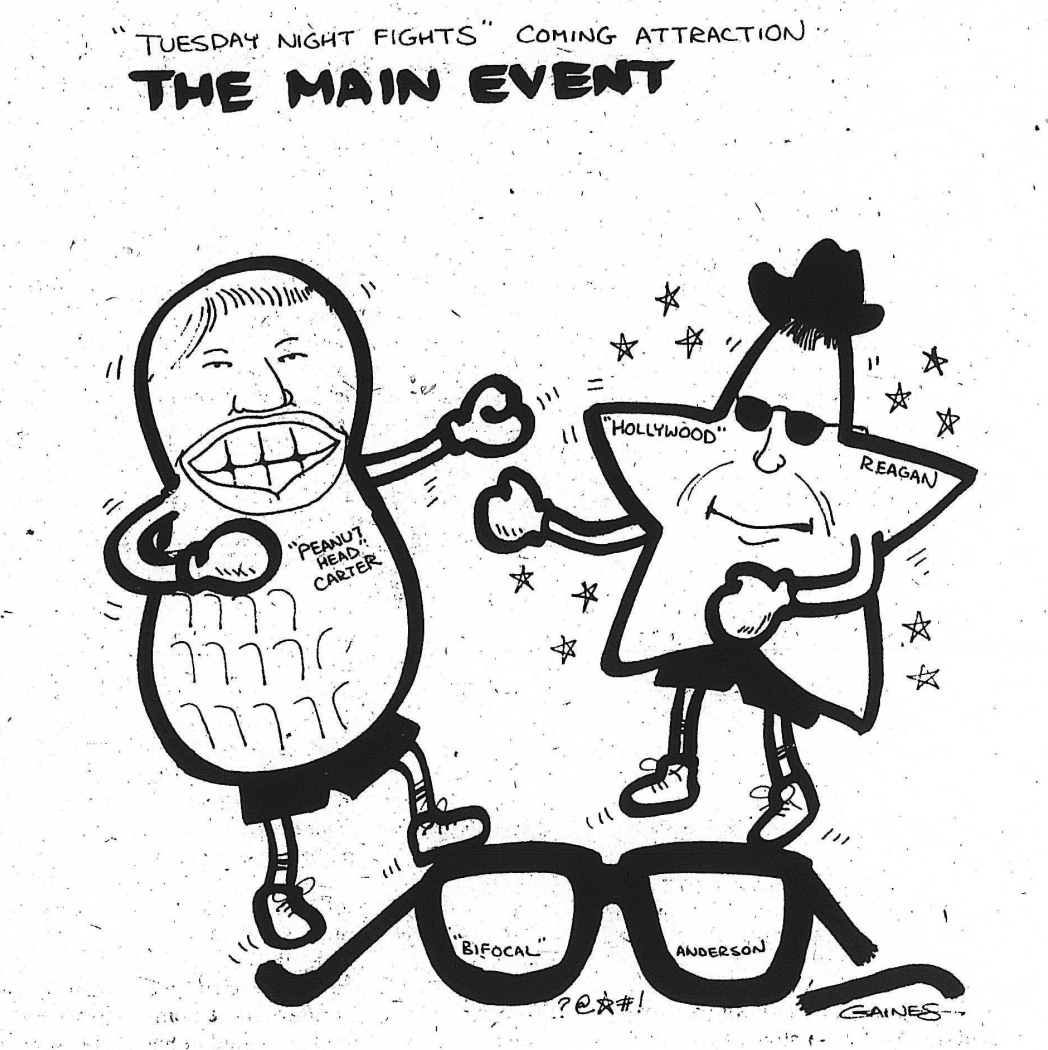
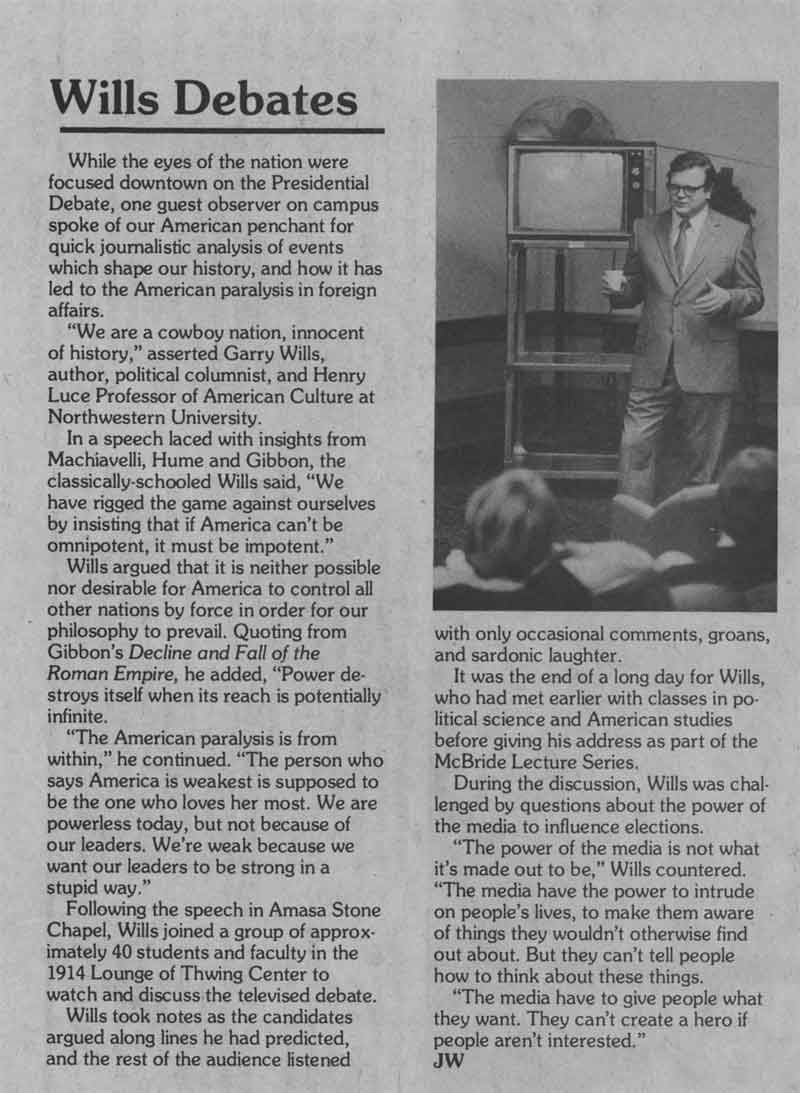
The Observer’s News Editor Mary Jones’ description of the 1980 Ronald Reagan-Jimmy Carter presidential debate in Cleveland suggests what is in store for the campus on October 5. Photo Editor Wei-Shen Chin opined, “covering the Presidential debates as photo editor of our nationally known publication has certain … well … minor difficulties. You see, there are still some Secret Service personnel in this modern age of satellite communications that haven’t heard of The Observer… so I told them I was from the PD.”
In a nod to the presidential debate held in Cleveland, the student newspaper has some fun.
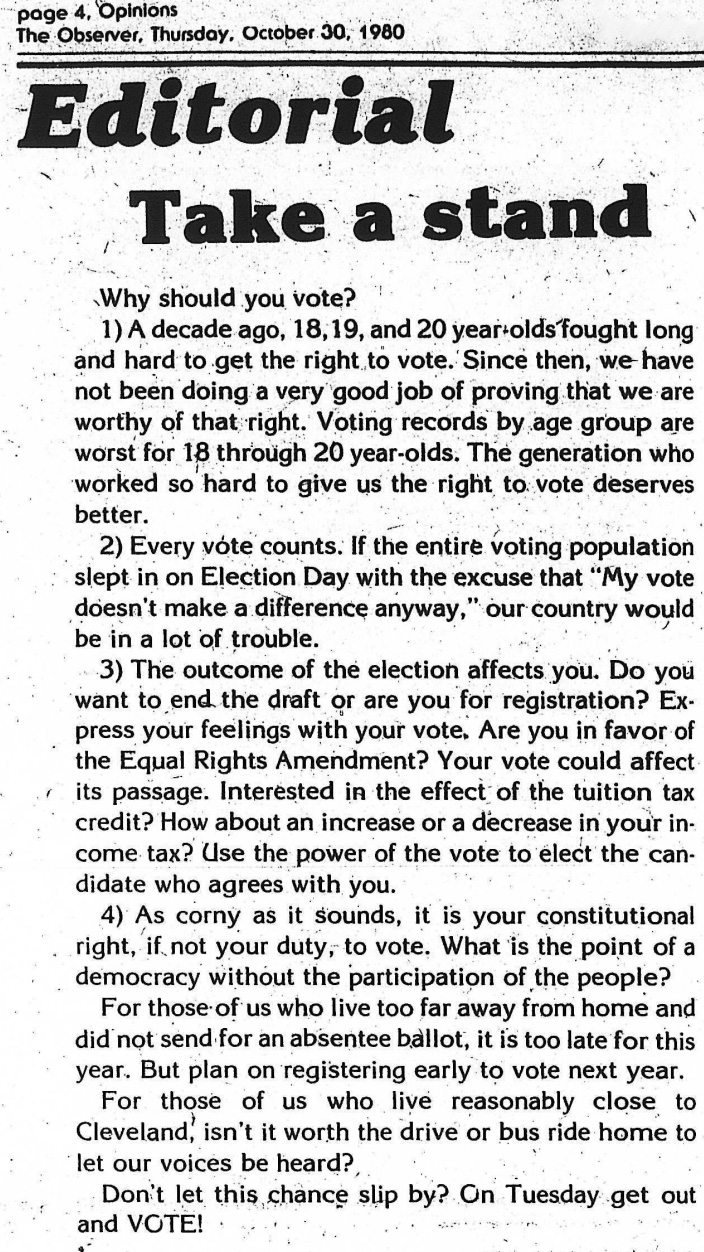
An editorial in the student newspaper urges students to vote.
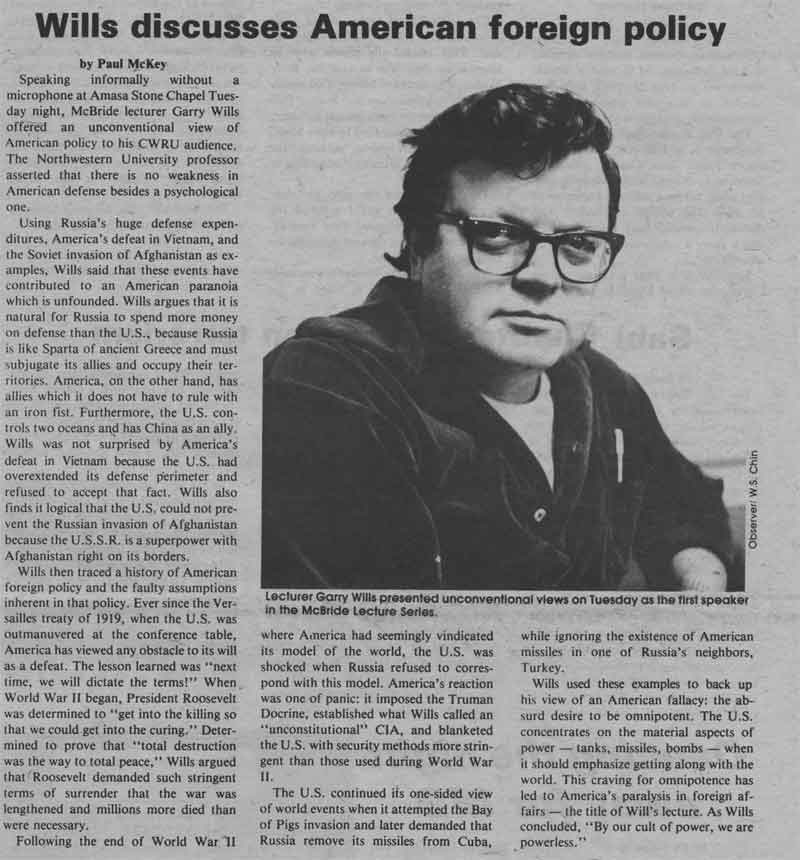
Northwestern University professor and political scientist Garry Wills lectured on campus, and watched and analyzed the Cleveland presidential debate with students.Ohio Popular Vote
National Popular Vote
Electoral Vote
Ronald Reagan (R)
2,206,545 (51.5%)
Jimmy Carter (D)
1,752,414 (40.9%)
John B. Anderson
(National Unity Campaign)
254,472 (5.9%)
Ed Clark (Libertarian)
49,033 (1.1%)
Barry Commoner (Citizens)
8,564 (0.2%)
Richard Congress
(Socialist Workers)
4,029 (0.1%)
Deirdre Griswold
(Workers World)
3,790 (0.1%)
Benjamin C. Bubar
(Statesman)
27Ronald Reagan (R)
43,904,153 (50.7%)
Jimmy Carter (D)
35,483,883 (41%)
John B. Anderson
(National Unity Campaign)
5,720,060 (6.6%)
Ed Clark (Libertarian)
921,299 (1.1%)
Barry Commoner (Citizens)
234,294 (0.3%)
Deirdre Griswold
(Workers World)
13,300 (0.02%)
Benjamin C. Bubar (Statesman)
7,212 (0.01%)
Richard Congress
(Socialist Workers)
4,029Ronald Reagan (R)
489
Jimmy Carter (D)
49Information was compiled by staff of the Case Western Reserve University Archives, September 2004.
-
1
2026-03-31T15:30:45+00:00
1936: Political Satire
7
Campaigning at CWRU: Presidential Elections, 1936: Political Satire
plain
2026-04-23T13:30:04+00:00
1936
Information was compiled by staff of the Case Western Reserve University Archives, September 2004.
1936
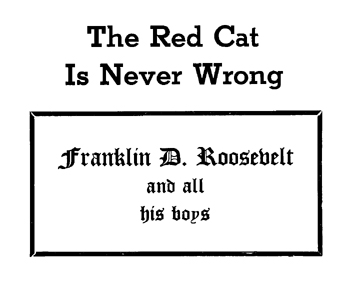
The WRU humor magazine, The Red Cat, published an election issue featuring a two-page “interview” with candidates Alfred M. Landon (R) and Franklin D. Roosevelt (D). Reporter George Klein described his strategy for getting one-on-one interviews with candidates. “Didn’t have much trouble getting to see the Republican candidate, ‘Happy” Landing. Just wrote him a diplomatic note like this: Dear Alf, Like to have a talk with you. Think I can do you some good! Yours, Red Porter, Red Cat, Star Reporter … At the White House I have a little trouble. The guards won’t believe who I am. But just as they’re about ready to bounce me, F. D. sticks his head out of one of the west wing windows and yells, ‘Hey, Red, come on up.”
The WRU humor publication, The Red Cat, featured predictions on the election results; covering all bases, both Landon and Roosevelt were picked as winners.
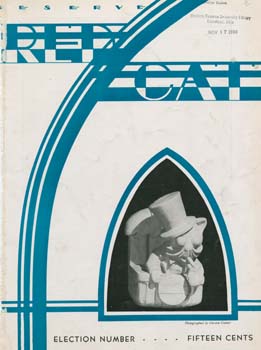
The cover of The Red Cat featured a caricature of Roosevelt.
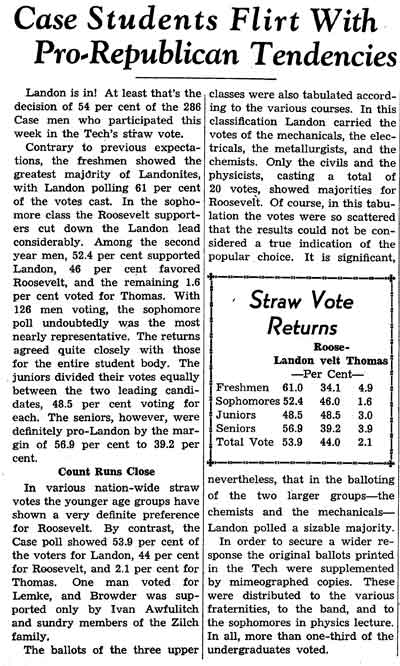
Alf Landon won the straw vote at Case.
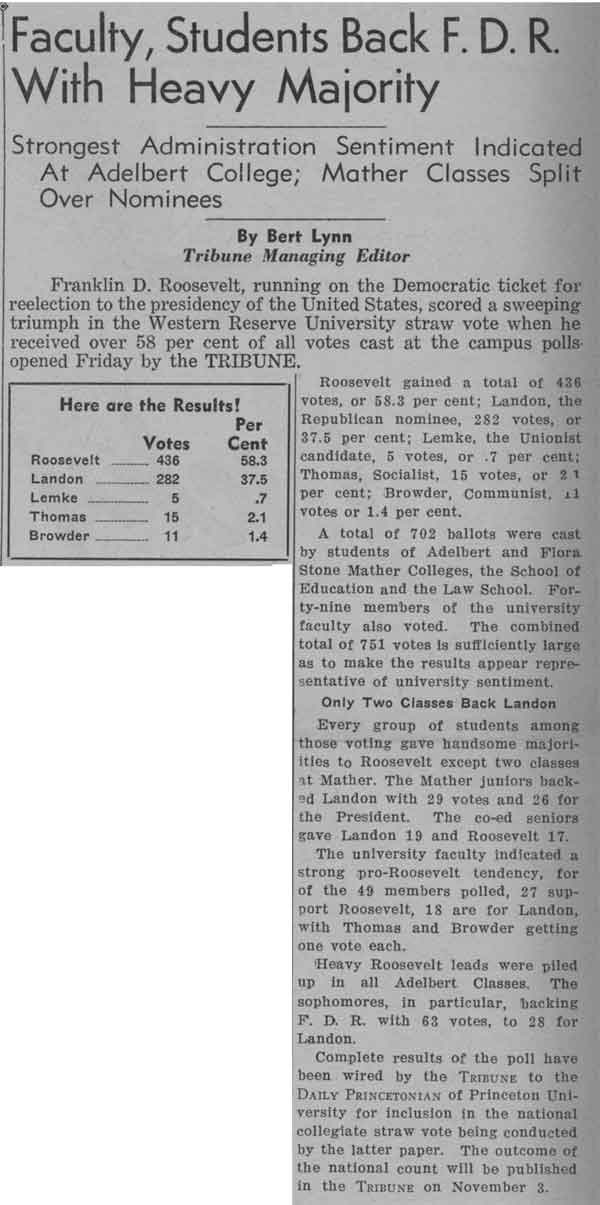
Roosevelt won the straw vote at WRU.Ohio Popular Vote
National Popular Vote
Electoral Vote
Franklin D. Roosevelt (D)
1,747,140 (58%)
Alfred M. Landon (R)
1,127,855 (37.4%)
William Lemke (Union)
132,212 (4.4%)
Earl Russell Browder (Communist)
5,251 (0.2%)Franklin D. Roosevelt (D)
27,747,636 (60.79%)
Alfred M. Landon (R)
16,679,543 (36.54%)
William Lemke (Union)
892,492 (1.96%)
Norman M. Thomas (Socialist)
187,785 (0.41%)
Earl Russell Browder (Communist)
79,211 (0.17%)Franklin D. Roosevelt (D)
523
Alfred M. Landon (R)
8Information was compiled by staff of the Case Western Reserve University Archives, September 2004.
-
1
2026-03-31T19:10:07+00:00
1944: Roosevelt
7
Campaigning at CWRU: Presidential Elections, 1944: Roosevelt
plain
2026-04-23T20:11:10+00:00
1944
Information was compiled by staff of the Case Western Reserve University Archives, September 2004.
1944
It was almost unanimous. WRU and Case students backed Franklin D. Roosevelt (D) in straw vote and survey. The national popular vote favored Roosevelt. But Ohio, barely, voted for Thomas E. Dewey (R).
Vice President Henry Wallace visited Cleveland and spoke with a Reserve Tribune reporter.
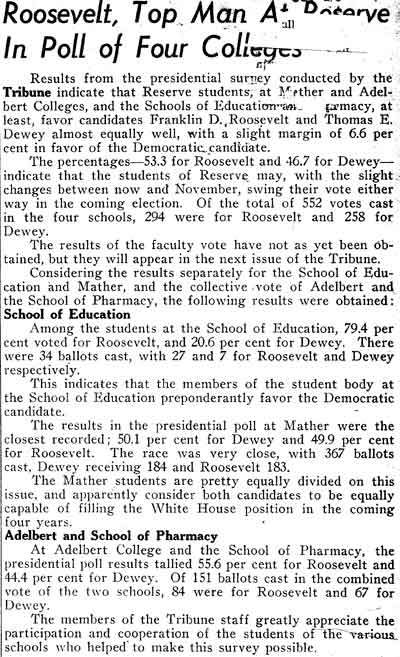
Survey results at four WRU schools favored Roosevelt for a fourth term.
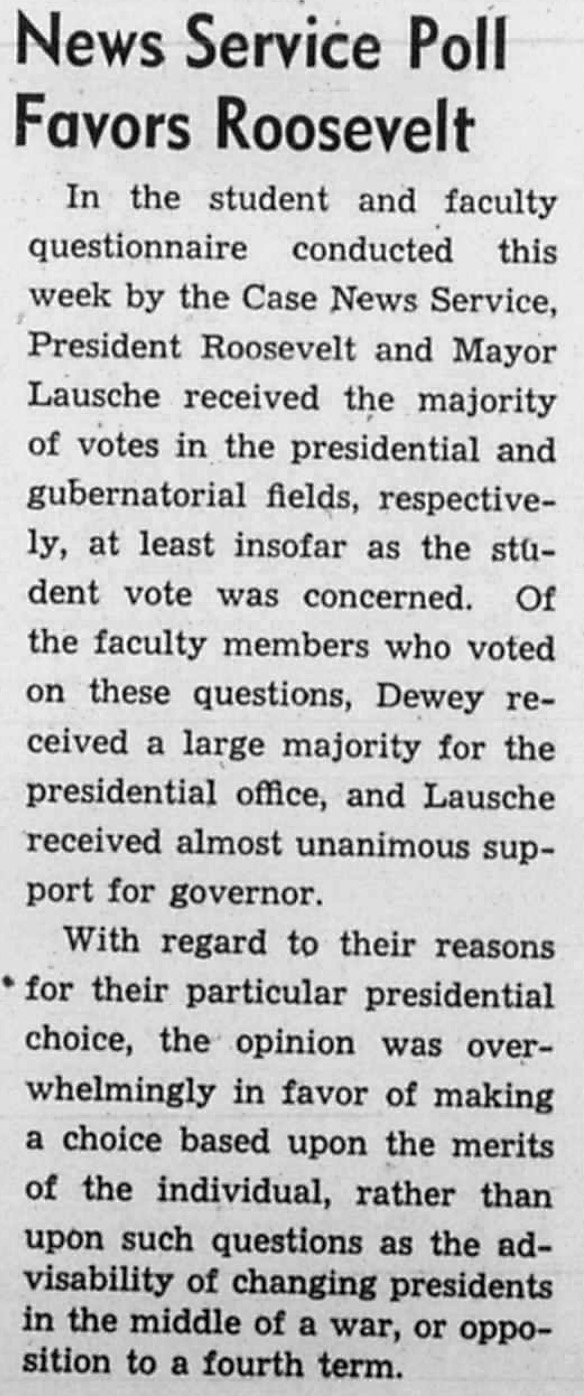
Students at Case favored Roosevelt, but faculty members favored Dewey.Ohio Popular Vote
National Popular Vote
Electoral Vote
Thomas E. Dewey (R)
1,582,293 (50.2%)
Franklin D. Roosevelt (D)
1,570,763 (49.8%)Franklin D. Roosevelt (D)
25,611,936 (53.39%)
Thomas E. Dewey (R)
22,013,372 (45.89%)
Norman M. Thomas (Socialist)
79,000 (0.16%)
Claude A Watson (Prohibition)
74,733 (0.16%)Franklin D. Roosevelt (D)
432
Thomas E. Dewey (R)
99Information was compiled by staff of the Case Western Reserve University Archives, September 2004.
-
1
2026-03-31T20:18:21+00:00
2008: First African-American President
7
Campaigning at CWRU: Presidential Elections, 2008: First African-American President
plain
2026-04-23T14:29:43+00:00
2008
Information was compiled by staff of the Case Western Reserve University Archives, October 2012.
2008
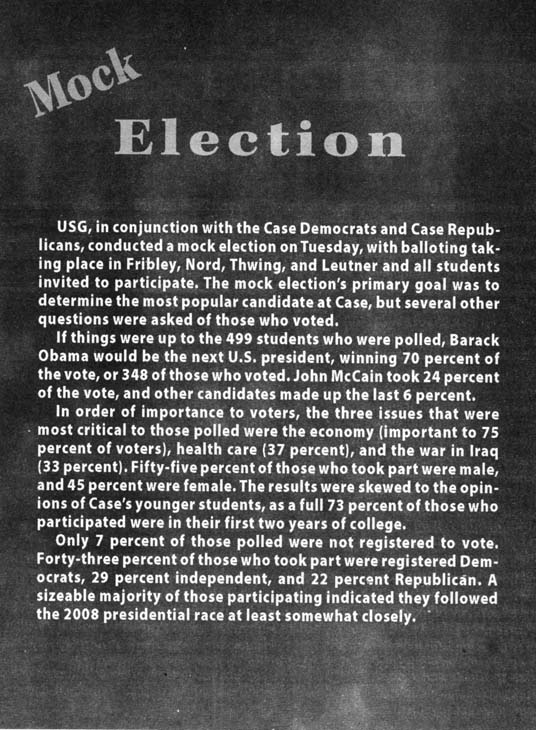
The election year saw many visits to Ohio by presidential candidates and their campaigns. Chelsea Clinton visited CWRU to speak about her mother, Democratic candidate Hilary Clinton. Cleveland State University hosted the final Democratic debate between Hilary Clinton and Barack Obama before the Ohio primary. The Case Republicans and Case Democrats sponsored a primary straw poll in the winter and a mock election in the fall.
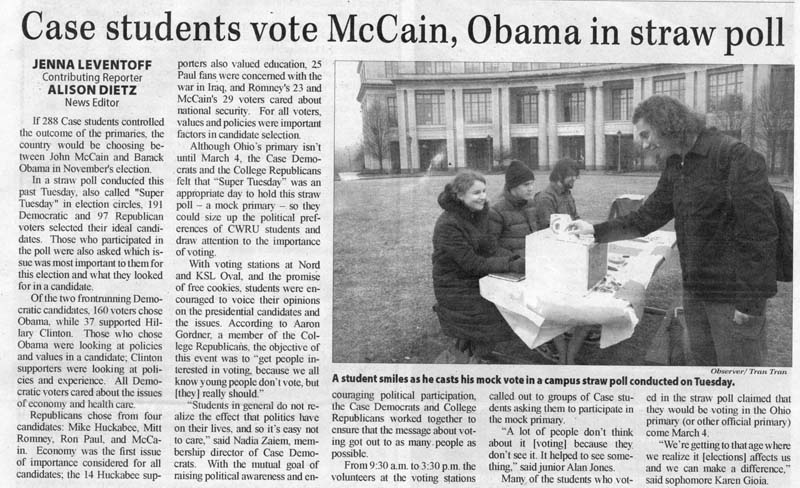
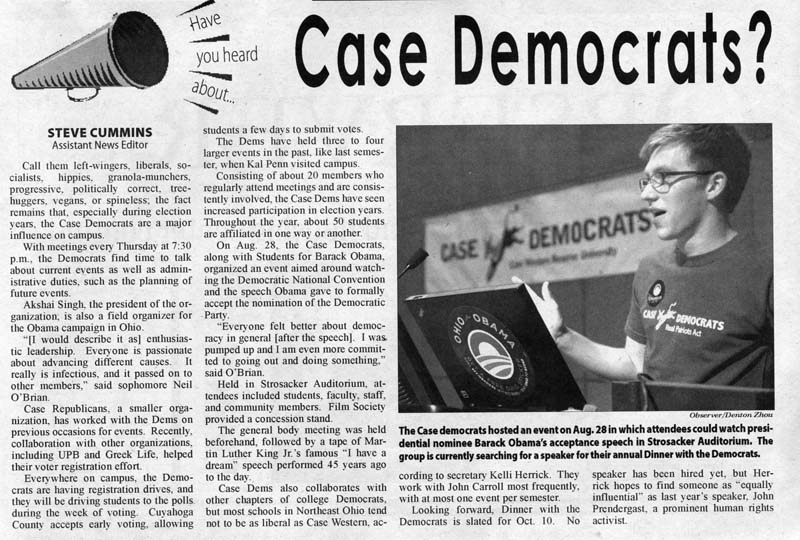
A straw poll conducted on "Super Tuesday" (2/5/2008), a month before the Ohio primary, saw the students select Barack Obama as the Democratic nominee and John McCain as the Republican nominee for president.
Case Democrats organized an event in Strosacker Auditorium to watch Barack Obama's acceptance speech at the Democratic National Convention.
In the fall mock election CWRU students correctly predicted the election of Barack Obama as president.Ohio Popular Vote
National Popular Vote
Electoral Vote
Barack Obama (D)
2,940,044 (51.50%)
John McCain (R)
2,677,820 (46.91%)
Ralph Nader (Independent)
42,377 (0.74%)
Bob Barr (Libertarian)
19,917 (0.35%)
Chuck Baldwin (Constitution) 12,565 (0.22%)
Cynthia McKinney (Green)
8,518 (0.15%)
Richard Duncan (Independent) 3,905 (0.07%)
Brian Moore (Socialist)
2,735 (0.05%)Barack Obama (D)
9,498,516 (52.93%)
John McCain (R)
59,948,323 (45.65%)
Ralph Nader (Independent)
739,034 (0.56%)
Bob Barr (Libertarian)
523,715 (0.40%)
Chuck Baldwin (Constitution) 199,750 (0.15%)
Cynthia McKinney (Green) 161,797 (0.12%)
Brian Moore (Socialist)
6,538
Richard Duncan (Independent) 3,905Barack Obama (D)
365
John McCain (R)
173Information was compiled by staff of the Case Western Reserve University Archives, October 2012.
-
1
2026-03-31T19:14:48+00:00
1952: Case Liked Ike, But Not Reserve
7
Campaigning at CWRU: Presidential Elections, 1952: Case Liked Ike, But Not Reserve
plain
2026-04-23T13:34:57+00:00
1952
Information was compiled by staff of the Case Western Reserve University Archives, September 2004.
1952
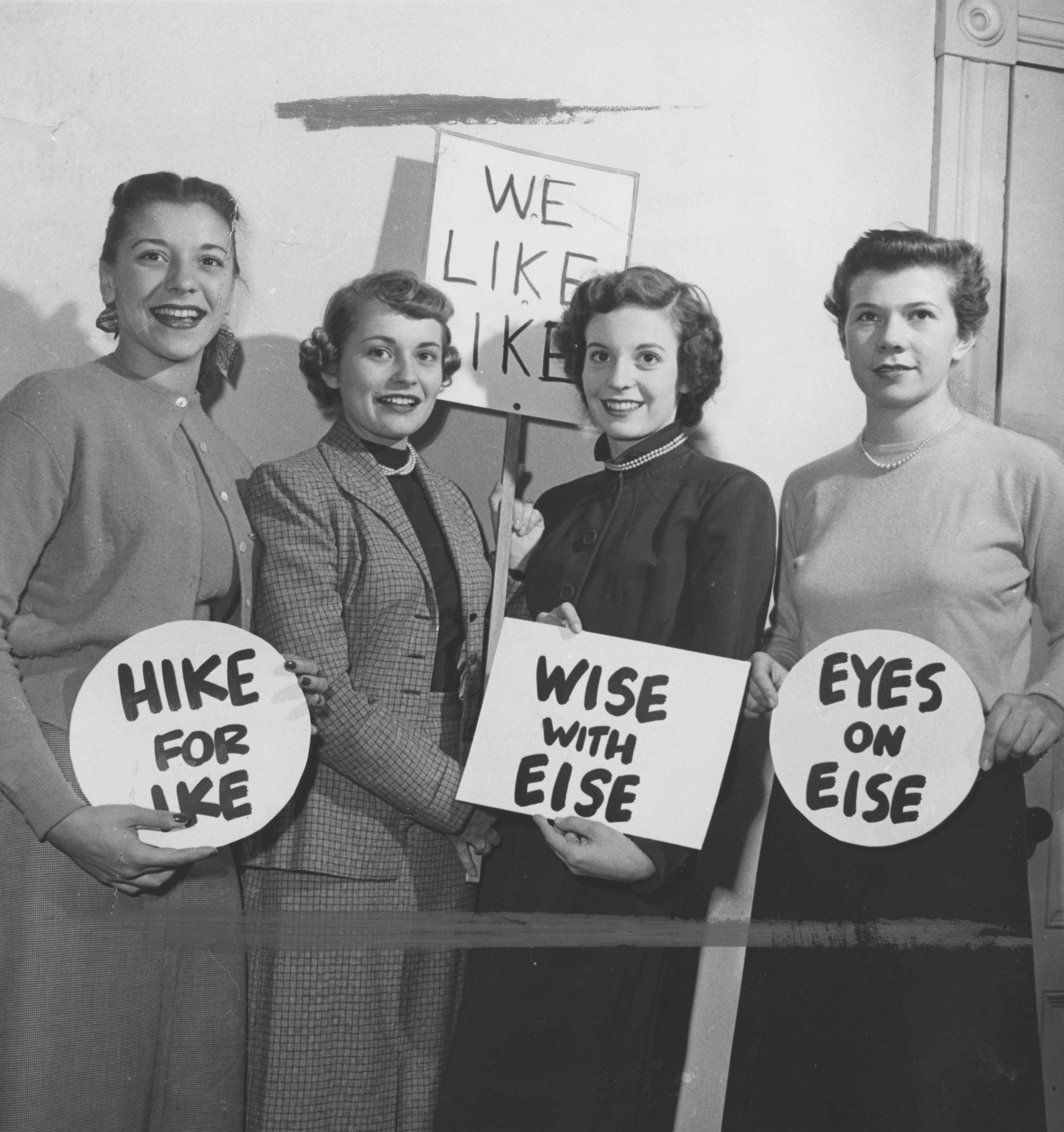
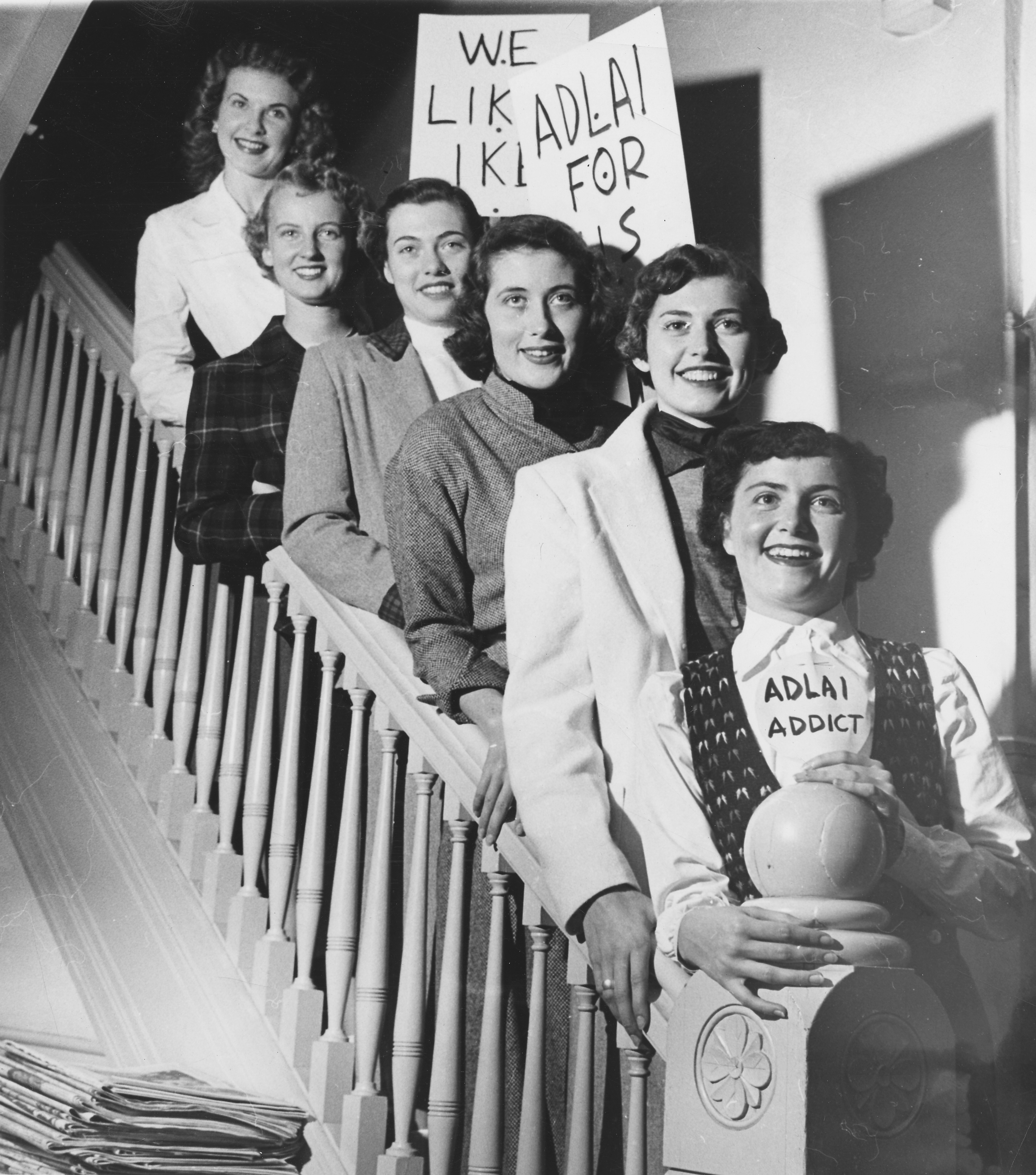
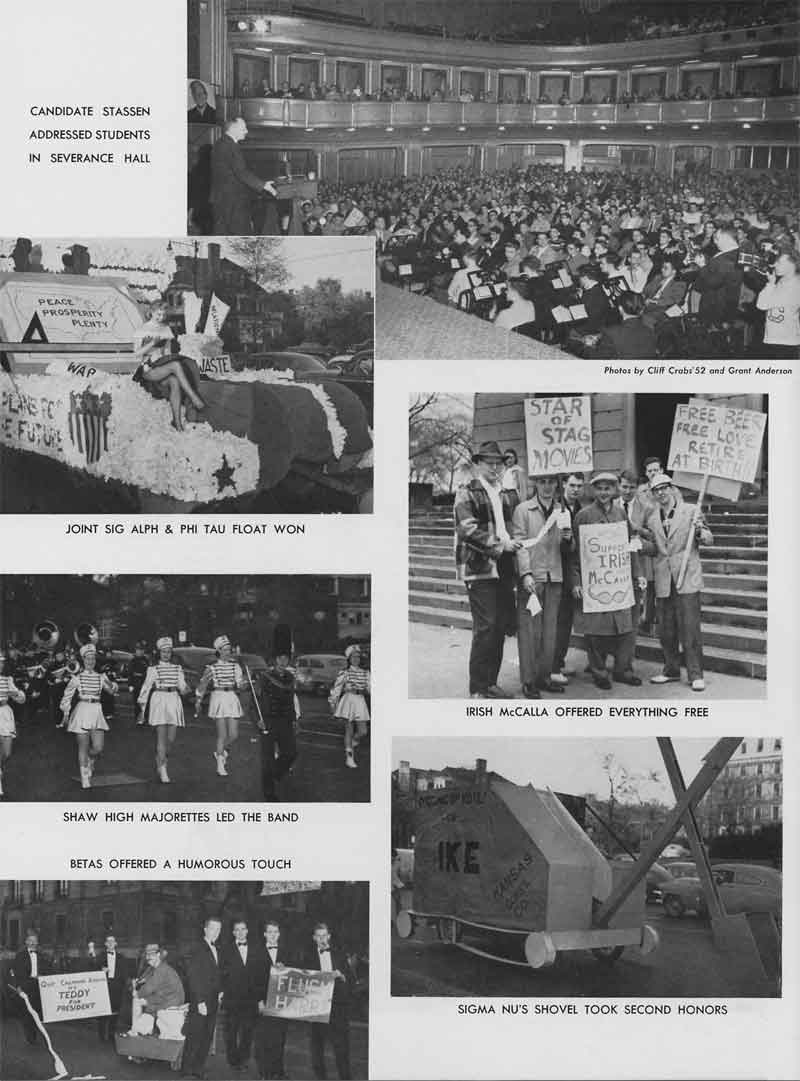
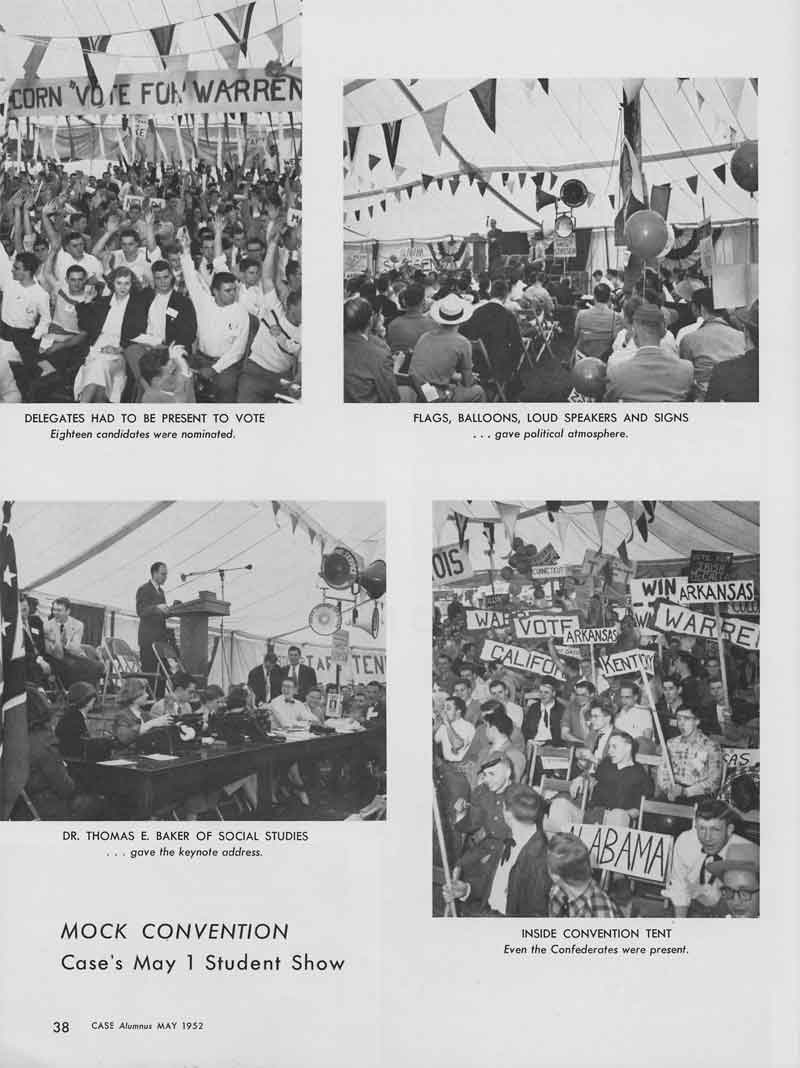
In an informal vote conducted by the Reserve Tribune, students were polled at the Eldred and Haydn Hall snack bars and the University Cafeteria. Democrat Adlai Stevenson received 164 votes, while Republican Dwight Eisenhower received 111. Case’s mock political convention went for Eisenhower. The then all-male Case undergraduate student body recruited faculty wives, college secretaries, and Lake Erie College students to serve as convention secretaries.
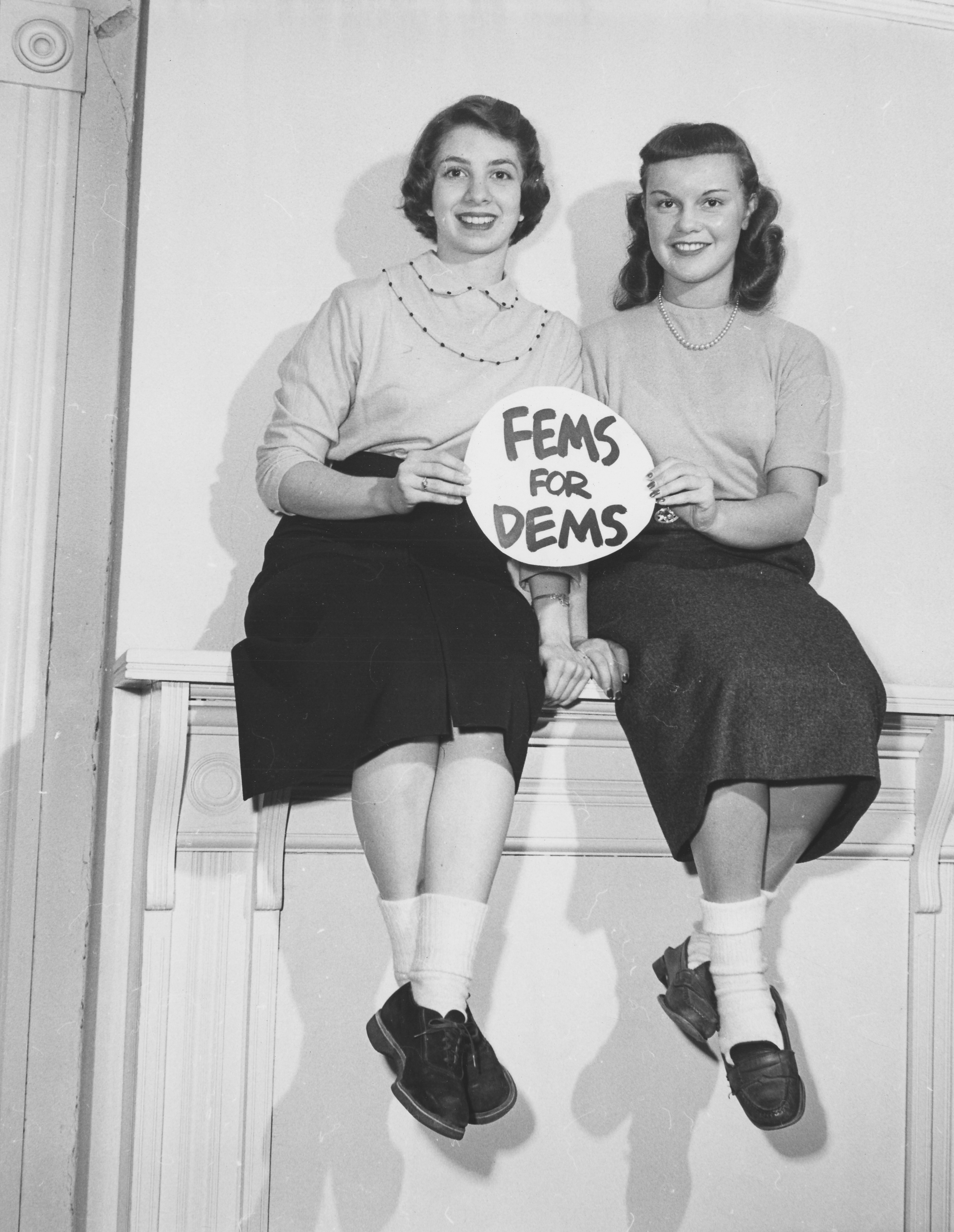
Women students show their support for the presidential candidates: Dwight D. Eisenhower and Adlai Stevenson.
Case Alumnus' May 1952 issue covered the Mock Political Convention - the parade, the speeches, the votes - reporting that 800 students participated.
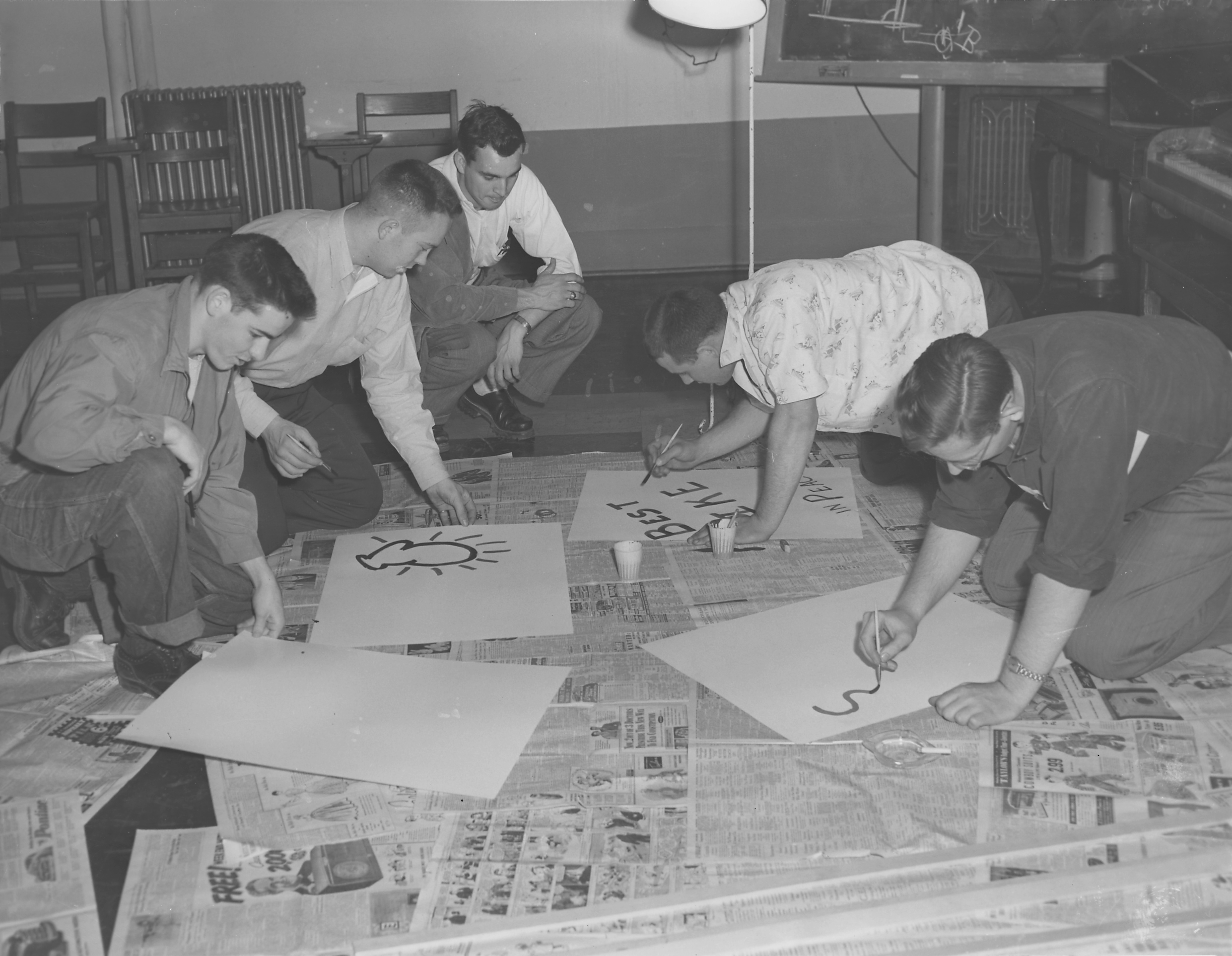
Students making signs for the Mock Political Convention (below).
More student support for Adlai Stevenson and the Democrats (below).Ohio Popular Vote
National Popular Vote
Electoral Vote
Dwight D. Eisenhower (R)
2,100,391 (56.8%)
Adlai E. Stevenson (D)
1,600,367 (43.2%)Dwight D. Eisenhower (R)
33,936,137 (55.13%)
Adlai E. Stevenson (D)
27,314,669 (44.38%)
Vincent Hallinan (Progressive) 140,416 (0.23%)
Stuart Hamblen (Prohibition) 73,413 (0.12%)Dwight D. Eisenhower (R)
442
Adlai E. Stevenson (D)
89Information was compiled by staff of the Case Western Reserve University Archives, September 2004.
-
1
2026-03-31T15:18:23+00:00
1924: “Fighting Bob” LaFollette and “Silent Cal” Coolidge
6
Campaigning at CWRU: Presidential Elections, 1924: “Fighting Bob” LaFollette and “Silent Cal” Coolidge
plain
2026-04-23T13:16:14+00:00
1924
Information was compiled by staff of the Case Western Reserve University Archives, September 2004.
1924
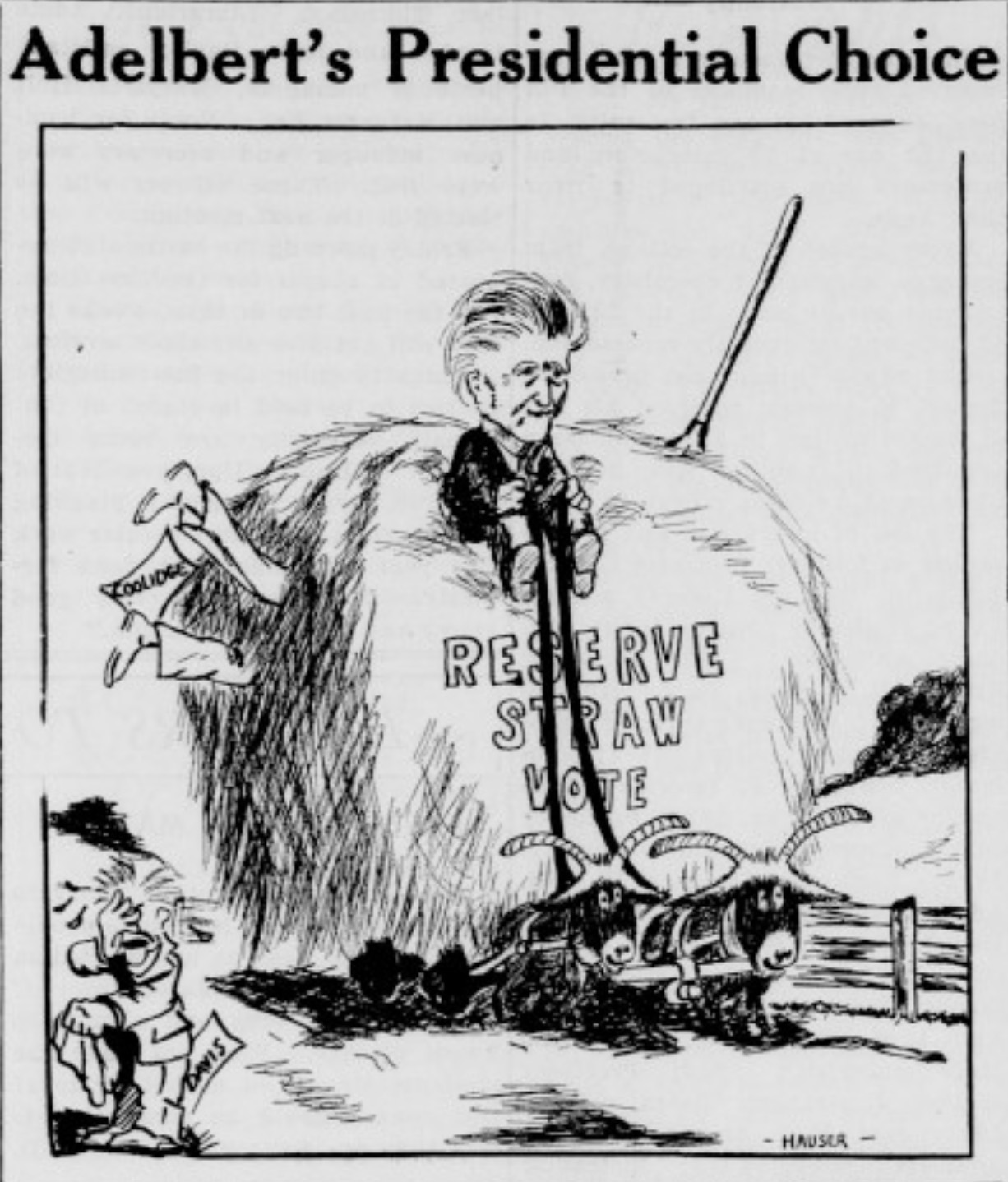
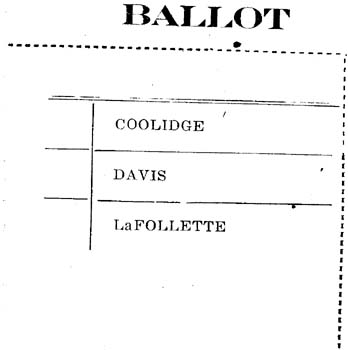
"Our opponents will receive a crushing defeat. As the cause of the people has always triumphed in the past, so will it be victorious in the present crisis of our country's history." The prediction of G.M. DeMarinis, executive secretary of WRU’s LaFollette supporters, proved correct. Adelbert College students backed Progressive Party candidate Robert LaFollette with 196 votes to Republican Calvin Coolidge’s 129 and Democrat John W. Davis’ 35. A poll of 30 faculty had Coolidge the victor with 15 votes to Davis’ 8 and LaFollette’s 7.
The ballot used in the straw poll at WRU.
This image from the Reserve Weekly reveals the winner of the WRU straw vote, Robert LaFollette.
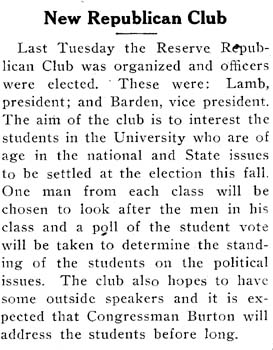
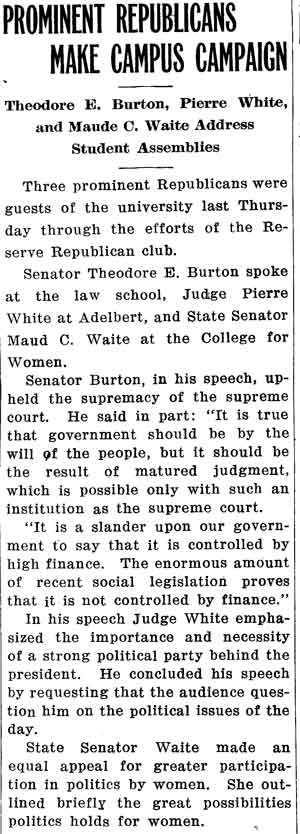
Senator Theodore E. Burton, Judge Pierre White, and State Senator Maud C. Waite visited the WRU campus through the efforts of the Reserve Republican Club.Ohio Popular Vote
National Popular Vote
Electoral Vote
Calvin Coolidge (R)
1,176,130 (58.3%)
John W. Davis (D)
477,888 (23.7%)
Robert LaFollette (Progressive)
358,008 (17.8%)
Frank T. Johns (Socialist Labor)
3,025 (0.2%)
William J. Wallace (Commonwealth Land)
1,246 (0.1%)Calvin Coolidge (R)
15,717,553 (54.06%)
John W. Davis (D)
8,386,169 (28.84%)
Robert LaFollette (Progressive)
4,814,050 (16.56%)
Herman P. Faris (Prohibition)
54,833 (0.19%)
Frank T. Johns (Socialist Labor)
28,368 (0.1%)Calvin Coolidge (R)
382
John W. Davis (D)
136
Robert LaFollette (Progressive)
13Information was compiled by staff of the Case Western Reserve University Archives, September 2004.
-
1
2026-03-31T19:28:28+00:00
1964: Civil Rights
6
Campaigning at CWRU: Presidential Elections, 1964: Civil Rights
plain
2026-04-23T18:47:56+00:00
1964
Information was compiled by staff of the Case Western Reserve University Archives, September 2004.
1964
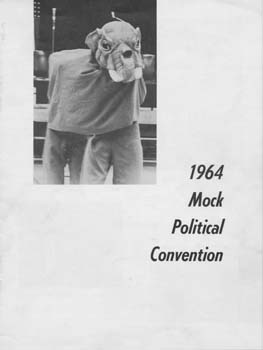
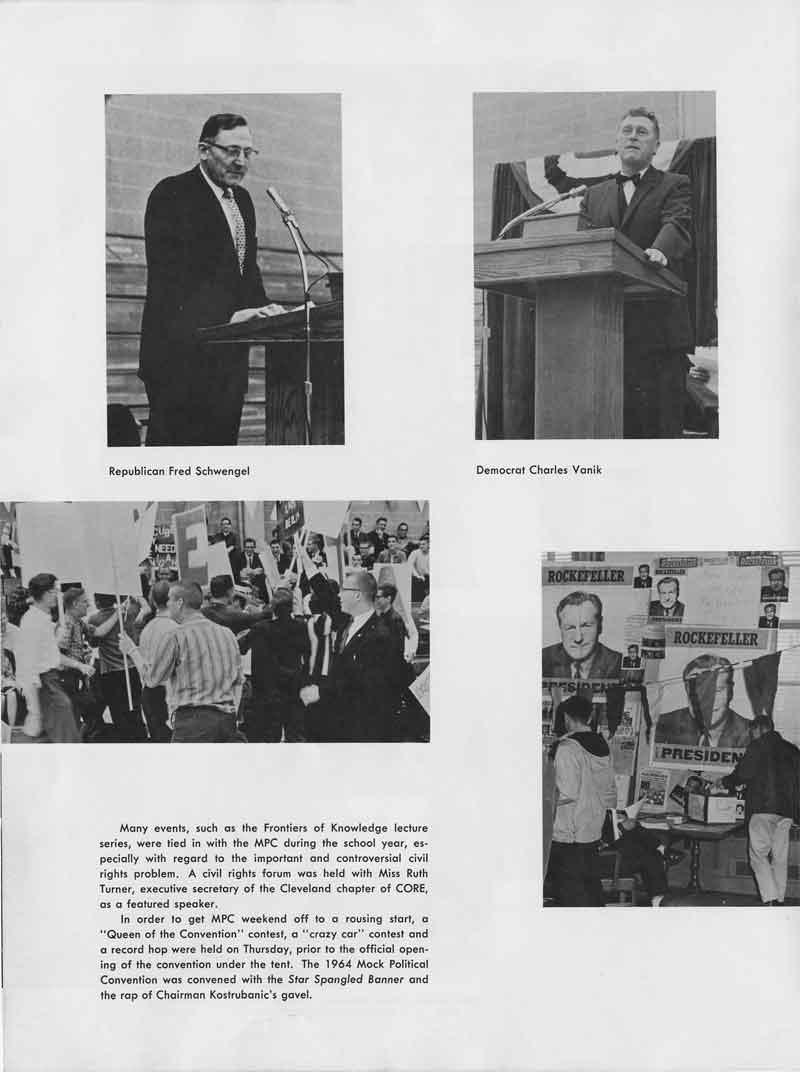
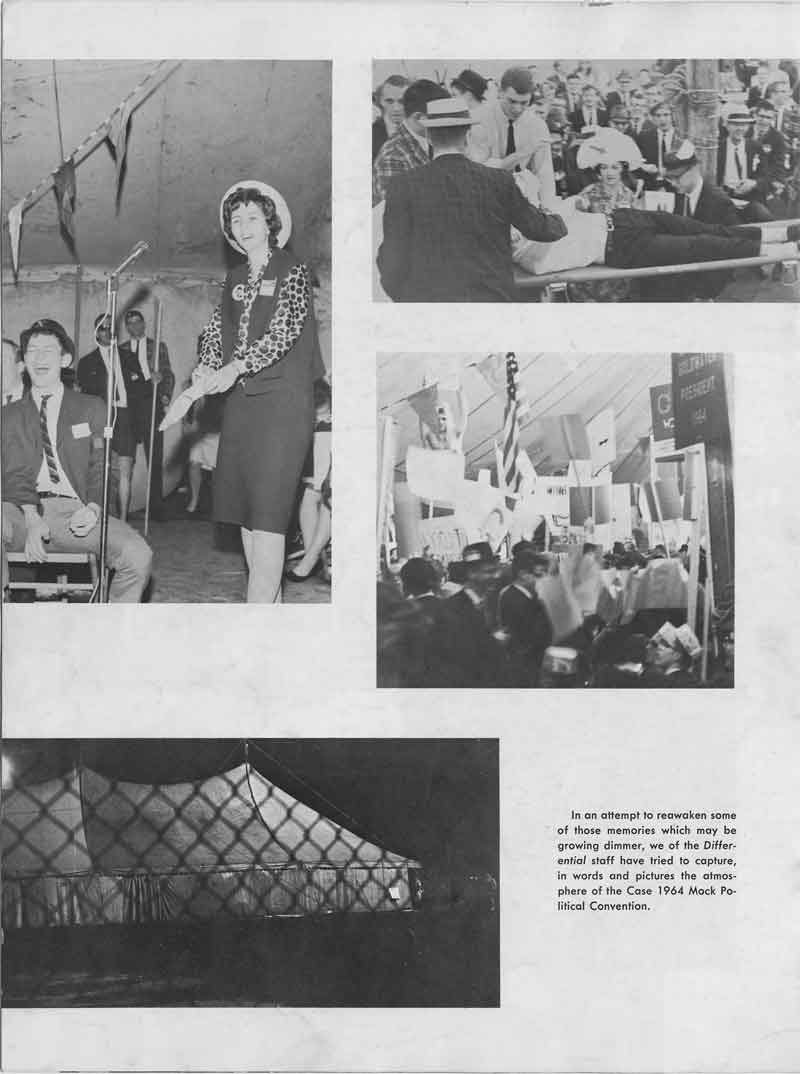
The delegates at the Case Mock Political Convention nominated Governor William Scranton of Pennsylvania and Governor Mark Hatfield of Oregon on the fifth ballot as the Republication nominees for president and vice president. Associated activities included a debate between Congressmen Charles Vanik (D-Ohio) and Fred Schwengel (R-Ohio), a civil rights forum featuring Ruth Turner, Executive Secretary of the Cleveland Chapter of the Congress on Racial Equality (CORE), and the Frontiers of Knowledge lecture series.
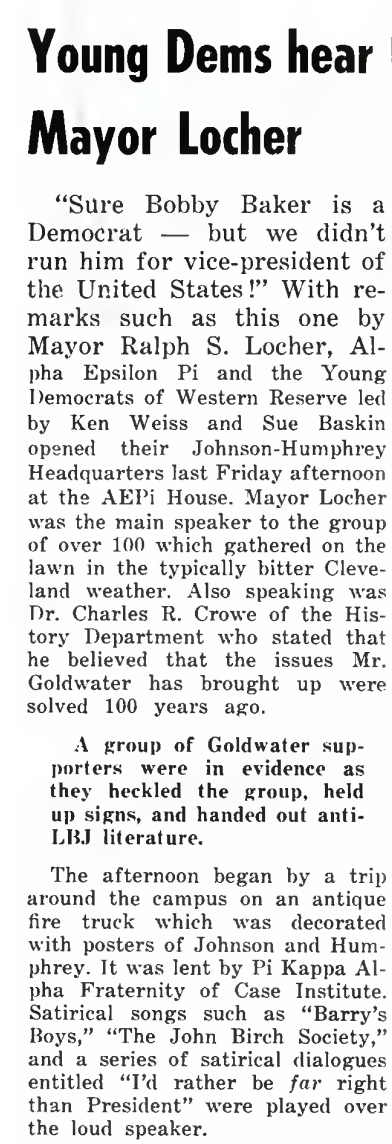
Mayor Ralph S. Locher was the main speaker at the opening of the Johnson-Humphrey headquarters.
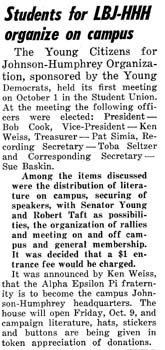
The Young Citizens for Johnson-Humphrey Organization held its first meeting on campus.
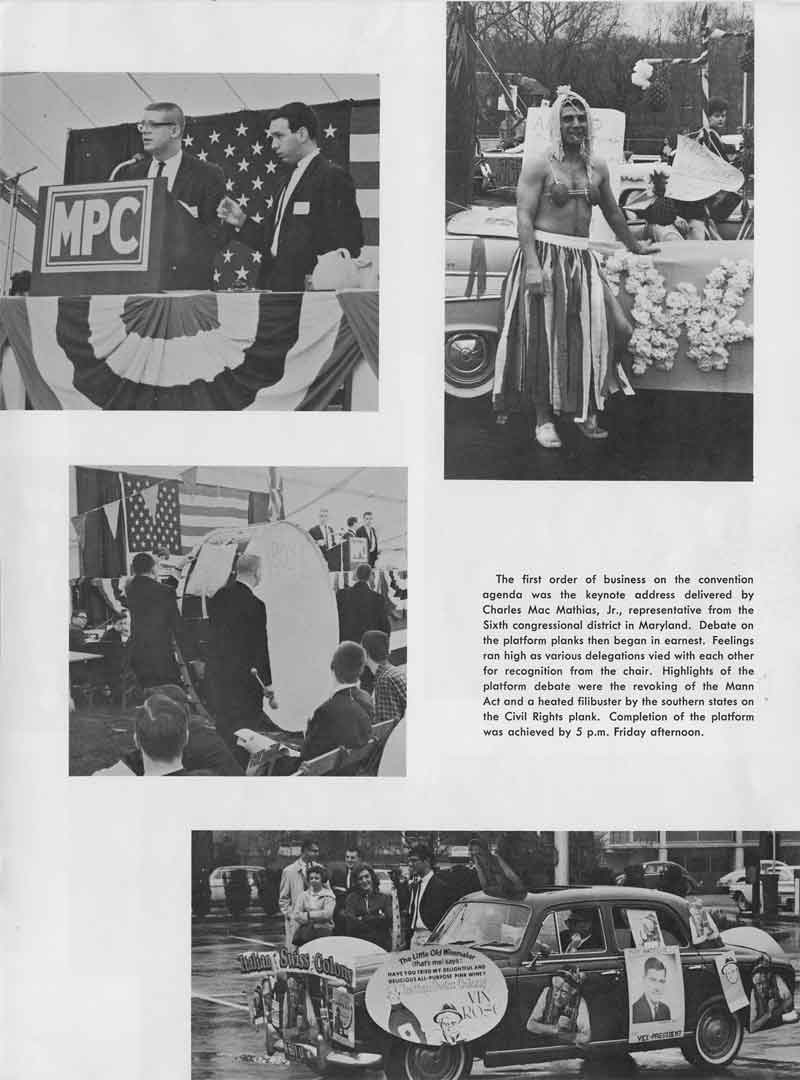
Case once again held a Mock Republican Convention (below). Featured was a debate between Republican Congressman Fred Schwengel and Democratic Congressman Charles Vanik, an alumnus of WRU and one of the organizers of the 1932 Mock Democratic Convention at WRU.
After the keynote address delivered by Maryland Congressman Charles M. Mathias, Jr., debate on the platform planks began. As reported by the yearbook, "Highlights of the platform debate were the revoking of the Mann Act and a heated filibuster by the southern states on the Civil Rights plank."Ohio Popular Vote
National Popular Vote
Electoral Vote
Lyndon B. Johnson (D)
2,498,331 (62.9%)
Barry M. Goldwater (R)
1,470,865 (37.1%)Lyndon B. Johnson (D)
43,126,584 (61.05%)
Barry M. Goldwater (R)
27,177,838 (38.47%)
Eric Hass (Socialist Labor)
45,187 (0.06%)
Clifton DeBerry (Socialist Workers)
32,701 (0.05%)Lyndon B. Johnson (D)
486
Barry M. Goldwater (R)
52Information was compiled by staff of the Case Western Reserve University Archives, September 2004.
-
1
2026-03-31T15:03:34+00:00
Sources used in Campaigning at CWRU: Presidential Elections, 1892-2008
6
Sources used in Campaigning at CWRU: Presidential Elections, 1892-2008
plain
2026-04-23T18:52:30+00:00
Research for this exhibit was conducted by staff of the Case Western Reserve University Archives from the following sources:
Sources in the Case Western Reserve University Archives:
- Student newspapers and magazines: The Adelbert, Case Tech, The College Folio, The Integral, The Observer, The Red Cat, Reserve Tribune, Reserve Weekly
- Student yearbooks of Adelbert College, Case Institute of Technology, Cleveland College, Flora Stone Mather College, Western Reserve University, and Case Western Reserve University
- Records of student organizations: Conservative Club, James Madison Club, Liberal Club, Mock Political Conventions, Suffrage League, Young Americans for Freedom, Young Democratic Club, Young Republican Club, Young Socialist Alliance
- University and alumni newspapers and magazines: Alumnae Folio, Campus News, Case Alumnus, Case Reserve Today, CWRU Magazine, Images, In Brief, Insight, Reserve, The Reserve Alumnus, Voice of Reserve
- University Archives photograph collection
Other sources:
- Boller, Paul F., Jr. Presidential Campaigns. (New York: Oxford University Press, 1984)
- Brinkly, Alan. Campaigns: A Century of Presidential Races From the Photo Archives of the New York Times. (New York: DK Publishing, 2001)
- Commission on Presidential Debates. "Debate History" http://www.debates.org/pages/history.html (31 August 2004)
- Cultice, Wendell W. Youth's Battle for the Ballot: A History of Voting Age in America. (New York: Greenwood Press, 1992)
- Ohio Secretary of State. "County Votes for Candidates for President in 1996" http://www.sos.state.oh.us/sos/results/index.html (18 August 2004)
- Ohio Secretary of State. "Election 2000 Official Results" http://www.sos.state.oh.us/sos/results/index.html (18 August 2004)
- Presidential Elections 1789-2000. (Washington. D.C., Congressional Quarterly Inc., 2002)
- Presidential Elections Since 1789, 5th ed. (Washington. D.C.: Congressional Quarterly Inc., 1991)
- Swerdlow, Joel L., ed. Presidential Debates: 1988 and Beyond. (Washington. D.C.: Congressional Quarterly, Inc., 1987)
- U.S. Federal Election Commission. "1996 Presidential General Election Results" 1997 http://www.fec.gov/pubrec/fe1996/presge.htm#OH and "1996 Popular Vote Summary for all Candidates Listed on at Least One State Ballot" 1997 http://www.fec.gov/pubrec/fe1996/summ.htm (18 August 2004)
- U.S. Federal Election Commission. "2000 Official Presidential General Election Results" 2001 http://www.fec.gov/pubrec/2000presgeresults.htm (18 August 2004)
- U.S. Federal Election Commission. "Official General Election Results for United States President November 2, 2004" http://www.fec.gov/pubrec/fe2004/federalelections2004.shtml (19 September 2008)
- U.S. Federal Election Commission. "Official General Election Results for United States President November 4, 2008" http://www.fec.gov/pubrec/fe2008/2008pres.pdf (19 October 2012)
- U.S. Federal Election Commission. "2008 Presidential Popular Vote Summary for all Candidates Listed on at Least One State Ballott," http://www.fec.gov/pubrec/fe2008/tables2008.pdf
To simplify and shorten pages, detailed citations have been omitted from the web version. Citations and source documents are available for consultation in the University Archives.