Four Corners 1
"What makes the rhetoric of empathy as it is applied to queer indie games (and other video games by, about, or for marginalized people) so problematic? First, as many of those who have condemned this rhetoric have pointed out, it minimizes the lives and identities of those who are seen as “different” or “other.” Although a video game may offer a glimpse into queer experience, for example, no game can replicate the fullness of lived queer experience or the real stakes of being a queer body in the world." (Ruberg 60)
Ruberg argues that relegating queer indie games as "empathy games" minimizes their meaning. Oversimplifying the genre takes away from core values of these types of games. In creating this separation between what is considered 'normal' and 'different', the term "empathy games" has potential to make the divide between marginalized and non marginalized identities worse (60). In "Gone Home", we see Sam depicted as 'different' due to their sexuality. The structure of this empathy game already depicts Sam as different which therefore perpetuates the divide between marginalized and non marginalized identities. If the player is not previously aware of Gone Home's status as an empathy game, the experience is completely different, . However, if we immediately label Gone Home as an empathy game, we may be more inclined to view Sam in a more marginalized way.
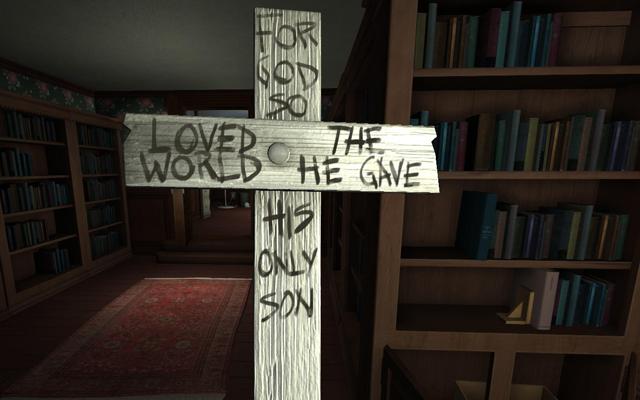
This image of a cross represents one of the many horror elements that are present in the game. This makes the player feel more shocked about the environment in addition to just feeling empathetic towards the Greenbriar family.
Games labeled as empathy game often minimize the very real lives and experiences of typically marginalized people.